


Equity Market Optimism Index
Current Phase
Cautious Optimism
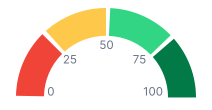

Index Value: 44.05
Summary
Cautious optimism signifies a phase where market prices are under pressure and volatility is elevated, but sustained domestic investor inflows continue to support market stability despite foreign portfolio outflows.
Index Value (LHS)
How to Embed this Chart?
Current Phase
Cautious Optimism
Index Value: 44.05
Summary
Cautious optimism signifies a phase where market prices are under pressure and volatility is elevated, but sustained domestic investor inflows continue to support market stability despite foreign portfolio outflows.
Showing: Index Value • Range: 10 Years
Index Value (LHS)


Equity Market Optimism Index is created using various high frequency economic indicators to track the confidence of investors in the Indian equity markets.Equity Market Optimism Index indicates any shift in the market behaviour, foreseeing the economic stability of India.The index's diverse indicators capture both domestic and global investor confidence, reflecting broader market sentiments.
The index covers diverse indicators covering both domestic and global market sentiments. We have assigned appropriate weights to each of these indicators, which reflect the market sentiments.

Credit Spread AAA vs G-Sec (10Y)

Credit Spread AAA vs G-Sec (1Y)

Credit Spread AAA vs G-Sec (3Y)

Credit Spread AAA vs G-Sec (5Y)

Consumer Price Index (CPI) Inflation- Headline

Crude Oil Price (Indian Basket)

Domestic Institutional Investors (DIIs) Investment - Equity

Foreign Portfolio Investments (FPIs) - Equity
The Equity Market Optimism Index serves as a comprehensive guide for individuals and businesses to navigate the complexities of the equity market and its implications for the broader economy. Understanding equity markets direction is crucial for effective financial decision-making in both the short and long term. Its components and interpretation offer insights into the right timing for various financial decisions, from investment choices to expense planning. By aligning financial strategies with the prevailing economic conditions and investor sentiment, as indicated by the index, individuals and financial advisors can make more informed decisions, ensuring that their financial planning is in sync with the broader economic environment.
Asset Allocation: Gauging the index's readings help in better asset allocation. For instance, a higher reading might encourage a higher allocation to equities, while a lower reading might suggest a more conservative approach with an increased focus on bonds or other safer assets.
Income and Expenses Management: During expansion phases, individuals might expect increased income (e.g., bonuses, higher returns) and might plan for higher expenses. In contrast, a recessionary phase suggests a need for cautious spending and saving more.
Economic Stability and Job Prospects: A robust market suggests a growing economy with potentially more job opportunities, and vice versa. Strong economic growth prospects and stability could lead to expansion in business opportunities, increased investments by the companies, higher labour requirements and higher wages. Conversely, falling growth scenarios potentially lead to job market instability.
Liabilities and Income Prospects: In a strong recovery or expansion phase, individuals might be more comfortable taking on liabilities (like loans) due to stable or growing income prospects. In recessionary times, focusing on reducing liabilities and securing stable income sources becomes crucial.
Apr
2022
The Reserve Bank of India (RBI) initiated an aggressive monetary tightening cycle between Apr- Dec 2022 to combat post-pandemic inflation. The Monetary Policy Committee (MPC) raised the repo rate by 225 basis points (bps) across five meetings, marking the steepest annual hike since 2018.
Feb
2022

The Russia-Ukraine War, with Russia’s military intervention in Ukraine on February 24, 2022, was a major geopolitical conflict that has caused widespread international concern and economic repercussions. It marks a severe intensification of the long-standing tensions between Russia and Ukraine.
Mar
2020

The COVID-19 pandemic, a global health crisis caused by the novel coronavirus, began affecting India significantly from March 2020. Characterised by widespread infections, lockdowns, and public health emergencies, the pandemic has had profound implications on the Indian economy and society. According to the Ministry of Health and Family Welfare (MoHFW), COVID-19 caused 5,33,318 deaths as of December 19, 2023.
Sep
2018
The crisis involving Dewan Housing Finance Corporation Ltd. (DHFL), one of India's largest Housing Finance Companies (HFCs), unfolded between 2019 and 2020. It marked a significant episode in the country's financial sector, particularly impacting the Non-Banking Financial Company (NBFC) and real estate sectors.
Sep
2018
The IL&FS (Infrastructure Leasing & Financial Services) Crisis of 2018 was a significant event in the Indian financial sector, marked by the company's default on several debt obligations beginning September 2018. IL&FS, a major infrastructure development and finance company, was considered a systemically important NBFC in India and played a critical role in India's infrastructure sector.