


Interest Rate Outlook Index
Current Phase
Nearing Optimal Rate
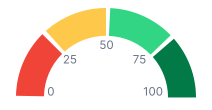

Index Value: 44.44
Summary
This phase reflects a period where the repo rate is getting closer to the 6% optimal level, suggesting a more balanced monetary policy approach aligned with improving economic growth and stability in the inflation rate.
Index Value (LHS)
How to Embed this Chart?
Current Phase
Nearing Optimal Rate
Index Value: 44.44
Summary
This phase reflects a period where the repo rate is getting closer to the 6% optimal level, suggesting a more balanced monetary policy approach aligned with improving economic growth and stability in the inflation rate.
Showing: Index Value • Range: 10 Years
Index Value (LHS)


The Interest Rate Outlook Index analyses interest rate fluctuations to understand economic phases and monetary policy stance, using indicators such as inflation, liquidity, credit demand, government borrowings, and investment scenarios. The index is useful for analysing interest rates’ impact on various sectors of the economy and changing borrowing costs
The Interest Rate Outlook Index covers diverse economic parameters, covering both demand and supply side components. We have assigned appropriate weights to each of these indicators, considering their individual impact in reflecting the interest rate outlook.
The Interest Rate Outlook Index serves as a pivotal tool in financial planning, offering a comprehensive view of interest rate movements and their broader implications. This index evaluates various factors including liquidity, credit demand, government borrowings, and investment scenarios. Interest Rate Outlook Index is indispensable in crafting strategies that are both responsive and anticipatory to economic shifts.
Fixed-Income Investment Decisions: Changes in interest rates directly impact bond markets. Understanding upcoming trends empowers you to get the right mix of fixed-income instruments – such as corporate bonds or government securities – to align with expected rate changes.
Equity Investment Strategy: Interest rate trends influence corporate earnings and, consequently, stock market performance. This also aids in evaluating whether to invest in growth stocks, which generally benefit from low interest rates, or value stocks, which are more attractive in high-interest periods.
Loan and Mortgage Decisions: The Interest Rate Outlook Index is essential for choosing between fixed or variable rate loans and making informed foreclosure decisions, leading to potential cost savings in liability planning.
Debt Refinancing: Insights from the Interest Rate Outlook Index enables you to optimally time debt refinancing, ensuring you to benefit from the most favourable interest rate environments.
Savings and Emergency Funds: Understanding the direction of interest rates helps in choosing the best saving instruments, balancing between liquidity and yield.
Expense Management: Anticipating changes in interest rates is crucial for managing large expenses, such as education or significant purchases, to align them with periods of favourable rates.
Annuity and Pension Fund Decisions: The Interest Rate Outlook Index aids in making informed decisions regarding annuities and pension funds, which are affected by interest rate changes, ensuring a stable retirement income adjusted for these fluctuations.
Apr
2022

The Reserve Bank of India (RBI) initiated an aggressive monetary tightening cycle between Apr-22 and Dec-22 to combat post-pandemic inflation. The Monetary Policy Committee (MPC) raised the repo rate by 225 basis points (bps) across five meetings between Apr-22 and Dec-22, marking the steepest annual hike since 2018.
Mar
2020

The COVID-19 pandemic, a global health crisis caused by the novel coronavirus, began affecting India significantly from March 2020. Characterised by widespread infections, lockdowns, and public health emergencies, the pandemic has had profound implications on the Indian economy and society. According to the Ministry of Health and Family Welfare (MoHFW), COVID-19 caused 5,33,318 deaths as of December 19, 2023.
Jul
2017
+Implementation+in+India.svg)
On July 1, 2017, India underwent a major tax reform with the implementation of the Goods and Services Tax (GST), marking a significant milestone in the country's taxation history. GST was introduced as a comprehensive indirect tax on the manufacture, sale, and consumption of goods and services throughout India, replacing multiple cascading taxes levied by the central and state governments.
Nov
2016

Demonetisation, announced on November 8, 2016, was a significant decision by the Indian government to withdraw the legal tender character of the Specified Bank Notes (SBNs), involving the high-value currency notes (₹ 500 and ₹ 1,000) from circulation. It represented a drastic step by the government in its fight to curb black money, counterfeit currency and corruption.
Apr
2014
In April 2014, the Reserve Bank of India (RBI) initiated a significant shift in its monetary policy approach, focusing more intently on inflation management. This shift was part of a broader strategy to stabilise the Indian economy by controlling high inflation rates. With the signing of the new Monetary Policy Framework Agreement (MPFA) between the Government of India and the RBI on Feb 20, 2015, Flexible Inflation Targeting (FIT) was formally adopted in India. The Central Government has notified 4% CPI inflation as the target for the period from August 5, 2016 to March 31, 2021 with the upper tolerance limit of 6% and the lower tolerance limit of 2%. For the period April 1, 2021 to March 31, 2026 too, the inflation target has been kept at the same level as was for the previous 5 years.


