


Services Sector Activity Index
Current Phase
Strong Recovery
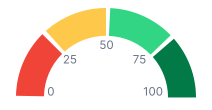

Index Value: 83.13
Summary
A strong recovery signifies a phase where the services sector performs better than the previous quarters, which is marked by increasing confidence among consumers and businesses, and high trade and investment.
Index Value (LHS)
How to Embed this Chart?
Current Phase
Strong Recovery
Index Value: 83.13
Summary
A strong recovery signifies a phase where the services sector performs better than the previous quarters, which is marked by increasing confidence among consumers and businesses, and high trade and investment.
Showing: Index Value • Range: 10 Years
Index Value (LHS)


Services Sector Activity Index is crafted using various high frequency economic indicators which captures the demand and supply side fluctuations, seasonal variations, impact of domestic policy measures, tax reforms, employment situations and global developments, to provide a timely insight into the performance of the services sector in India. Services sector is a crucial indicator for policymakers to formulate effective economic and trade policies; and also, to track the demand sentiments in the economy.
The index covers diverse economic parameters covering both demand and supply side factors. We have assigned appropriate weights to each of these indicators, which reflect the impact of these factors on the services sector activities.
Insights from the services sector, a major component of India’s GDP, offer a strategy that is both informed and responsive to the dynamic nature of the Indian economy, especially within the vital services sector. These insights ensure that financial planning is robust, adaptive, and ready to seize emerging opportunities.
Performance Analysis of Services Sub-sectors: Identifying trends in sub-sectors such as hospitality, IT, or financial services is key in forecasting market conditions, indicating potentially favourable times to invest in these areas.
Demand Forecasting in Services: Indicators such as domestic air traffic and rail freight traffic shed light on mobility on demand within the services sector, aiding in the adjustment of spending and savings strategies, particularly during economic downturns.
Job Market Stability in Services Sector: Observing trends in the services sector provides a predictive view of employment stability, crucial for planning financial security and emergency savings for those employed in the sector.
Policy Changes and Tax Reforms Impact: Monitoring shifts in policy and tax reforms related to the services sector is essential. Understanding these changes helps in strategically adjusting investment plans to either mitigate risks or leverage new opportunities that arise from these economic policy shifts.
Apr
2025

The EU and the US are India’s largest trading partners and a key source of FDI and Exports. Donald Trump’s victory in the 2024 elections and his subsequent announcement of reciprocal tariffs on trading partners reignited the concerns around protectionist policies as a means. European Parliament (EP) is the EU’s directly elected legislative body, with 720 members (MEPs) representing 27 member states. Elections occur every five years.
Feb
2022

The Russia-Ukraine War, with Russia’s military intervention in Ukraine on February 24, 2022, was a major geopolitical conflict that has caused widespread international concern and economic repercussions. It marks a severe intensification of the long-standing tensions between Russia and Ukraine.
Mar
2020

The COVID-19 pandemic, a global health crisis caused by the novel coronavirus, began affecting India significantly from March 2020. Characterised by widespread infections, lockdowns, and public health emergencies, the pandemic has had profound implications on the Indian economy and society. According to the Ministry of Health and Family Welfare (MoHFW), COVID-19 caused 5,33,318 deaths as of December 19, 2023.
Jul
2017
+Implementation+in+India.svg)
On July 1, 2017, India underwent a major tax reform with the implementation of the Goods and Services Tax (GST), marking a significant milestone in the country's taxation history. GST was introduced as a comprehensive indirect tax on the manufacture, sale, and consumption of goods and services throughout India, replacing multiple cascading taxes levied by the central and state governments.
Nov
2016

Demonetisation, announced on November 8, 2016, was a significant decision by the Indian government to withdraw the legal tender character of the Specified Bank Notes (SBNs), involving the high-value currency notes (₹ 500 and ₹ 1,000) from circulation. It represented a drastic step by the government in its fight to curb black money, counterfeit currency and corruption.


