India and New Zealand have signed a landmark India–New Zealand Free Trade Agreement (NZ–India FTA), described by Indian officials as a “once‑in‑a‑generation” pact that aims to reshape bilateral trade and investment ties.
The Free Trade Agreement was signed on 27 April 2026 at Bharat Mandapam in New Delhi, a deal negotiated in just nine months, making it one of the fastest FTAs India has ever concluded. With 100% duty-free access for Indian exports, a USD 20 billion investment commitment from New Zealand, and the world's first AYUSH chapter in a trade agreement, this is a deal that could redefine bilateral ties between two Indo-Pacific democracies for decades.
Here's a deep dive into what the deal covers, who wins, what's been kept off the table, and why the timing matters.
From Stalled Talks to Record-Speed Conclusion
The India–New Zealand trade relationship has a longer backstory than the headlines suggest. A Joint Study Group first recommended an FTA back in 2009. Formal negotiations were launched in 2010, but the process stalled after nine rounds, with only informal meetings taking place in 2015 and 2016.
The breakthrough came in March 2025, when New Zealand Prime Minister Christopher Luxon visited New Delhi, and both sides agreed to restart talks. What followed was remarkable: five formal rounds of negotiations and several intersessional meetings later, the agreement was concluded on 22 December 2025. Commerce Minister Piyush Goyal and New Zealand Trade Minister Todd McClay signed the deal at a ceremony four months later.
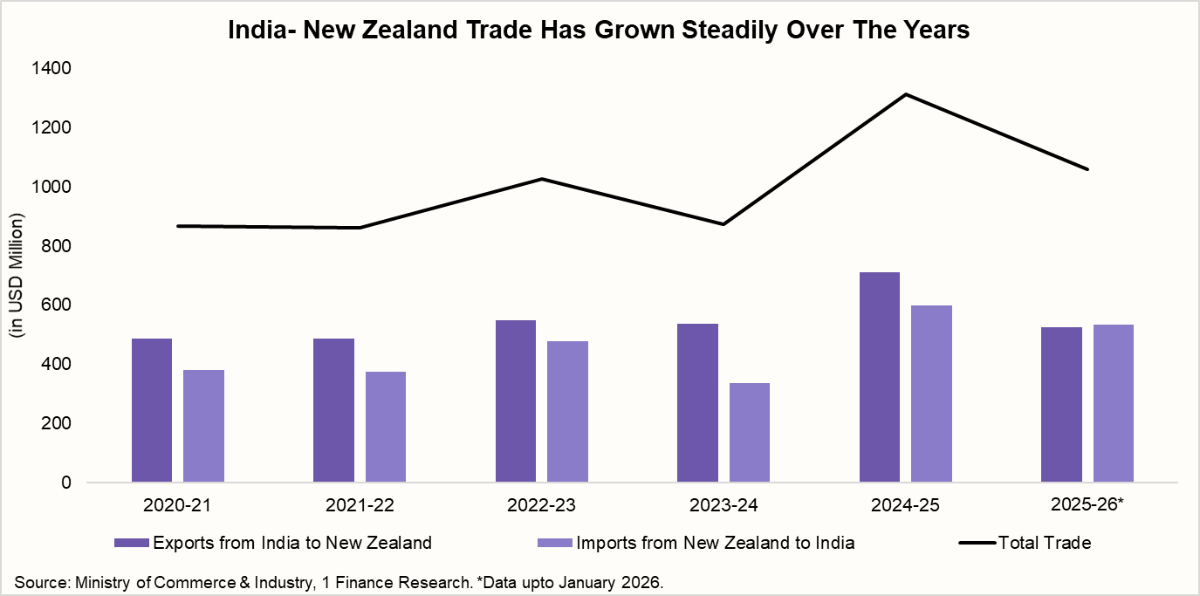
Merchandise trade between India and New Zealand has shown consistent growth in recent years, underscoring the deepening of their economic relationship. Total bilateral trade in goods and services reached about US$2.4 billion in 2024, while merchandise trade alone climbed to US$1.29 billion in FY 2024–25, representing a robust 49% year‑on‑year increase.
This FTA is also India's seventh trade deal in five years, following agreements with Mauritius (2021), the UAE (2022), Australia (2022), the EFTA nations (2024), the UK (2025), and Oman (2025), with the EU deal concluded in January 2026. The pace signals a fundamental shift in India's trade diplomacy: from cautious engagement to aggressive, strategic integration.
What India Gets
The headline win for India is unambiguous. Every single Indian export tariff line, all 8,284 of them, receives duty-free access to New Zealand from day one. New Zealand had maintained tariffs of up to 10% on roughly 450 lines of key Indian exports, covering textiles, apparel, leather, ceramics, carpets, automobiles, and auto components. Those barriers drop to zero.
But the real story is in the sector-by-sector breakdown. Here's where the opportunities lie:
| Sector | India's exports (recent trend) | Tariff coverage | Tariff change | Impact & opportunity |
|---|---|---|---|---|
| Agriculture | USD 51.8 bn in 2024–25 (+7.3% vs 2023–24). | 1,379 lines (17% of total). | Peak 5% tariffs eliminated (tea already zero‑duty). | Stronger access for fruits & vegetables, coffee/tea/spices, cereals, and processed foods; supports India's premium agri‑exports. |
| Marine | USD 7.0 bn in FY25 (up from 6.8 bn). Exports to NZ rose from 15.35 m to 15.89 m. | 363 lines (4.4% of total). | Peak 5% tariffs reduced to zero. | Zero‑duty access in a market where NZ imports ~USD 0.26 bn in marine products boosts Indian seafood exports. |
| Textiles & Clothing | USD 36.9 bn in 2024–25 (+6.1%). Exports to NZ from 98.14 mn. to 103.14 mn. | 1,057 lines (13% of total). | Peak 10% tariffs fully eliminated. | India gains a duty‑free base in a market importing ~USD 1.9 bn in textiles/clothing, lifting competitiveness. |
| Engineering | USD 77.5 bn in FY25 (+20.3%). Exports to NZ from 47.76 m to 68.26 m. | 1,396 lines (16.9% of total). | Peak 10% tariffs eliminated. | With NZ importing ~USD 11 bn in engineering goods, Indian capital goods, auto parts, and machinery gain strong pricing edge. |
| Leather & Footwear | USD 5.5 bn in 2024–25 (from 5.3 bn). Exports to NZ: USD 8.52 m in 2024–25. | 181 lines (footwear, leather, accessories). | Peak 10% tariffs reduced to zero. | NZ's global leather/footwear imports ~USD 0.51 bn; India can target mid‑ to high‑value segments such as footwear, bags, belts, and wallets. |
| Pharmaceuticals | USD 24.5 bn in 2024–25 (+10.8%). Exports to NZ: USD 57.52 m. | 90 lines; peak 5% tariffs reduced to zero. | Peak 5% tariffs reduced to zero. | In a market importing ~USD 1.4 bn of pharma products, Indian generics and speciality drugs gain lower entry barriers. |
| Plastic & Rubber | USD 13 bn in FY25 (from 12 bn). Exports to NZ rose from 18.87 m to 23.66 m. | 397 lines (4.8% of total). | Peak 10% tariffs eliminated. | With NZ importing ~USD 2.05 bn in plastics/rubber, packaging, automotive, and industrial rubber, exporters gain better margins. |
A few things stand out from this data.
Engineering is the biggest prize. New Zealand imports roughly USD 11 billion in engineering goods annually — capital goods, auto components, machinery, industrial equipment, and India's exports to NZ in this segment already jumped 43% in a single year (from USD 47.76 million to USD 68.26 million) even before the FTA kicked in. With tariffs of up to 10% now eliminated, Indian manufacturers are positioned to capture a significantly larger share of that market.
Recommended for you
Readers also explored

India’s Unemployment Rate in 2025
 7 min read

Currency in Circulation: How Much Money Exists in the World?
9 min read
Textiles have a ready-made beachhead. India's textile exports to NZ already crossed USD 100 million in FY25. In a market that imports USD 1.9 billion in textiles and clothing globally, zero-duty access gives Indian exporters a meaningful pricing edge over competitors from China, Thailand, and Vietnam, who don't have comparable FTA terms.
Pharma is quietly significant. New Zealand imports USD 1.4 billion in pharmaceuticals globally. India's generic and speciality drug makers, already exporting USD 57.5 million to NZ, now get zero duty, a more predictable market entry. For a sector where margins are tight and regulatory predictability matters, this is a substantial advantage.
India also secures duty-free access to critical industrial inputs — wooden logs, coking coal, and scrap metals, which lowers production costs for Indian manufacturers and improves their competitiveness across global value chains.
What New Zealand Gets
This isn't a one-sided deal. New Zealand has secured meaningful concessions, particularly for its non-dairy export sectors. More than half of New Zealand's exports to India will become duty-free immediately, with tariffs on remaining products phased out over time.
The key product categories benefiting include forestry products, lamb, wool, seafood, iron, steel, and scrap aluminium. For New Zealand's meat and wool exporters, industries that have long looked at India's scale with frustration, this FTA finally cracks open the door.
In agriculture, a Tariff Rate Quota (TRQ) system has been established for apples, kiwifruit, and Manuka honey, with Minimum Import Price conditions and seasonal import windows. These are designed to give Indian consumers more choice without triggering a flood of imports that would undermine domestic farmers.
Wine is another area of opportunity. Tariffs will be reduced gradually over ten years. Dairy ingredients meant for re-export receive immediate duty-free access, while tariffs on bulk infant formula and other high-value dairy products will phase down over seven years.
India is currently New Zealand's 12th-largest export market, accounting for just over 1.5% of total goods and services exports. That's a small share, but in a market of 1.4 billion people with a rapidly growing middle class, the trajectory matters more than the current baseline.
What's Been Kept Off the Table
India negotiated hard to shield its most vulnerable domestic sectors. Around 30% of all tariff lines have been excluded from concessions, a deliberate carve-out to protect industries where liberalisation could cause widespread economic and political disruption.
Sectors fully excluded from tariff concessions:
- Dairy — milk, cheese, butter, and most dairy products
- Agriculture staples — sugar, onions, spices, edible oils, pulses, coffee
- Industrial commodities — copper, aluminium, rubber
The dairy exclusion is the headline story. This is the first New Zealand FTA to exclude core dairy, a sector that accounted for NZ$24 billion, roughly 30% of the country's total goods exports, in 2025. For New Zealand's powerful dairy lobby, it was a significant disappointment.
But for India, it was non-negotiable. The dairy cooperative ecosystem, anchored by Amul and thousands of regional cooperatives, supports millions of small farmers and is deeply woven into the rural economy. Opening it to competition from one of the world's most efficient dairy exporters would have been economically devastating and politically explosive.
Where limited access has been granted:
- Apples, kiwifruit, Manuka honey — allowed through a Tariff Rate Quota (TRQ) system with Minimum Import Price conditions and seasonal import windows
- Wine — tariffs to be phased down gradually over ten years
- Dairy ingredients for re-export — immediate duty-free access
- Bulk infant formula and high-value dairy — tariffs phased down over seven years
The core message is clear: India traded breadth for protection. Full zero-duty access to New Zealand for its exporters, in exchange for firm red lines on dairy and sensitive agriculture at home.
Beyond Trade in Goods
The FTA's ambition extends well beyond tariff lines. It covers services, professional mobility, traditional medicine, agricultural cooperation, and long-term investment — making it one of India's most comprehensive trade agreements to date.
- Services access: New Zealand has opened 118 services sectors to Indian providers and offered Most-Favoured Nation (MFN) treatment in 139 sectors, spanning IT, professional services, construction, telecommunications, tourism, and education.
- Visa and mobility: The agreement creates 5,000 Temporary Employment Entry visas and 1,000 Work and Holiday visas per year for Indian professionals in IT, engineering, healthcare, and construction. A student‑mobility annex lets Indian students work 20 hours per week during studies, with post‑study work rights up to three years for STEM bachelor’s graduates and four years for doctorates. In New Zealand, these provisions have drawn criticism, with officials estimating over 20,000 Indian migrants annually and pushback from the NZ First party ahead of ratification.
- The AYUSH chapter — a global first: No bilateral trade agreement in the world has ever included a dedicated chapter on India's traditional medicine systems. This FTA changes that, with a comprehensive annex on Ayurveda, Yoga, Unani, Siddha, and Homeopathy that creates structured pathways for Ayurvedic product exports, wellness tourism, yoga services, and collaborative research, while also giving prominence to Maori health practices. For India's growing wellness industry, this could become a template for future FTAs.
- USD 20 billion investment commitment: New Zealand has committed to facilitating approximately USD 20 billion of investment into India over 15 years, targeting education infrastructure, agriculture, renewable energy, and technology.
- Agricultural cooperation with teeth: The pact goes beyond liberalisation by committing both sides to Action Plans for kiwifruit, apples, and honey, including Centres of Excellence, better planting material, and technical support for Indian farmers. New Zealand’s market access via Tariff Rate Quotas is linked to delivering on these productivity plans, monitored by a Joint Agriculture Productivity Council. In practice, New Zealand does not just gain the right to sell apples to India; it also has to help India grow better ones.
Conclusion
The FTA has been signed but is not yet in force. India needs cabinet approval; New Zealand needs parliamentary sign-off, a process expected to take around six months, though migration politics could introduce delays.
The India–New Zealand FTA won't reorder global trade on its own. Bilateral trade of USD 2.4 billion is modest compared to India's trade with the US, EU, or China. But the deal's significance lies elsewhere.
It shows that India can negotiate comprehensive trade agreements at speed, protecting sensitive sectors while unlocking real opportunities for its exporters. It proves that two democracies on opposite ends of the Indo-Pacific can choose integration over anxiety. And the sector data makes a convincing case: when you look at New Zealand's USD 11 billion in engineering imports, USD 1.9 billion in textile imports, and USD 1.4 billion in pharma imports, and place Indian exporters at zero duty against competitors who are still paying tariffs, the commercial logic is hard to argue with.
In 2026, with trade wars escalating and multilateral institutions under strain, every new corridor of trust counts. This one counts more than its headline numbers suggest.