The first half of 2026 demonstrated how quickly market leadership can change. The Hormuz crisis unsettled investors in the first quarter, but easing geopolitical tensions and the accelerating AI investment cycle fuelled a sharp recovery across global equities during the second quarter.
July, however, offered a timely reminder that markets rarely move in a straight line. Sharp corrections across several AI-driven markets highlighted the risks of elevated valuations and concentrated leadership, just as investors turned their attention to the upcoming second-quarter earnings season.
This edition reviews the key developments that shaped global markets during the first half of 2026, examines the growing influence of AI on market leadership and explores the risks and opportunities that could define the months ahead.
| Key Takeaways |
|---|
| South Korea (+101%), Taiwan (+59%), and Japan (+39%) have been the best-performing equity markets in H1-2026, while India (-11%) and China (-9%) have lagged. |
| The S&P 500 rebounded 15% in Q2 after a 5% decline in Q1, but with the Magnificent Seven accounting for 32.5% of the index, valuations remain dependent on AI-driven earnings delivery. |
| India: NIFTY-50 earnings growth slowed to ~4%, while NIFTY MidCap-150 earnings grew ~25% by June 2026. |
| AI leadership globally has become increasingly concentrated, with Taiwan's TSMC (44%), South Korea's Samsung & SK Hynix (54.8%) and the US Magnificent Seven (32.5%) accounting for an outsized share of their respective benchmark indices. |
| The renewed US-Iran conflict, crude oil volatility and AI earnings execution are likely to be the key drivers of global markets in H2-2026. |
How Global Markets Performed in the First Half of 2026
The first half of 2026 (H1-2026) was shaped by two distinctly different market environments. The year began amid concerns over slowing global growth, tariff-related tensions and then the Strait of Hormuz crisis rattled financial markets all over the world. The disruption stoked fears of an oil-driven inflation shock, triggering a sell-off across global equities.
The second quarter marked a turnaround. As geopolitical tensions eased and fears of a prolonged energy shock subsided, investor focus shifted back to fundamentals and the AI investment cycle. Strong technology earnings and improved risk appetite fuelled a broad-based recovery across global equities, with several markets recovering sharply from their March lows.
The chart below compares the performance of major equity markets in both quarters, highlighting how returns evolved between Q1 and Q2. Plotting both quarters together helps distinguish markets that staged a strong recovery from those that maintained consistent momentum or lost steam during the period.
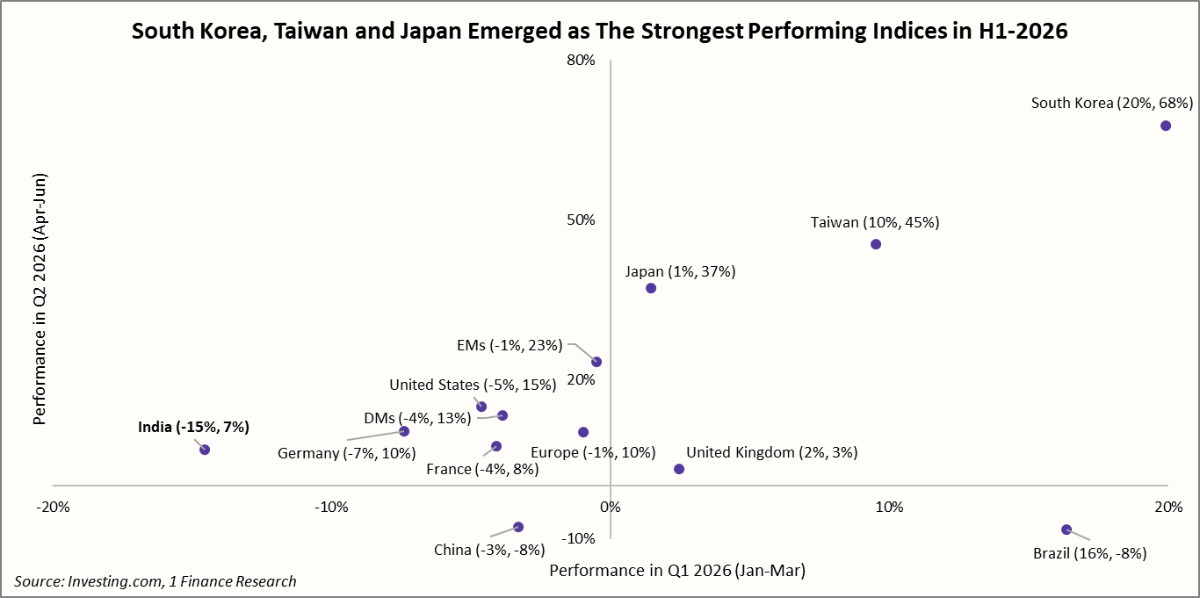
When seen across both quarters, Asian markets led by South Korea, Taiwan and Japan emerge as clear outperformers, driven by semiconductor demand, AI-led investment and improving corporate profitability. At the other end of the spectrum, China and India lag, impacted by softer macroeconomic conditions and weaker investor sentiment.
Another notable trend was the sharp turnaround in US equities. After declining around 5% in the first quarter, amid the Strait of Hormuz crisis, the S&P 500 rebounded 15% in Q2 as geopolitical risks eased and investor focus returned to the AI investment cycle. Brazil experienced the opposite trajectory, delivering outsized gains in Q1 before surrendering much of that performance during the second quarter.
Recommended for you
Readers also explored
Currency in Circulation: How Much Money Exists in the World?
 9 min read
India's IT Sector Outlook for FY2026
8 min read
US Valuations Leave Little Room for Earnings Disappointments
The S&P 500's recovery was driven by more than just improving investor sentiment. As the chart below illustrates, corporate earnings grew 17.6% year-on-year in Q2, providing fundamental support for the market's advance. Strong profit growth, led by large-cap technology companies, reinforced confidence in the AI investment cycle and helped propel US equities sharply higher after a weak start to the year.
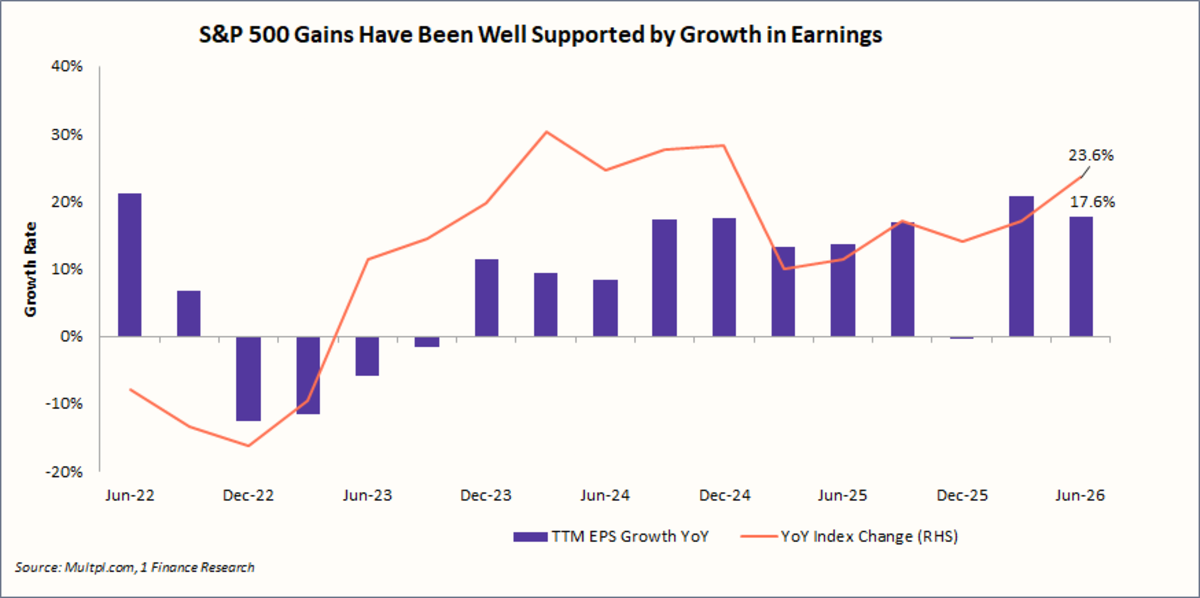
While aggregate index-level earnings remain healthy, a large share of these is concentrated in a handful of mega-cap technology companies. The Magnificent Seven accounts for roughly one-third of the S&P 500's market capitalisation, making their earnings trajectory disproportionately important to overall index performance.
The concentration in earnings is mirrored by an equally concentrated investment cycle. Microsoft, Amazon, Alphabet, Meta and Oracle are expected to invest a record $677 bn in AI infrastructure, data centres and advanced semiconductors in 2026. As a result, today's valuations increasingly depend on these investments translating into sustained earnings and cash flow growth, leaving less room for execution disappointments.
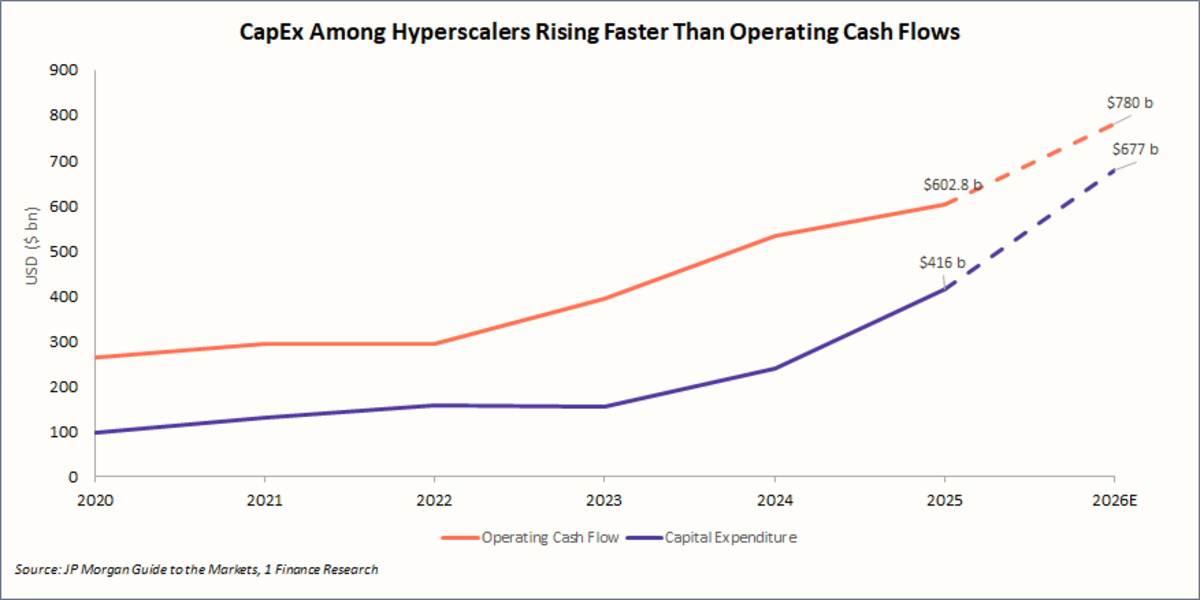
The key risk is therefore not today's earnings, but tomorrow's execution. Current valuations assume that AI adoption, enterprise spending and monetisation will continue to accelerate. If those expectations are met, the investment cycle can extend further. If not, weaker earnings guidance from these firms could have an outsized impact on the broader market.
Beyond the hyperscalers, AI investment is increasingly being financed through private credit, structured financing and other alternative funding channels. While this broadens access to capital and accelerates infrastructure buildout, it also increases financial leverage across the AI ecosystem. As projects become more capital intensive, the pressure to generate sustainable returns on investment will only intensify.
Unlike the US, where AI and technology have remained the dominant market drivers, India's equity market has been shaped by a different mix of domestic fundamentals, policy support and valuation dynamics.
India's Large-Cap Earnings Hold the Key to FII Inflows
India's equity market has undergone a meaningful reset over the past 18 months. Persistent FII outflows (mainly from large-caps), coupled with slowing corporate earnings, have led to a correction in NIFTY-50 valuations. In contrast, domestically driven mid-cap companies have delivered a stronger earnings recovery, supported by improving profitability across cyclical sectors.
The chart highlights the widening divergence between large and mid-cap earnings. NIFTY-50 trailing twelve-month (TTM) earnings growth has moderated sharply from its post-pandemic peak of nearly 45% in June 2022 to around 4% by mid-2026.
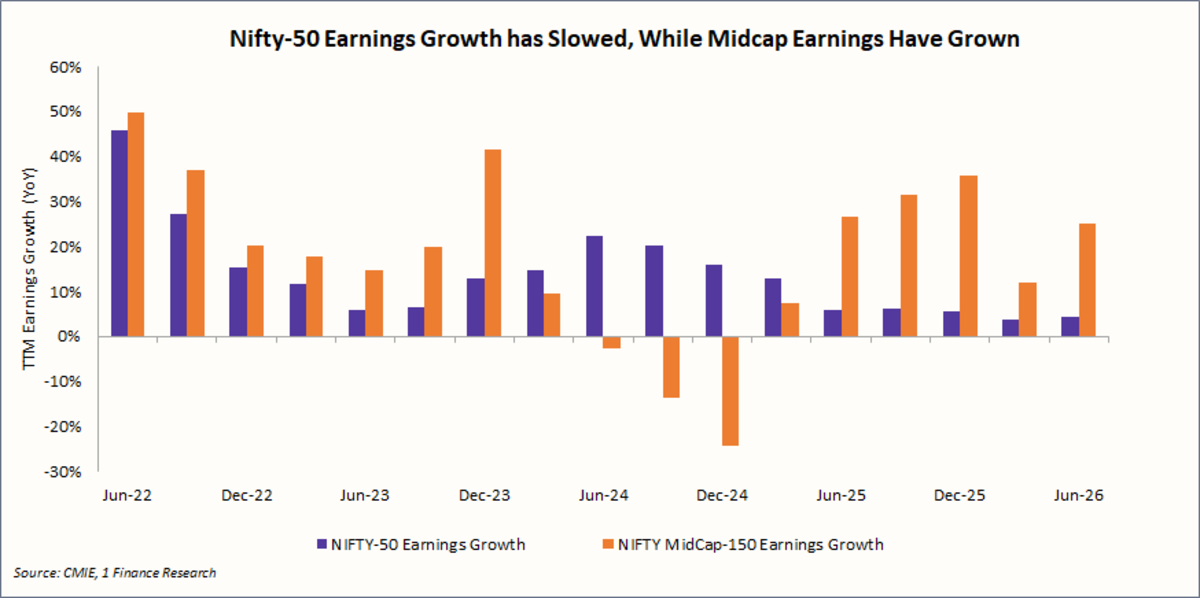
In contrast, NIFTY MidCap-150 earnings (+25% in Jun-26) have rebounded strongly after a weak 2024, supported by improving profitability across domestic cyclical sectors. With foreign institutional investors predominantly invested in India's large-cap universe, a sustained recovery in NIFTY-50 earnings is likely to be a key prerequisite for a meaningful revival in FII inflows.
The earnings outlook will remain closely tied to India's macro environment. A sustained moderation in crude oil prices would ease input cost pressures, support corporate margins and improve India's external balances, creating a more favourable backdrop for both earnings and foreign capital flows.
Further, development of the South-West monsoon will also warrant close attention. While a normal monsoon would support rural demand and sectors linked to consumption, a weaker-than-expected season could weigh on agricultural incomes and discretionary spending.
Asia's AI Champions Also Come with Concentration Risk
South Korea’s KOSPI (+101% in H1-2026) has been the strongest-performing equity market in 2026, driven by the global AI investment cycle. Its major constituents, Samsung Electronics and SK Hynix, have benefited from surging demand for high-bandwidth memory (HBM) and DRAM chips, reinforcing the country's position as a critical supplier to the AI ecosystem.
However, the recovery remains uneven, with semiconductor exports offsetting weakness in domestic demand and construction. As a result, Korea's earnings outlook remains closely tied to global AI spending, memory-chip pricing and continued investment by hyperscalers.
Taiwan has followed a similar trajectory. Taiwan Semiconductor Manufacturing Company (TSMC), which accounts for ~44% of the TAIEX, has driven much of the market's earnings and returns as demand for advanced AI chips accelerated.
The table below compares the concentration of major global equity indices, highlighting how a handful of companies account for an outsized share of index performance.
| Index | Major Constituent(s) | Combined Weight | Why it Matters |
|---|---|---|---|
| TAIEX (Taiwan) | Taiwan Semiconductor Manufacturing Company (TSMC) | 44.0% | With no cap on constituent weights, TSMC now accounts for ~44% of Taiwan's benchmark. |
| KOSPI (South Korea) | Samsung Electronics + SK Hynix | 54.8% | The combined weight of these two constituents has tripled since 2016 (~16%). |
| S&P 500 (US) | Magnificent Seven | 32.5% | Nvidia alone is ~7.5% of the entire index, the largest single constituent. |
| AEX (Netherlands) | ASML Holding | 14.7% | Euronext caps any single constituent at 15%, a structural circuit-breaker Korea and Taiwan lack. |
| Nikkei 225 | Advantest, Tokyo Electron, SoftBank | 25.2% | Nikkei is PRICE-weighted, not cap-weighted. Toyota (Japan's largest firm) is only ~1.3% of the index. |
The comparison highlights that concentration risk is not uniform across markets. South Korea and Taiwan derive much of their performance from a handful of technology companies, whereas Japan's concentration is amplified by the Nikkei's price-weighted methodology. In contrast, the Netherlands mitigates single-stock concentration through Euronext's 15% constituent cap, despite ASML's market dominance.
For investors, this distinction matters. Concentrated markets can outperform when AI spending is strong but are also more vulnerable to earnings disappointments. Whether today's market leaders retain their edge will depend on the durability of the AI investment cycle and the breadth of future earnings growth.
What Investors Should Watch in H2 2026
The first half of 2026 demonstrated how quickly market leadership can emerge, while July underscored how rapidly it can reverse when expectations are challenged. The sharp correction in South Korea (-20%), compared with Japan (-6%) and Taiwan (-3%), highlights how markets with high AI concentration remain particularly vulnerable to shifts in investor sentiment.
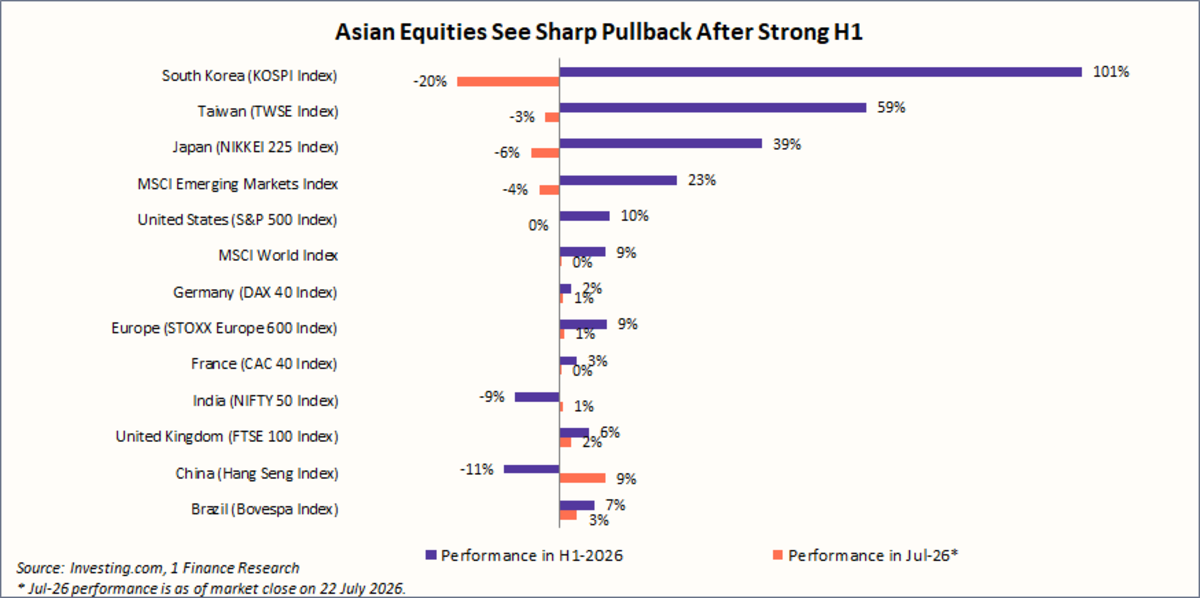
With second-quarter earnings due over the coming weeks, investors will closely monitor whether AI-related companies can justify continued capital spending and sustain the earnings growth that has underpinned this year's rally. After years of multiple expansion, elevated valuations leave little room for execution missteps.
At the same time, the renewed US-Iran conflict has brought geopolitical risks back into focus after a period of relative calm. A sustained rise in crude oil prices could rekindle inflationary pressures, cloud the global growth outlook and increase the likelihood of a more hawkish monetary policy stance across major economies.
Against this backdrop, equity markets are entering the second half of 2026 with little margin for disappointment. As valuations become increasingly demanding and geopolitical risks resurface, market performance is likely to depend more on corporate earnings delivery than further multiple expansion.
History suggests that periods of narrow market leadership rarely persist indefinitely. As earnings growth broadens and valuations normalise, leadership typically rotates across sectors, regions and investment styles. Rather than attempting to identify the next market leader, investors are likely to be better served by maintaining diversified portfolios that can participate across a range of market outcomes.