Gold isn't a single decision anymore. Between physical metal, digital gold, ETFs, FoFs, EGRs, SGBs, multi-asset funds, futures, and jeweller schemes, the format someone picks quietly decides how much they actually keep, through making charges, resale spreads, and tax timelines that differ more than most people expect. This section breaks down what each route actually gets you, what it costs going in and coming out, and who it genuinely suits.
This blog walks through why gold still earns a place in an Indian portfolio, the routes to invest in it, what actually moves the price, and how to time and structure your purchases so you are not leaving money on the table. By the end, you will know which route fits a wedding fund, which fits a long-term portfolio hedge, and what to check before you commit to any of them.
Gold and Silver Investment Options at a Glance
| Way | Regulated by | Total cost | Tax treatment (LTCG) | Liquidity | Best suited for |
|---|---|---|---|---|---|
| Physical gold | No financial regulator | 3% GST + 5% GST on making charges (near zero on coins, high on jewellery) | 12.5% after 24 months | Moderate, sell at a discount | Jewellery, gifting |
| Digital gold | Unregulated (no SEBI/RBI oversight) | 3% GST + 3–5% buy-sell spread + storage fees after free period | 12.5% after 24 months | High, platform buyback | Small, casual buyers only |
| Gold and silver ETFs | SEBI | No GST, no making charges. Expense ratio 0.5–0.9% a year | 12.5% after 12 months | High, exchange hours | Pure investment, demat holders |
| Gold and silver FoFs | SEBI | Two layers, FoF expense ratio ~0.20% + underlying ETF's 0.3–0.6% | 12.5% after 24 months | End-of-day NAV | No-demat, SIP investors |
| Electronic gold receipts (only gold) | SEBI | No GST on exchange trades, 3% only on physical delivery. Brokerage, demat, and vault storage (₹0.20–0.35/gram/month) | 12.5% after 24 months | High, T+1 settlement | Investors wanting direct gold ownership |
| Sovereign Gold Bonds (only gold) | RBI | No GST, no making charges, no storage cost. Secondary market premium/discount + brokerage | Tax-free only for original subscribers to maturity; otherwise 12.5% after 12 months | Tradable on exchange, but thin secondary volumes | Existing holders; new buyers have narrower benefits |
| Jeweller gold savings plan | Unregulated | No interest, no GST advantage. Bonus month is the only gain (8–9% if redeemed as planned) | No specific benefit | Poor, locked to one jeweller | Planned jewellery purchase |
Why Gold and Silver Still Belong in an Indian Portfolio
Gold's job in a portfolio was never to outrun equities. It's there for the years the stock market doesn't cooperate, and for a country where households have historically trusted it more than nearly any financial asset.
Over 1996 to 2025, the Nifty delivered average annual returns of 11.4% against gold's 9.4% over the same period. Gold lost that race, and that's fine, because the value shows up elsewhere. Between January 2010 and December 2011, the Nifty declined 12% while gold rose 63%. A portfolio holding both doesn't dodge the equity drawdown, but it cushions it.
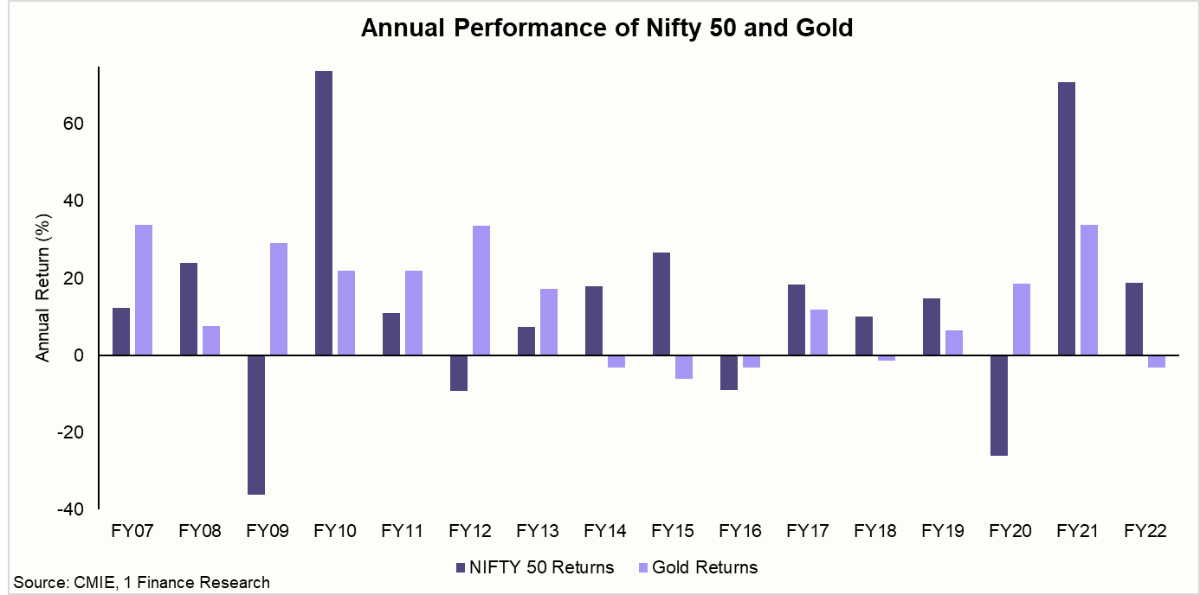
At first glance, this comparison may make gold seem like the weaker investment. However, judging gold solely by long-term returns misses the role it plays in a portfolio. Unlike equities, which are primarily growth assets, gold often behaves differently during periods of economic uncertainty. This difference in performance is precisely why gold continues to be an important part of a well-diversified portfolio.
That hedge is increasingly formal rather than ornamental. India's gold demand rose 10% year on year to 151 tonnes in the first quarter of 2026, and investment demand, up 54% year on year to 82 tonnes, now outpaces jewellery, whose share fell to around 30% of total demand, the lowest on record since 2000. Indians are buying more gold as bars, coins, and paper products than as jewellery, for the first time in a quarter century.
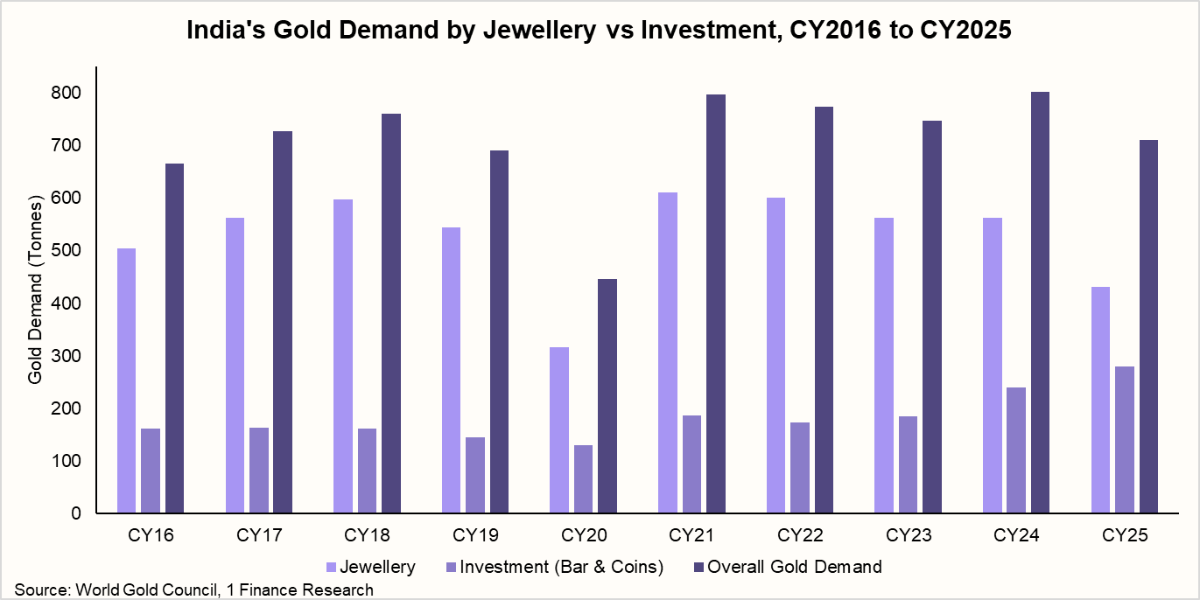
Rather than viewing gold as an alternative to equities, it is better seen as a complement. A modest allocation of 5–15% can help improve portfolio stability without compromising long-term growth, allowing investors to benefit from the strengths of both asset classes.
Different Ways to Invest in Gold and Silver
Gold and silver in India can be held in seven distinct ways:
- Physical metal
- Digital gold
- Exchange-traded funds
- Fund of funds
- Electronic gold receipts
- Sovereign Gold Bonds
- Jeweller savings plans.
Each carries a different regulator, cost structure, and tax treatment, and not every route applies equally to both metals; SGBs and EGRs, for instance, are gold-only. The breakdown below covers each one in turn.
Physical Gold and Silver
Buying jewellery, coins, or bars from a jeweller or e-commerce platform (Tanishq, CaratLane, Amazon). The most familiar route, no minimum ticket size, but the costliest for pure investment.
| Understanding Physical Gold and Silver Investments | |
|---|---|
| Regulated by | No specific financial regulator. General consumer protection and BIS hallmarking rules apply |
| What you actually own | Physical metal (gold and silver jewellery, coins, or bars) |
| Where to buy | Jewellery shops, bullion dealers, e-commerce platforms such as Tanishq, CaratLane, or Amazon |
| Total cost | Gold value (reflects the 5% import duty, reduced in Budget 2026) + making charges (near zero on coins/bars, high on handcrafted jewellery) + 3% GST on value + 5% GST on making charges |
| Safety | Branded versus unverified, not shop versus online. Unhallmarked metal from unverified sellers carries purity fraud risk. E-commerce adds delivery risk and stricter returns |
| Liquidity | Moderate. Sell back to a jeweller, usually at a discount to spot for making charges and purity uncertainty |
| Tax treatment | LTCG at 12.5% if held over 24 months. STCG at slab rate if sold sooner |
💡 What the resale spread actually costs, in rupees Take ₹1,00,000 worth of gold jewellery, valued at today's market rate, sold back to a jeweller. A jeweller's margin typically cuts 5% to 10%, or ₹5,000 to ₹10,000. Refining and repurification adds another 1% to 3%, roughly ₹1,000 to ₹3,000. Weight loss from soldering or embedded stones during melting takes a further bite, often ₹1,000 to ₹2,000 depending on the piece. Stack these together, and what you actually receive is closer to ₹85,000 to ₹93,000, a real loss of ₹7,000 to ₹15,000 on a single transaction, purely from the format gold was held in, not from any price movement. Now compare the same ₹1,00,000 in an ETF, EGR, or SGB. These redeem or trade at the actual market price, with no melting, refining, or margin cut involved, so selling ₹1,00,000 worth returns close to the full amount, minus only brokerage, typically well under 1%. Over one transaction, that's the difference between losing up to ₹15,000 and losing perhaps ₹500 to ₹1,000, the same metal, the same price move, with the format as the only variable. |
Digital Gold and Silver
A fintech-era way to buy fractional gold or silver through apps like Paytm, PhonePe, or Google Pay, without stepping into a shop. Your money buys whatever gram weight the app's rate allows at that moment, credited to your account down to fractions of a gram. That gold is real, held in insured vaults run by a refiner like MMTC-PAMP, SafeGold, or Augmont; the app itself is just the storefront, not the custodian. You can leave it in the app indefinitely, sell it back anytime at the live rate, or request physical delivery as a coin or bar, though delivery only kicks in once your holding crosses a minimum weight, and it adds making and shipping charges on top.
The catch is regulatory, not physical; this entire space sits outside SEBI and RBI oversight. SEBI issued a public advisory on November 8, 2025, Press Release No. 70/2025, clarifying that digital gold products aren't notified as securities or regulated commodity derivatives, and carry no SEBI investor protection; that's the one thing every buyer needs to know before using it.
| 💡 At today's rate of ₹14,417 per gram for 24K gold, ₹100 buys roughly 0.0069 grams, a sliver smaller than a grain of rice. Sell that same holding back the same day, and the buy-sell spread, typically 3% to 5%, means you'd recover roughly ₹95 to ₹97, not the full ₹100, even with gold's price unchanged. The gap isn't a loss on gold, it's the cost of the format, and it's the same reason larger digital gold holdings quietly underperform a plain ETF over time. |
| Understanding Digital Gold and Silver Investments | |
|---|---|
| Regulated by | No specific financial regulator. SEBI's November 2025 advisory confirms digital gold isn't a security or regulated commodity derivative, and carries no investor protection. Governed only by GST and contract law. |
| What you actually own | Fractional gold, backed by physical gold with custodians like MMTC-PAMP, SafeGold, or Augmont. Apps like Paytm or PhonePe are just the storefront. |
| Where to buy | Fintech and payment apps partnered with MMTC-PAMP, SafeGold, or Augmont. |
| Total cost | Gold value + 3% GST + buy-sell spread (typically 3% to 5%, higher signals hidden fees) + storage fees after an initial free period. |
| Safety | No grievance redressal through SEBI or RBI. Depends entirely on the custodian's credibility; check for vault audits, insurance, and an appointed trustee. |
| Liquidity | High. Sell back to the platform anytime, or convert to physical delivery, which adds making and delivery charges. |
| Tax treatment | Same as physical gold. LTCG 12.5% after 24 months. STCG at slab rate if sold sooner. |
Gold and Silver ETFs
Exchange-traded funds that hold physical gold or silver on your behalf, structured as a mutual fund scheme but listed and traded on NSE or BSE exactly like a stock. Each unit you buy represents a proportional legal claim on the gold sitting in the fund's vault, so the price you see on screen isn't set by the fund manager; it moves in near-real-time with the actual metal's market price, tracked with only a small margin of error. You hold this as demat units in your trading account, not as physical metal or even a receipt for it, so there's nothing to store, insure, or worry about losing.
When you sell, you get the live market price minus a small brokerage cost, typically well under 1%, with none of the making-charge or refining deductions that eat into a physical gold sale, so you recover close to the full value of what your units are worth that day. This is also the route SEBI itself points to explicitly as the regulated alternative to unregulated digital gold, since the fund, its custodian, and its holdings are all subject to SEBI's disclosure, audit, and investor-protection rules in a way digital gold apps simply aren't.
| Understanding Gold and Silver ETFs | |
|---|---|
| Regulated by | SEBI. Must hold at least 95% in physical gold of 995 fineness, meeting LBMA standards. |
| What you actually own | Demat units representing a fractional claim on gold or silver held by the fund's custodian, no physical delivery. |
| Where to buy | Any stock broker, via demat and trading account, like buying shares. |
| Total cost | No GST, no making charges. Expense ratio 0.5% to 0.9% a year, plus brokerage. |
| Safety | SEBI-regulated, transparent NAV, audited custodian holdings, safer than digital or physical gold. |
| Liquidity | High. Trades during market hours (9:15 AM to 3:30 PM IST) at live price, needs a demat account. |
| Tax treatment | LTCG 12.5% after 12 months, shortest threshold of any route. STCG at slab rate if sooner. |
Gold and Silver FoFs
Mutual funds that invest in gold or silver ETFs on your behalf, giving you the same underlying exposure as an ETF but through a regular mutual fund account, no demat needed. You hold this as mutual fund units, not gold and not even ETF units directly; your fund manager holds the ETF units, and you hold a claim on the fund itself, an extra layer between you and the metal compared to owning the ETF outright.
When you redeem, you get the fund's NAV for that day, calculated once after markets close rather than a live tradable price, and because the FoF has already paid the ETF's own expenses before you ever bought in, what you recover reflects both layers of cost baked into the NAV, not just what gold did that day. The trade-off is a second layer of cost, but the payoff is accessibility: no demat account, SIP-friendly, and usable through mutual fund platforms most retail investors already have set up.
| Understanding Gold and Silver FoFs | |
|---|---|
| Regulated by | SEBI, as regular mutual fund schemes. |
| What you actually own | Units in a fund holding units of an underlying gold or silver ETF, an indirect claim on the metal. |
| Where to buy | Any mutual fund platform or AMC directly, no demat account required. |
| Total cost | Two layers: FoF expense ratio ~0.20% + underlying ETF's 0.3% to 0.6%, totalling ~0.50% to 0.80% a year, versus 0.30% to 0.50% for the ETF directly. SIP from ₹100 to ₹500, lump sum from ₹1,000. |
| Safety | SEBI-regulated, but inherits any premium or discount the underlying ETF trades at versus actual gold value. |
| Liquidity | End-of-day NAV, not real-time like an ETF. |
| Tax treatment | LTCG 12.5% after 24 months, unlisted units don't get the ETF's 12-month advantage. STCG at slab rate if sooner. |
Electronic Gold Receipts
The newest and most rigorously regulated way to hold physical gold digitally, launched by BSE in 2022 and expanded to NSE in May 2026. An EGR is a demat security backed 1:1 by real gold sitting in a SEBI-accredited vault, not a fund's holding or a fintech app's promise. You hold this as a demat security in your trading account, and unlike an ETF, it represents direct beneficial ownership of specific vaulted gold rather than a fund unit, with the option to convert it into an actual physical coin or bar on request, in denominations from 1 gram to 1 kilogram.
When you sell on the exchange, you get the live traded price minus normal brokerage, with T+1 settlement, no melting or refining deduction the way physical resale carries, so you recover close to full value. This instrument is gold-only; there's no equivalent Electronic Silver Receipt on either exchange, so silver investors have to rely on ETFs or FoFs for comparable exchange-traded exposure.
| 💡Say you buy 10 grams worth of EGR on NSE at today's rate, roughly ₹1,44,170. You can hold it in your demat account indefinitely and sell it on the exchange anytime at the live price, or, if you'd rather have the physical metal, place a delivery request, the exchange withdraws the equivalent gold from the vault and you receive an actual 10-gram coin or bar within a few working days, paying 3% GST only at that point of physical conversion, not before. Either way, whether you sell on-screen or take delivery, you're never exposed to the 8% to 10% resale spread that hits someone selling physical jewellery back to a jeweller. |
| Understanding Electronic Gold Receipts | |
|---|---|
| Regulated by | SEBI, under the Gold Exchange Framework (2022) and Vault Managers Regulations, 2021. Classified as securities with SCORES grievance access. |
| What you actually own | Direct beneficial ownership of physical gold (995 or 999 fineness) in a SEBI-accredited vault, credited to demat, unlike ETF fund units. |
| Where to buy | BSE (since October 2022) or NSE (since May 4, 2026), through a SEBI-registered broker with EGR enabled. |
| Total cost | No GST on exchange trades, 3% only on physical conversion. Brokerage, demat fees, and vault storage (~₹0.20–0.35/gram/month). Minimum unit is 100 milligrams. |
| Safety | SEBI-regulated, audited vaults, formal grievance redressal. Liquidity can lag since not all brokers have EGR enabled yet. |
| Liquidity | Exchange trading with T+1 settlement, convertible to physical delivery in a few working days. |
| Tax treatment | LTCG 12.5% after 24 months, STCG at slab rate if sooner. Gold-EGR conversion isn't a taxable transfer; holding period carries forward. |
Sovereign Gold Bonds
The scheme most gold guides still default to, though it's worth knowing upfront, this door is currently closed to new investors. The government paused fresh issuance in February 2024, and no tranche has opened since, existing bonds remain fully valid, but you can no longer subscribe directly. What you hold is a government security denominated in grams of gold, credited to your demat account or held in a certificate, not physical metal at any point, even at maturity you receive cash, not a gold coin or bar.
The only way in today is buying an existing bond on the secondary market, NSE or BSE, at whatever price it's trading, which can sit at a premium or discount to gold's actual spot value depending on demand. When you sell or redeem, you get that market or redemption price plus the 2.5% annual interest already paid out along the way, with no melting or making-charge deduction at any stage. Like EGRs, this instrument is gold-only, there's no silver equivalent bond that has ever existed.
| Understanding Sovereign Gold Bonds | |
|---|---|
| Regulated by | RBI, on behalf of the Government of India. The only gold route with a sovereign guarantee. |
| What you actually own | A government security in grams of gold, redeemed as cash equivalent, not physical metal. |
| Where to buy | No primary issuance since February 2024. Only available via the secondary market (NSE or BSE) through a demat account. |
| Total cost | No GST, making charges, or storage cost. Secondary market premium/discount plus brokerage. |
| Safety | Sovereign-backed, the safest gold instrument. Tax-free maturity gains, per Budget 2026, now apply only to original subscribers holding the full 8 years. |
| Liquidity | Tradable on the exchange, plus premature redemption after 5 years on notified windows. Thin secondary volumes and wider spreads. |
| Tax treatment | Interest is always taxable at the slab rate. Capital gains are tax-free only for original subscribers who hold to maturity; otherwise, LTCG is 12.5% after 12 months. |
Gold and Silver Savings Plan (Jeweller Schemes)
A monthly instalment plan run by a jeweller, where the final instalment is added free, and the accumulated value must be redeemed as jewellery, not cash.
Most schemes run for 8 to 11 months, with a minimum monthly instalment that varies by jeweller, commonly starting around ₹500 to ₹3,000. Each payment is converted into gold grams at that day's rate rather than being locked at the price on the day you join, so your final gold quantity reflects the average rate across the whole tenure. Redemption typically isn't limited to plain gold, most schemes let the accumulated value go toward diamond or studded jewellery too, with the jeweller applying the balance as a discount against the piece you choose.
| 💡Say you pay ₹5,000 every month for 11 months, that's ₹55,000 in total. The jeweller then adds one more month, ₹5,000, for free. So you end up with ₹60,000 to spend on jewellery, even though you only paid ₹55,000. That's a free bonus of about 9%, but you can only use it to buy jewellery, not take it as cash. At redemption, that ₹60,000 doesn't convert into a fixed weight of gold locked at the price you started with, it buys whatever quantity of gold ₹60,000 gets you at the market rate on the day you redeem, so if gold has risen over those 11 months, your money buys less gold than it would have on day one, and if it's fallen, it buys more. |
| Understanding Gold and Silver Savings Plan | |
|---|---|
| Regulated by | No financial regulator. Unlike bank Gold Deposit Schemes, RBI doesn't regulate these. |
| What you actually own | A running credit balance with a specific jeweller, redeemable only as jewellery, not gold you hold or sell elsewhere. |
| Where to buy | Directly through a jeweller's showroom or app, e.g. Tanishq's Golden Harvest, CaratLane's Treasure Chest. |
| Total cost | No interest, no GST advantage. Bonus instalment is the only gain, roughly 8% to 9% on a 10 or 11-month cycle, redeemable only against jewellery. |
| Safety | Depends entirely on the jeweller's financial credibility, with no deposit insurance or regulatory backstop. |
| Liquidity | Poor. No cash refund if jewellery isn't purchased; funds are locked to that jeweller. |
| Tax treatment | No specific tax benefits. The bonus month is a purchase discount, not investment income. |
What Determines Gold and Silver Prices
Four forces move gold, and only one of them is domestic.
Real interest rates. Gold pays no yield, so it competes directly with cash and bonds after inflation. When real rates fall, the cost of holding gold instead of interest-bearing assets drops, and demand rises. This is gold's most consistent long-term driver, more reliable than any single headline event.
The US dollar. Gold is priced globally in dollars, so a weaker dollar makes it cheaper for buyers everywhere else, lifting demand. Gold's climb past $5,500 an ounce in January 2026 came alongside sustained dollar weakness; the two moved together, as they usually do.
Central bank buying. Central banks bought 863 tonnes of gold in 2025, the fourth consecutive year of far above-average official demand. The shift accelerated after roughly $300 billion of Russia's reserves were frozen in February 2022, a signal to reserve managers worldwide that foreign currency holdings could be frozen overnight; gold cannot. The RBI has been part of this, holding 880.5 tonnes by Q1 2026 and repatriating around 274 tonnes from the Bank of England and BIS between March 2023 and September 2025.
Domestic demand cycles. Festive and wedding-season buying adds short-term texture on top of everything above, but it's the smallest and most predictable of the four; it doesn't set the trend, it just moves prices around the edges of one.
Tips to Invest in Gold and Silver Smartly
Match the route to the goal. Buying for a wedding or festival calls for physical gold or a jeweller savings scheme. Buying for pure portfolio exposure calls for ETFs, EGRs, or SGBs, since they skip making charges entirely. Using the wrong route for your actual goal is the single most common and costly mistake.
Treat jewellery as a purchase, not an investment. Making charges and GST create a cost floor before any price appreciation even starts. If the goal is return, not adornment, a plain coin, bar, ETF, or EGR clears that floor almost entirely.
Check purity and cost transparency before buying. A BIS hallmark on physical gold, and a published expense ratio on ETFs or FoFs, tell you what you're actually paying for. Skipping this step is how making charges and hidden spreads quietly erode returns.
Does the day you buy actually matter? Akshaya Tritiya and Dhanteras are exactly when jeweller demand and price spikes, making them the worst days to buy if price is your only concern. The stronger approach for most investors is rupee-cost averaging, a monthly SIP into an ETF, FoF, or jeweller scheme, which automatically spreads purchases across both festive spikes and off-season dips, removing the need to time anything at all.
Don't mistake trading instruments for investment ones. Futures and options offer leveraged exposure with no LTCG benefit and real risk of loss beyond the initial margin; they suit active traders, not portfolio investors.
💡 Why timing matters more than you'd think
Take ₹1,20,000 invested in gold across 2025, two ways.
Lump sum on Dhanteras (October 18, 2025): At an estimated rate of ₹1,24,000 per 10 grams that day, ₹1,20,000 buys roughly 9.7 grams.
Monthly SIP (₹10,000 a month, January to December 2025): Gold opened the year near ₹76,500 per 10 grams, crossed ₹1,00,000 by April, and closed the year at ₹1,33,195. Averaging purchases across all twelve months instead of buying on one day, the same ₹1,20,000 buys roughly 11.4 grams.
That's nearly 17% more gold for the same money, not because the SIP investor timed anything better, but because spreading purchases across the year automatically captured the cheaper early months instead of paying the higher price the festive season and the year-end rally had already baked in by October. |
Advantages of Investing in Gold and Silver
A hedge against a weakening rupee and rising prices. Since gold is priced in dollars globally, a falling rupee alone pushes the domestic price up, independent of what gold does internationally. That's a currency hedge most Indian assets don't offer.
No counterparty risk. Physical gold, and to a large extent EGRs and SGBs, don't depend on a company staying solvent or a bond issuer repaying debt. It's the one major asset class where the "risk" is purely price movement, not someone else defaulting.
Genuine portfolio diversification. Gold's low correlation with equities means it tends to hold or gain value in the exact periods stocks fall hardest, cushioning a portfolio's worst drawdowns rather than amplifying them.
High liquidity across every format. Physical gold can be sold at any jeweller, ETFs and EGRs trade on exchange during market hours, and digital gold platforms buy back instantly. Few assets convert to cash this easily across so many different routes.
A widening menu of ways to hold it. What used to mean jewellery or bars now spans ETFs, SGBs, EGRs, and FoFs, each with different cost, tax, and liquidity profiles, letting an investor pick the format that actually fits their goal instead of defaulting to physical gold by habit.
Risks of Investing in Gold and Silver
No income, only price appreciation. Gold pays no dividend or interest, SGBs being the one exception with their 2.5% annual coupon. Returns depend entirely on price movement, so gold can go through long stretches of flat or negative real returns.
Making charges and spreads erode returns early. Physical jewellery loses 8% to 25%+ instantly to making charges and GST. Even cleaner formats, digital gold, FoFs, carry spreads or double-layered expenses a plain ETF or EGR avoids.
Regulatory gaps in the newer formats. Digital gold sits outside SEBI and RBI oversight entirely, with no grievance redressal if a platform fails. Jeweller savings schemes carry similar exposure, their safety depends on that one jeweller's financial health alone.
Storage and purity risk for physical gold. Theft, loss, and purity disputes are real costs unique to holding the metal yourself. These vanish once you move to ETFs, SGBs, or EGRs.
Opportunity cost over long horizons. Over 1996 to 2025, gold returned 9.4% annually against the Nifty's 11.4%. A portfolio overweighted in gold for decades has historically lagged one properly allocated to equities.
Conclusion
Gold in India is no longer one decision; it's eight, and the right one depends on what you're actually trying to do. A wedding purchase and a decade-long portfolio hedge call for different routes entirely, and treating them the same is where most of the cost in gold investing comes from.
The newer, SEBI-regulated formats- ETFs, EGRs, SGBs where available, now do almost everything physical gold does, without the making charges, storage risk, or purity questions. Physical gold still has its place, increasingly for sentiment and occasion, not the investment case.
Gold's job in a portfolio was never to outrun equities. It's there for the years the rest of the portfolio doesn't cooperate, and for that, the format matters as much as the decision to hold it at all.