India's Pharma Sector Outlook for FY27
India's pharmaceutical exports crossed $8.1 billion in the first quarter of FY27, up 6.8% from a year earlier. On the surface, that looks like business as usual for an industry that has spent two decades as the world's pharmacy. Underneath it, the ground has shifted. On April 2, 2026, the US imposed a 100% tariff on patented pharmaceutical products and their active ingredients under Section 232 of the Trade Expansion Act, the first time Washington has used a national security tariff on medicines at this scale.
For now, India is largely untouched. Generic drugs and biosimilars, which make up the bulk of what India ships to the US, are explicitly excluded from the tariff. But that exclusion comes with a catch, a formal review within a year that could bring generics into scope. That single clause is the most important thing in this outlook.
This piece walks through where India's pharma sector stands as FY27 opens, what the US tariff regime actually covers and what it doesn't, the structural growth bets the industry is making regardless (CDMO, biosimilars, GLP-1 drugs), and what advisors should be watching before the one-year review comes up.
Key Drivers and Risks of the Indian Pharma Sector
India's pharma sector enters FY27 with export demand holding steady and a domestic market projected to grow from roughly $60 billion currently to $130 billion by 2030, but the outlook carries genuine two-sided risk. The Section 232 generics exclusion, a widening gap between input cost inflation and price-controlled ceiling rates, and continued dependence on Chinese APIs sit alongside real tailwinds from a weaker rupee, strong stock market performance, and sustained government incentives. The balance points to a sector with strong underlying support, but one where a single policy decision could meaningfully shift the picture.
Overall Outlook: 🟡 Cautiously Positive
| Pharma Sector Outlook | ||
|---|---|---|
| Factor | Current Assessment | What to Watch |
| API & China Dependency | 🔴 High Risk | PLI-backed domestic API capacity ramp-up; China trade policy |
| Inflation & Price Controls | 🔴 High Risk | WPI trajectory vs NPPA's fixed ceiling adjustment through April 2027 |
| US Tariff Exposure (Section 232) | 🟡 Neutral | Commerce Dept's one-year review of the generics exclusion, due by April 2027 |
| Export Demand | 🟢 Supportive | US, EU demand trends; diversification beyond top 3 markets |
| Domestic Healthcare Demand | 🟢 Supportive | Insurance penetration, chronic disease burden, Ayushman Bharat coverage |
| USD/INR | 🟢 Supportive | Rupee trajectory, but partially offset by hedging lags and API import costs |
| FII Flows & Market Sentiment | 🟢 Supportive | Nifty Pharma vs Nifty50 relative performance |
| Government Policy (PLI, PRIP, Mission Biopharma) | 🟢 Supportive | Scale-up pace of biologics/API incentive schemes |
The dashboard above is a snapshot, not a forecast. Its colours will shift on two dates alone, the Commerce Department's tariff review and NPPA's next annual price reset, both due within the year.
For advisors, that's the practical filter. Client conversations about pharma exposure should center on those two triggers, not the current tariff rate or this year's input cost print, since neither of those numbers is what actually moves the picture from here.
India's Pharma Exports Rise as FY27 Begins
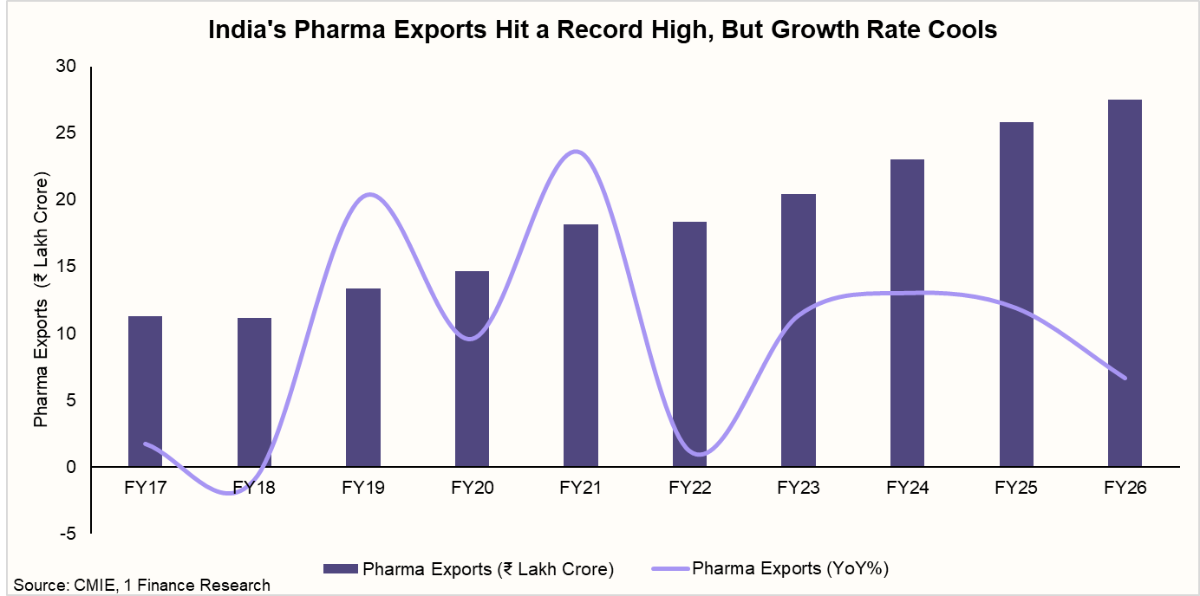
FY27 opened with two different growth stories inside the same sector. Exports held up on steady global demand, while the US business, still the industry's largest market, cooled sharply on a high base.
India's pharmaceutical exports rose 6.8% year on year to $8.1 billion in the April to June FY27 quarter, up from $7.58 billion a year earlier. June alone rose 7.13% to $2.81 billion, up from $2.63 billion in May, a sign momentum built through the quarter rather than front-loading at the start.
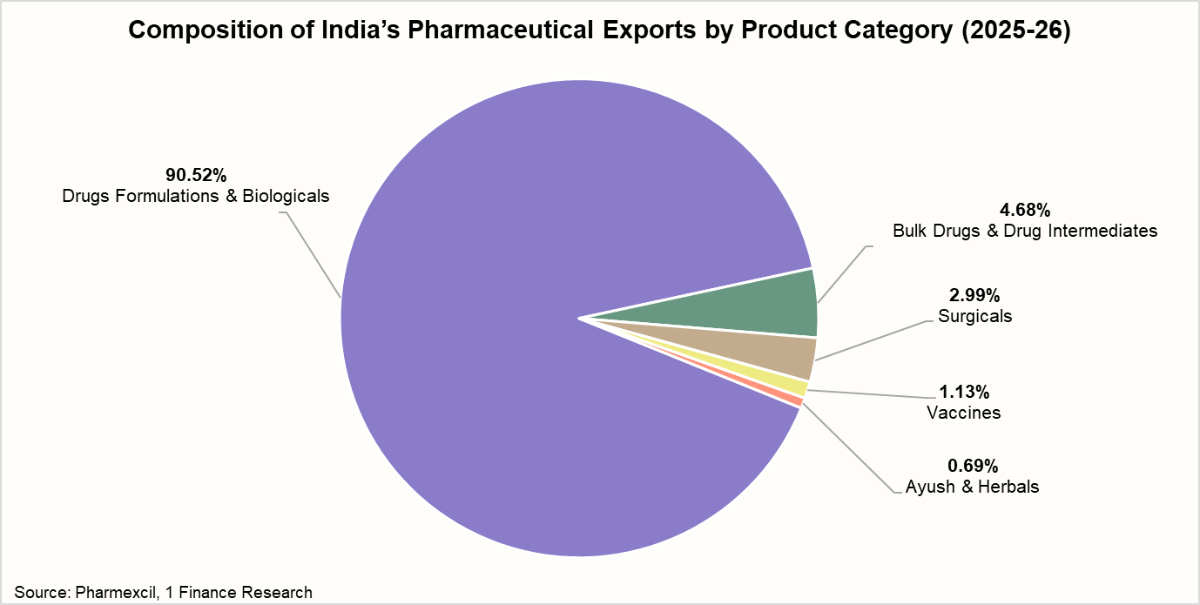
The growth wasn't concentrated in one category. Drug formulations and biologicals stayed dominant, at $5.98 billion, but grew only 4.14% year on year, the slowest of the major segments. The faster growth came from smaller categories: bulk drugs and intermediates rose 13.84% to $1.36 billion, vaccines surged 35.68% to $0.39 billion, and surgical products grew 11.95% to $0.21 billion.
India's Pharma Export Growth Varies Sharply by Market
Not every market moved the same way. The three lines in this chart tell three different stories, and blending them into one export growth number would hide what's actually happening in each.
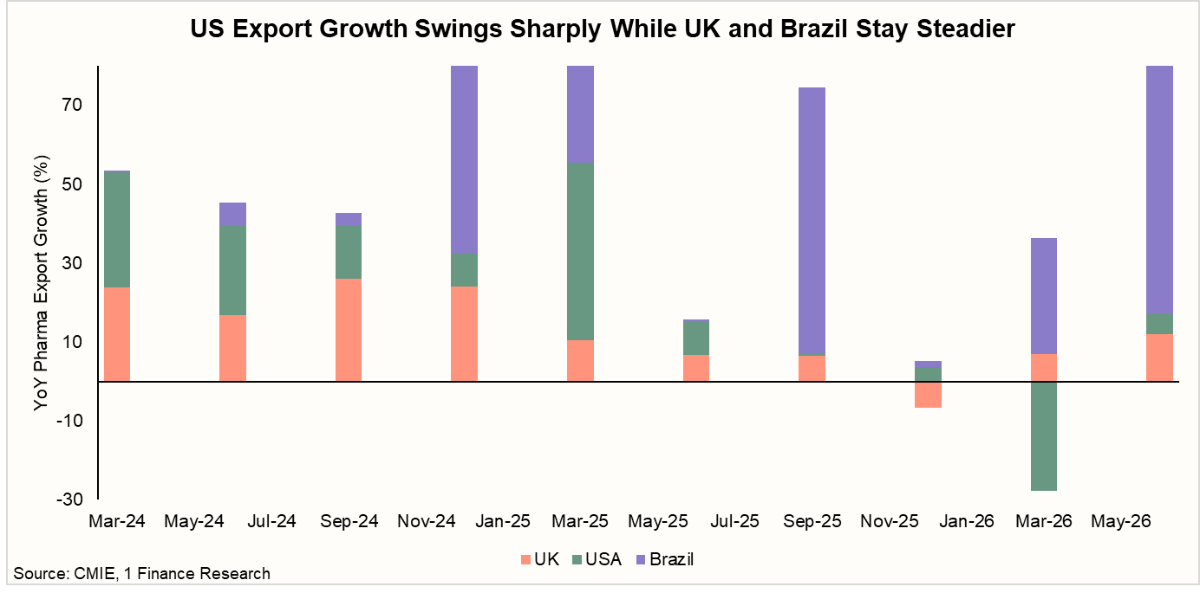
The UK stayed the steadiest, mostly ranging from high single digits to the mid-twenties, with only one dip into negative territory in late 2025.
The US swing traces back to one drug. Revlimid is a high-value cancer drug that came off patent, opening the field to generic makers. Growth spiked to nearly 45% in early 2025 on a burst of new generic Revlimid sales from Indian companies. A year later, that same high base turned the comparison negative. By mid-2026, growth was climbing back into positive territory as the base effect wore off.
Brazil's pattern is different in kind, not just degree. Growth spiked past 50% on multiple occasions, each followed by a sharp pullback, a shape that points to lumpy, order-driven demand rather than steady growth.
The takeaway: the US and Brazil swings are one-off events, not genuine shifts in demand. The UK's steadier line is the closer read on organic growth.
US Tariff and Its Impact on India's Pharma Sector
On April 2, 2026, the US imposed a 100% tariff on patented pharmaceutical products and Active Pharmaceutical Ingredients (APIs) under Section 232, a US trade law provision that lets the President impose tariffs on imports judged a threat to national security, historically used for steel and aluminium, now applied to medicines for the first time. For India, the impact is mixed, protected today, exposed ahead.
Generics and biosimilars are excluded for now, covering the bulk of India's US business. India supplies roughly 35% of all generics sold in the US, and the US accounts for 30-50% of revenue at major Indian drugmakers, which is why this exclusion matters more than the headline rate.
That exclusion isn't permanent. Commerce must report within a year on whether to narrow it, and that clock is already running.
A narrower slice of India is exposed right now. Unlike the EU, Japan, South Korea, Switzerland and Liechtenstein, which pay 15% on covered products, India gets no preferential rate, so any India-made patented drug or API defaults to 100%. This touches Sun Pharma's speciality portfolio (~20% of revenue, though partly made outside India) and India's CDMO/API majors supplying patented, not generic, drug pipelines. Exact dollar exposure isn't disclosed yet.
| Which Indian companies are most exposed if the exclusion narrows | ||
|---|---|---|
| Company | US revenue share | Note |
| Gland Pharma | 54% (FY25) | Highest US dependence |
| Aurobindo Pharma | 47% | High dependence; has US manufacturing |
| Dr. Reddy's Laboratories | 45% | High dependence; has US manufacturing |
| Sun Pharma | 20% of revenue from innovative drugs | Only segment exposed today |
| Cipla | Lower than peers | US manufacturing gives some buffer |
The pattern across these names is straightforward: revenue concentration in the US, not company size, drives exposure. Gland Pharma, Aurobindo, and Dr. Reddy's carry the highest stakes precisely because they lean hardest on that single market. For advisors, the practical takeaway is to track the one-year review, not the current tariff rate, since that's the event that would actually move these numbers.
Macroeconomic Factors Shaping India's Pharma Sector
Beyond the tariff story, seven broader economic forces are shaping how the sector performs right now, from currency and capital flows to input costs and domestic policy. Each factor below carries its own outlook rating, since not all of them are pulling in the same direction.
🟢 Rupee Movement
Pharma exporters earn in dollars but spend in rupees, so a weaker rupee should lift both margins and sentiment. Over the past 16 months, that's broadly held, the rupee has slid from around ₹85 to ₹95.7 per dollar, and Nifty Pharma has climbed from roughly 20,500 to 26,300 over the same window.
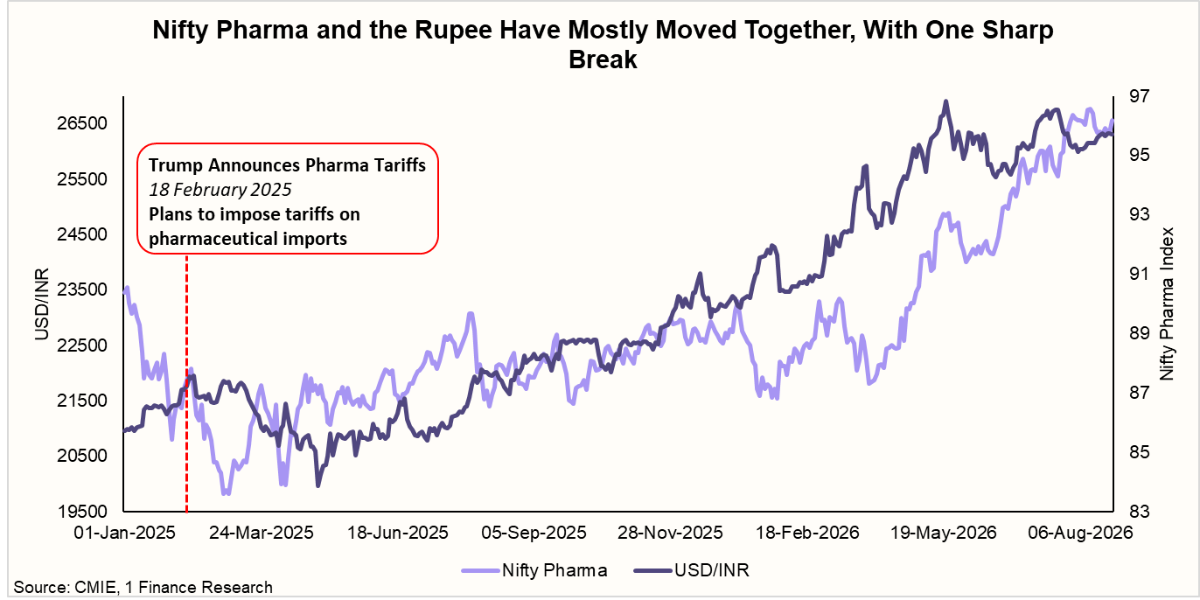
The two lines aren't in lockstep, though, and the gap between them tells its own story. From December 2025 into February 2026, the rupee kept weakening while Nifty Pharma fell instead of rising with it, a clear divergence. That stretch lines up with the period when Section 232 tariff fears were escalating in Washington, before the April 2026 proclamation confirmed generics would stay exempt. The market was pricing in tariff risk faster than any currency tailwind could offset it.
Once that exemption was confirmed, the index closed the gap fast. From April 2026 onward, Nifty Pharma rallied sharply and has moved roughly in tandem with the rupee since, sometimes outpacing it.
🟢 FII Flows
FIIs have been heavy net sellers of Indian equities through 2026, pulling out an estimated $29 billion. The Nifty50 is down 6.86% year-to-date as of mid-August. Nifty Pharma, over the same stretch, is up 17.74%.
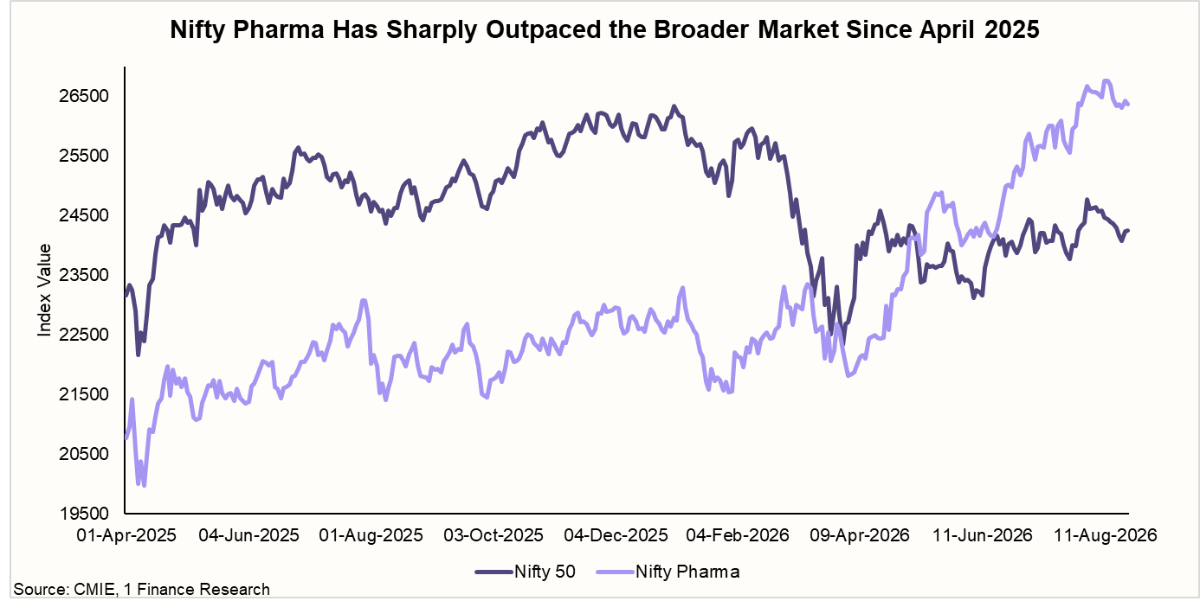
That gap is the story. While FIIs have been exiting the broader market amid geopolitical uncertainty and a weak macro backdrop, pharma has traded as a defensive safe haven rather than getting caught in the outflow. The index has specific catalysts behind the move too, tariff-relief rallies through late 2025 as the market priced in a softer US stance, and a fresh leg up once the April 2026 proclamation confirmed generics would stay exempt.
For advisors, this is a useful counter to the tariff-risk narrative earlier in this piece: the market has already voted, and it's treated pharma as one of the better places to hide this year, not a sector under pressure.
🟡 US Drug Pricing Policy
Alongside Section 232 tariffs, the US has pushed Most Favoured Nation (MFN) pricing, tying US drug prices to the lowest price charged elsewhere. An April 2026 Executive Order linked the two directly, offering tariff relief to manufacturers who sign MFN and domestic-production agreements. Fourteen large drugmakers, including Pfizer, Novartis, Sanofi and Merck, have signed on. CMS has also proposed two Medicare pricing models (GLOBE, GUARD) benchmarked to international prices, alongside the IRA's Medicare negotiation program, in effect since January 2026.
This is largely someone else's story for India. MFN pricing targets branded, patented drugs, not the generics that dominate India's US business, and early evidence shows limited real price impact so far. The one indirect channel: margin pressure on innovator companies could push more manufacturing outsourcing toward Indian CDMO players, reinforcing a trend already in motion.
🔴 API & Input Costs
India dominates finished generics, but the raw materials behind them tell a more exposed story.
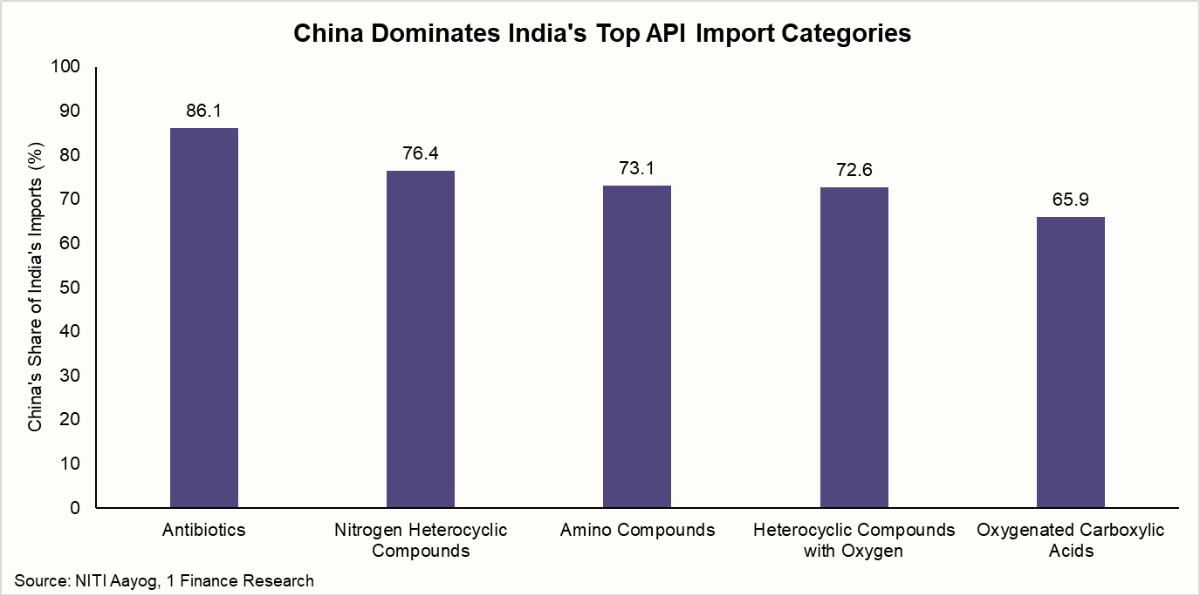
India sources bulk drugs and drug intermediates from a range of countries, including Italy, Germany, Singapore, the US, Spain and Switzerland. However, China remains overwhelmingly dominant, accounting for around 73.3% of India's total imports in 2025–26, highlighting the country's significant concentration in a single external source.
NITI Aayog's June 2026 Trade Watch report put India's Active Pharmaceutical Ingredient (API) and Key Starting Material dependence on China at 65%, rising to near-total for fermentation-based products like antibiotics. Government data placed before Parliament in March 2026 named specific APIs where China supplies 70% or more of India's imports.
Cost pressure has compounded this. West Asia tensions disrupted trade routes and pushed up petrochemical prices through 2026, and Pharmexcil flagged shortages of solvents like methanol, ammonia and propylene as early as April. Raw material costs for some medicines rose 20-30%, though companies have largely absorbed the increase rather than passing it on.
The government's PLI scheme is the policy response, incentivising domestic API production for 41 bulk drugs. Of 53 APIs where India had 90% import dependence, domestic manufacturing has started for 35. Progress, but the dependency this section opened with hasn't gone away, it's being chipped at.
🔴 Inflation
For most sectors, inflation is background noise. For pharma, it's mechanical: prices of nearly 900 essential medicines are legally tied to the Wholesale Price Index.
Higher inflation raises manufacturing, packaging, labour and logistics costs. Its impact is particularly important where companies have limited pricing power, and Indian pharma's regulated segment is the clearest case of that.
Nearly 900 essential medicines have their prices capped by National Pharmaceutical Pricing Authority (NPPA), adjusted once a year based on the prior year's WPI. For 2026, that adjustment was locked at just 0.65%, effective April 1, 2026, for the full year. Since then, WPI itself has climbed sharply, touching 9.87% by June, driven largely by the energy price surge from the West Asia conflict.
The result: manufacturers of price-controlled medicines are absorbing rising input costs, freight, packaging, energy, and labour, with almost no ability to pass them through. Their ceiling price stays fixed until the next annual reset in April 2027, regardless of where costs move in between.
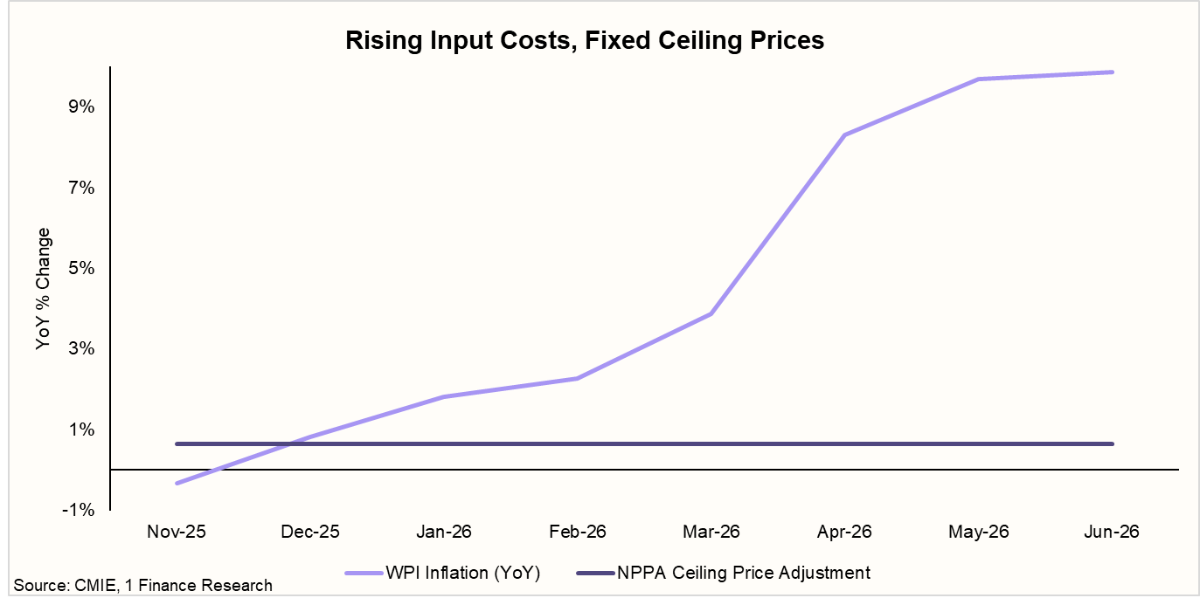
WPI ran below the National Pharmaceutical Pricing Authority (NPPA) 0.65% ceiling adjustment through November 2025, but crossed above it by December and kept climbing, reaching nearly 10% by June 2026. For most of this period, manufacturers of price-controlled medicines were absorbing rising costs with no ability to raise prices to match, since the ceiling stays fixed until the next annual reset in April 2027.
🟢 Domestic Healthcare Spending
While exports absorb the policy risk, India's domestic pharma market is doing the heavy lifting on growth. NITI Aayog puts India's domestic market at roughly $60 billion currently, projected to reach $130 billion by 2030, more than double.
| India's Domestic Pharma Market to More Than Double by 2030 | |
|---|---|
| Year | Domestic Pharma Market Size ($ billion) |
| 2025 (current) | 60 |
| 2030 (projected) | 130 |
Three drivers sit behind that number. Government healthcare spending nearly tripled, from ₹1.30 lakh crore in FY14 to ₹3.85 lakh crore in FY23. Insurance penetration remains under 40%, still a constraint, but Ayushman Bharat (PM-JAY) has extended coverage to 500 million people. And chronic disease burden keeps rising; India has over 100 million people living with diabetes, exactly the therapy categories where domestic demand concentrates.
| Government Health Expenditure, 2013-14 vs 2022-23 | ||
|---|---|---|
| Metric | 2013-14 | 2022-23 |
| Government Health Expenditure (GHE) | ₹1.30 lakh crore | ₹3.85 lakh crore |
| GHE as % of GDP | 1.15% | 1.43% |
| GHE as % of Total Health Expenditure | 28.6% | 43.7% |
| Out-of-Pocket Expenditure as % of THE | 64.2% | 43.4% |
| Per capita GHE | ₹1,042 | ₹2,786 |
| Primary healthcare expenditure | ₹0.5 lakh crore | ₹1.4 lakh crore |
This matters for the tariff story specifically. India's domestic market doesn't touch a single US tariff line; it grows on India's own demographics and spending, not on Washington's decisions. For a sector this exposed to US policy risk, a structurally growing, policy-insulated domestic base is the closest thing to a hedge it has.
🟢 Government Policy and Regulation
Beyond pricing, government policy shapes pharma through where capacity gets built and how competitive the sector stays globally. India's PLI push here is substantial: the Bulk Drugs PLI (₹6,940 crore), the Pharmaceuticals PLI (₹15,000 crore), and the Medical Devices PLI (₹3,420 crore) together total over ₹25,000 crore in incentive outlay, aimed at pulling manufacturing of critical APIs and high-value products back onshore.
Early results are visible on the API side specifically: of 53 APIs where India had 90% import dependence, domestic manufacturing has started for 35, though as covered earlier in this piece, that hasn't dented China's dominance in the highest-dependence categories like antibiotics.
Two newer moves are worth flagging. The PRIP scheme (₹5,000 crore) is shifting government support from pure manufacturing incentives toward R&D; seven Centres of Excellence have been set up at NIPER institutes for specialised drug discovery research. And Mission Biopharma SHAKTI, launched in 2026-27, specifically targets biologics and biosimilars manufacturing, the segment where India's export share (0.6%) lags furthest behind its manufacturing volume (roughly 60% of world vaccine output).
The pattern across all of this: policy is trying to move India up the value chain, from volume generics toward complex generics, biologics, and R&D-driven products, rather than just defending the existing generics business.
Conclusion
India's pharma sector enters FY27 strong: exports growing, the domestic market set to more than double by 2030, and Nifty Pharma outperforming the broader market by over 20 points this year. Generics, the bulk of India's US business, remain untouched by Section 232.
That protection has an expiry date. Commerce must review the exclusion within a year, and that single decision will do more to move this sector than anything covered here. Alongside it, a quieter squeeze is already live: input costs near 10%, price ceilings frozen at 0.65% until April 2027.
For advisors, the takeaway is simple. Track two dates, the tariff review and the next NPPA reset, and revisit client positioning as each resolves. The fundamentals are strong. Whether they stay that way is now Washington's call, not India's.