Every retirement plan already assumes an answer to how long the money needs to last. Most advisors have never chosen that answer on purpose, and the data shows exactly where the gap becomes dangerous.
Key takeaways
| Factor | Key takeaway |
|---|---|
| Starting number | Life expectancy at birth, 70.3 years, is a newborn's number. Someone who has already reached 70 is really looking at close to 83, a 13-year gap |
| Sequencing risk | Roughly 77% of a retirement portfolio's eventual outcome is decided by its first decade of withdrawals, not the long-run average return |
| Longevity tail | 12.6% of people who reach 60 today are modelled to still be alive at 90, and 4.9% at 95 |
| Affluence gap | Wealth, education and insurance status all push longevity above the national average, by as much as 7.6 years between the richest and poorest fifths |
| The Longevity Check | A five-step advisor framework: starting age, conditional horizon, tail exposure, profile adjustment, portfolio durability |
India Still Looks Young
India still reads as a young country, and by the raw numbers, it is more than a third of Indians are under 25. But the average is a snapshot, not a fixed state. India crossed 7 per cent of its population aged 65 and over in 2024, and is projected to cross 14 per cent by 2049 and 21 per cent by 2065.
Put against other countries, the more useful number isn't the percentage; it's the calendar. Against the 14 per cent threshold, India is currently 24 years behind Singapore, 31 behind South Korea, 35 behind the United States, 55 behind Japan, 61 behind Italy, 74 behind Britain, and 77 behind Germany.
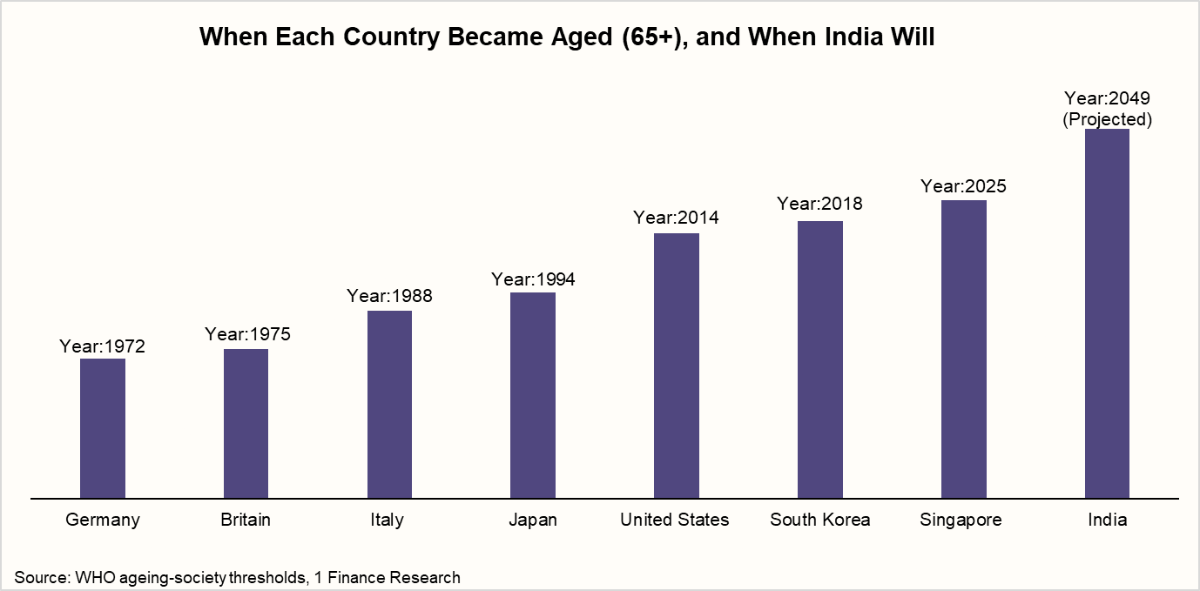
It's easy to feel calm about that gap on paper. It's harder once you think of it as one person's life. An Indian who is 35 today will be 60 in 2049, the year India reaches the ageing level Japan reached in 1994, and 76 in 2065, when India reaches the level Japan passed in 2007. The whole transition happens inside one working life and one retirement, to the generation currently in its thirties.
Recommended for you
Readers also explored

World GDP Breakdown 2025: Who Powers the Global Economy?
 8 min read

Nifty 50 Companies List 2025 : Top 50 Stocks in India
7 min read
Life Expectancy At Birth Is The Wrong Starting Point
India's most quoted longevity number is life expectancy at birth, 70.3 years. It is the number a newborn is exposed to, not the number that applies to a 60-year-old client sitting across the table today. Every year a person has already survived is a year of risk already behind them, and the planning number should rise to reflect that.
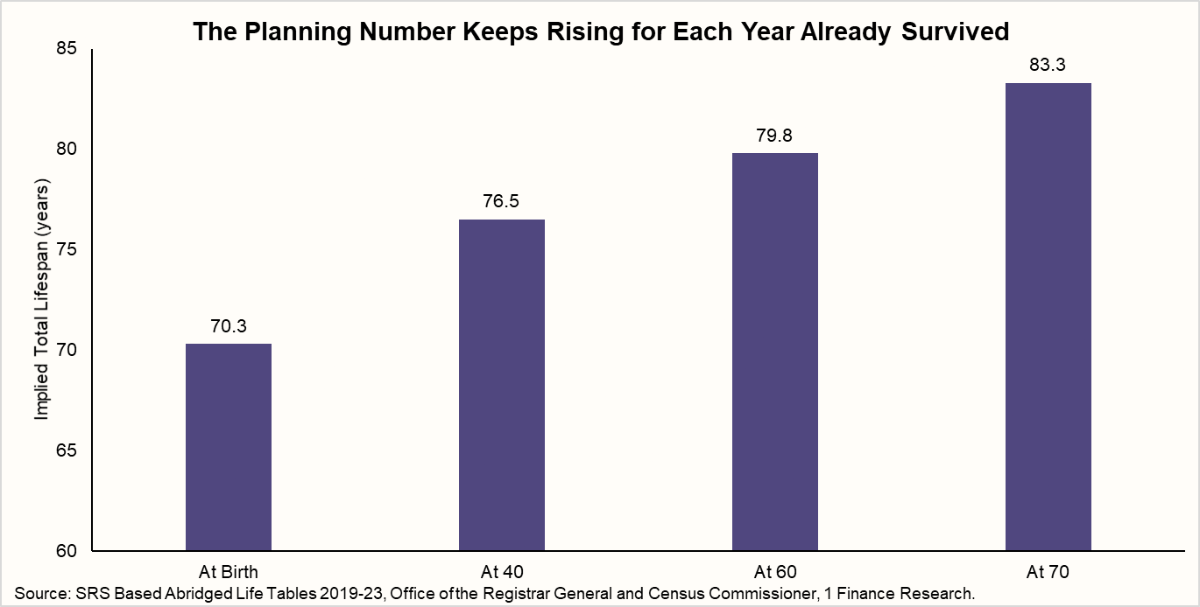
By the time a client reaches 70, the figure that actually describes their remaining lifespan is not 70.3. It is closer to 83.
| 💡13 years: The gap between India's headline life expectancy figure and the implied total lifespan of someone who has already reached 70. |
That gap changes what a plan is actually solving for. It is the difference between a plan that quietly assumes a client has 10 years of retirement spending left, and one that correctly assumes 20.
Why The First Decade Of Retirement Decides Everything
Even a plan with a stated horizon isn't fully protected, because retirement outcomes aren't decided by average returns. They are decided disproportionately by what happens early.
| 💡Roughly 77%: The share of a retirement portfolio's eventual outcome that Wade Pfau's widely cited retirement income research attributes to the returns of just its first decade of withdrawals. |
Two clients can retire with identical corpuses, withdrawal rates and long-run average returns, and still end up in completely different places, purely because of what markets did in their first five to ten years. This is sequencing risk, and a longer, unexamined horizon makes it worse; there is more time for an early shock to compound before the plan can recover. For a client retiring at 60, that first decade runs to roughly 70, exactly where the riskiest retirement years still lie ahead.
The same research shows required corpus does not scale in a straight line with horizon length either. Bill Bengen's original work and the 1998 Trinity Study, extended by Michael Kitces and Wade Pfau, found the safe withdrawal rate falling from roughly 4.0% at 30 years to 3.5% at 40 years and 3.25% at 50 years. This is US market derived, not India specific, but the same shrinking increment shape reappears in the illustrative Indian model later in this newsletter.
A Retirement Plan Must Survive A Range Of Outcomes
Even a correctly chosen horizon can mislead if it is treated as a single number rather than a range of outcomes. A modelled Indian survival curve shows what share of people actually reach each age, and the shape looks nothing like a cliff at the average.
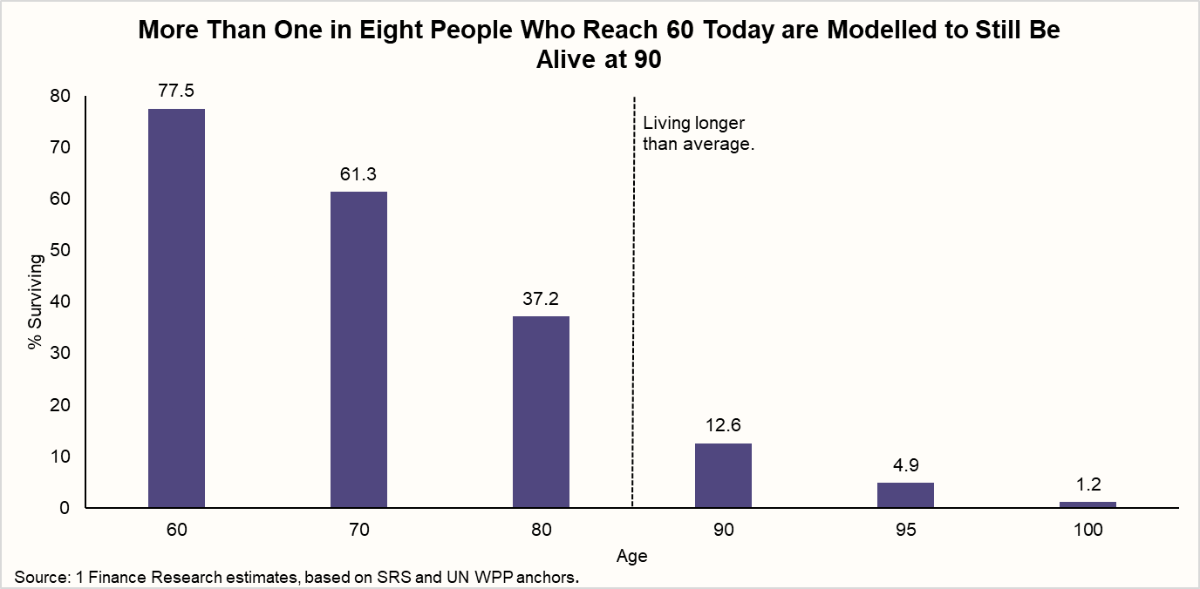
A plan sized to the average outcome is, by construction, likely to fail everyone who lives longer than average, which is close to half of any client base by definition. The relevant planning question was never whether a client will live to the average age. It is whether the plan survives the plausible one, well past it.
Wealth, Education And Insurance, All Push Longevity Higher
None of the figures above describes India evenly. They describe a population average that a client who is affluent, urban, educated and insured has typically already outperformed before the plan is even built.
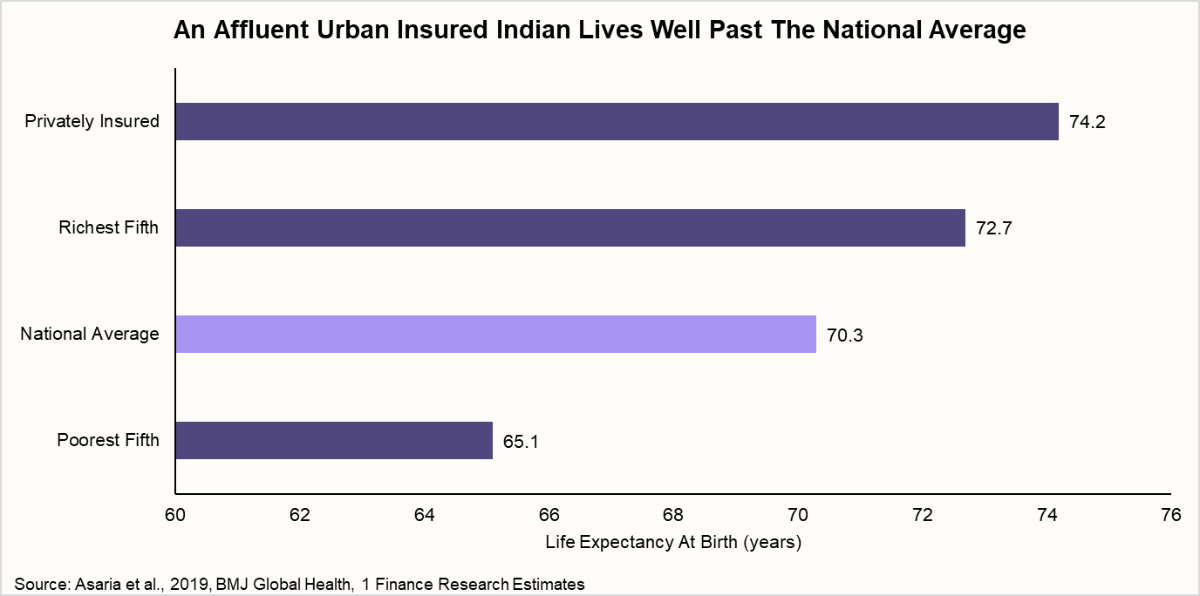
| 💡7.6 years: The gap in life expectancy at birth between India's richest and poorest household wealth quintiles. |
These are associations, not proof of cause. The privately insured figure in particular partly reflects selection, since people who buy individual health cover already skew toward stable employment and better baseline health. But the direction is consistent across every marker available. Wealth, education and insurance status all point the same way, toward a longer life than the national figure implies, never a shorter one.
Planning For A Longer Life Costs Less Than It Feels
The usual objection to extending a client's planning horizon is that it sounds expensive: why fund 30 years when 20 probably covers it? The data says the opposite. Each extra year costs less than the one before it, and all of it costs less than the alternative: a client who outlives the plan.
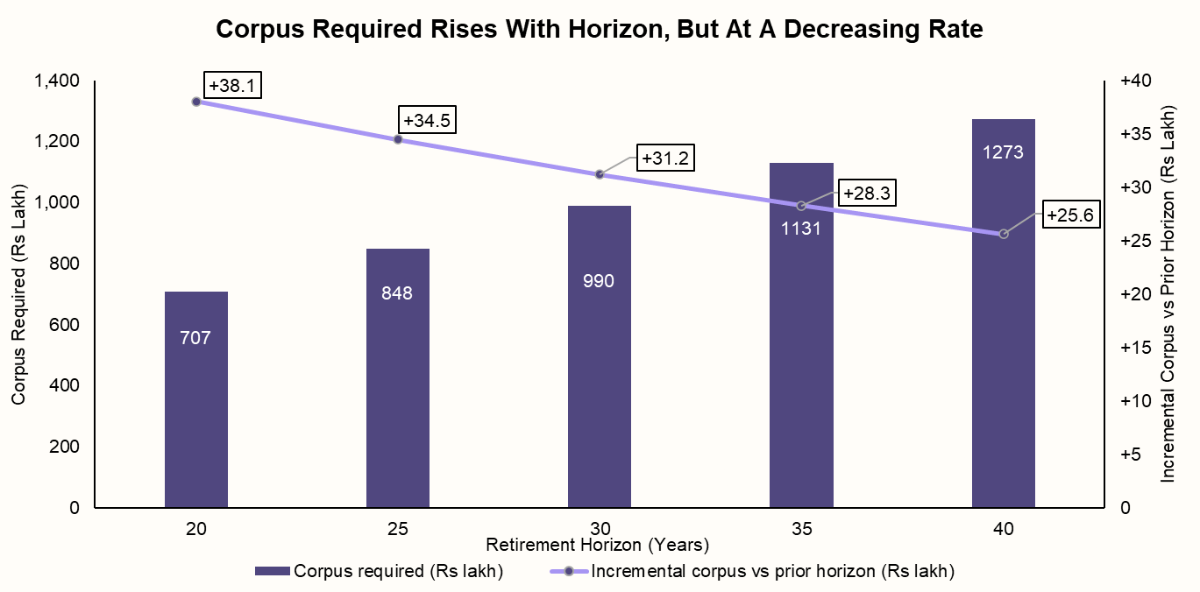
Illustrative model. Assumes a client retiring at 60, withdrawing a level Rs 12 lakh a year in today's money, with a constant 2% annual real (inflation-adjusted, post-tax) portfolio return. Not historical or market data, not a corpus recommendation.
| Horizon +125%, corpus +65%. Extending the modelled horizon from 20 to 45 years more than doubles the number of years the plan has to fund. The required corpus rises by roughly two-thirds. |
The pattern is the argument. Protecting a client to 90 instead of 80 adds about a third to the corpus, not double. Protecting them to 95 or 100 adds barely a tenth more each time. The cost shrinks the further out the plan reaches, the opposite of how this decision usually gets priced.
Weighing that shrinking cost against a much larger, fixed one: a client who outlives the plan with no income left. A plan sized to the average outcome fails everyone who lives longer than average, close to half of any client base by definition. The real question was never whether a client reaches the average age. It is whether the plan survives well past it, at a cost smaller than most advisors and clients assume.
The Longevity Check Every Retirement Plan Should Pass
Put the last six sections together and a single operating discipline falls out of them, not a list of separate warnings.
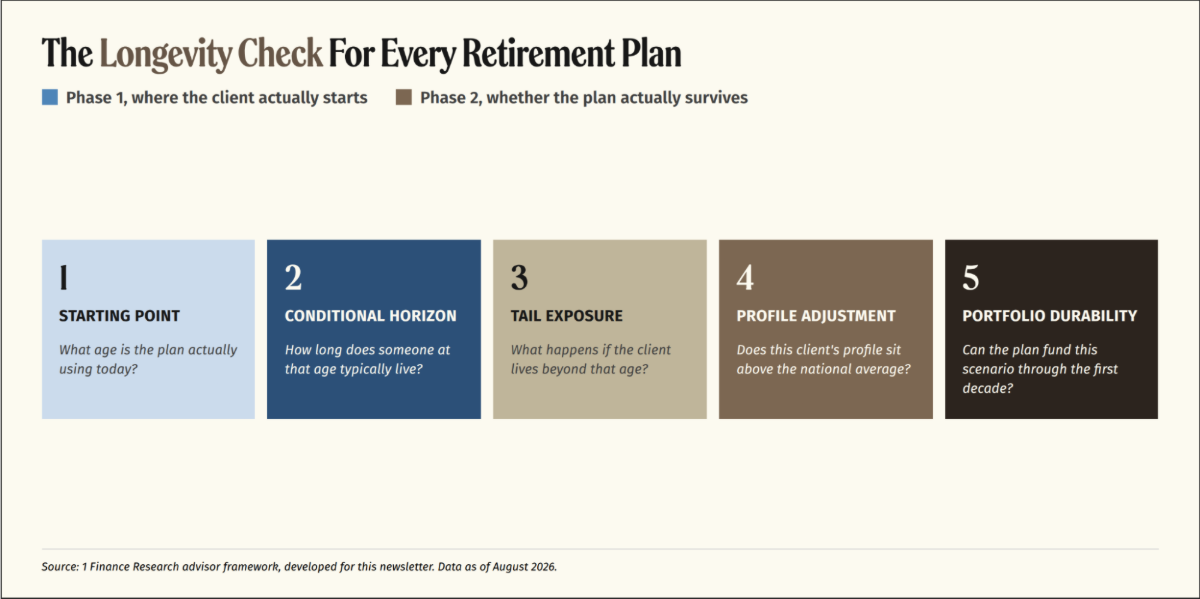
Each step maps directly to a section above. Starting point and conditional horizon replace the birth-based default with the number that actually applies to the client. Tail exposure replaces a single planning age with the range the survival curve actually shows. Profile adjustment replaces the national average with the client's own income, education, location and insurance status. Portfolio durability asks whether the corpus, the withdrawal approach and the first decade of returns can actually deliver the scenario the first four steps just defined.
How To Actually Fix The Retirement Planning Horizon
A retirement plan built the right way does not start with a corpus target. It starts with a horizon the advisor and client have agreed on explicitly, in writing, wide enough to cover the plausible outcome rather than only the average one, adjusted for who the client actually is rather than who the national average describes, and revisited on the same schedule as the return and inflation assumptions sitting next to it.
That plan treats longevity the way it already treats market risk, as a variable to be modelled and stress tested, rather than a constant to be assumed. It protects the first decade of withdrawals specifically, since that decade decides more of the outcome than any other.
None of that changes what a client has already saved. It changes what the plan is actually solving for. A retirement plan succeeds when a client living longer than expected changes nothing about their financial independence, not when the corpus happens to run out somewhere close to the age the client died. Getting there starts with an advisor willing to name the horizon out loud, and defend it the same way every other assumption in the plan already gets defended.