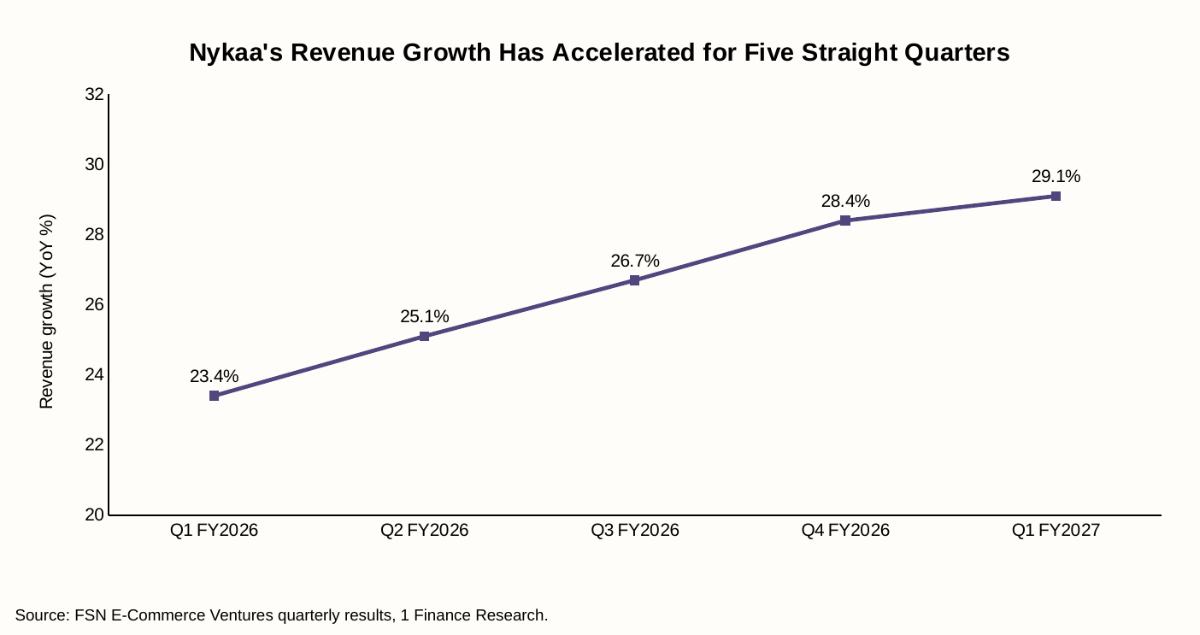
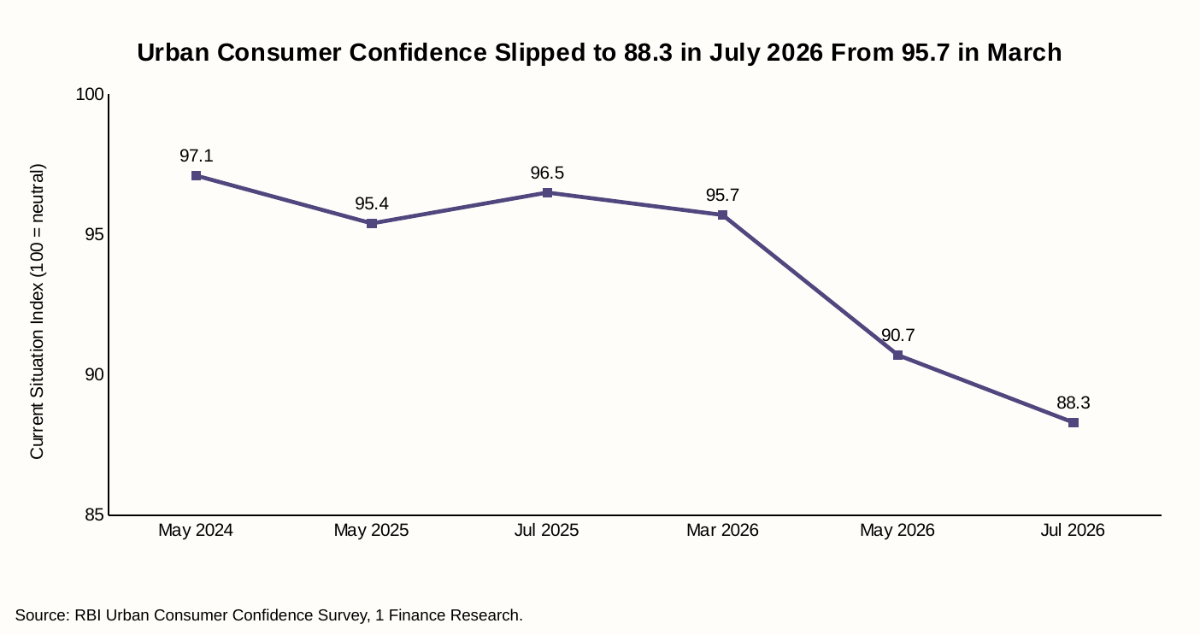
The lipstick effect is not really taking hold in India in 2026. Urban households told the Reserve Bank of India in July 2026 that conditions are worse than a year ago, pushing the Current Situation Index down to 88.3 from 90.7 in May. Beauty spending kept growing, with Nykaa's beauty gross merchandise value up 28% and Hindustan Unilever's Beauty and Wellbeing business up 12% in the June quarter.
The textbook version of the effect also needs big purchases to stall. They did not. Passenger vehicle dispatches to dealers hit 4,39,309 units in August 2026, the highest for any August on SIAM's record, though still below July 2026 (4,57,810) and the festive peak of October 2025 (4,60,739). Mumbai registered a projected 12,503 property registrations in the same month, the highest August count in over 14 years. In 2026, India's market is one where policy made big purchases cheaper, and households traded up in both directions.
Below, we set out what the effect is, where it shows up in Indian data, what the 2026 numbers say, where households pulled back, and what it all means for a portfolio.
What Is the Lipstick Effect
The lipstick effect describes a shift in spending during hard times, away from expensive commitments and towards small treats that still feel like an indulgence. Estée Lauder chairman Leonard Lauder popularised the idea after noticing lipstick sales rise following the 2001 slowdown.
For investors, the interest lies in what it implies for earnings. If a category keeps growing when confidence falls, it behaves like a defensive business with the growth of a discretionary one. That combination usually earns a higher valuation multiple, which is why analysts watch it.
Two cautions apply from the start. The effect is not a reliable rule, since it failed in 2020 when masks removed the reason to wear makeup. And in India, beauty is a structural growth story in its own right, helped by the shift to online buying and a move to premium products. Strong beauty sales in a weak year may simply be that trend continuing, so any honest analysis has to separate the two.
Why Consumers Trade Down Instead Of Cutting Out
When real income falls, whether wages lag prices or a job feels less secure, people don't cut spending evenly. The income effect hits big, deferrable purchases first. The substitution effect explains the next move: swapping toward cheaper options within a category, a home-brewed coffee instead of a café one, rather than giving up the category altogether.
Marginal utility explains why the swap feels good. Each extra rupee spent on something you already have plenty of buys less satisfaction than the first, so a small, affordable treat delivers a disproportionate return relative to its cost. Consumer confidence decides which purchases get postponed altogether, big, hard-to-reverse ones, because unwinding them is costly if things get worse. Together these forces produce what economists call affordable indulgence, spending that survives because it is cheap and feels good.
Where Consumers Cut Back And Where They Still Spend
Big-ticket categories, cars, housing, electronics, luxury travel, furniture, get deferred first. Small-ticket categories, beauty, coffee and dining, confectionery, entertainment, affordable fashion, wellness, tend to hold up.
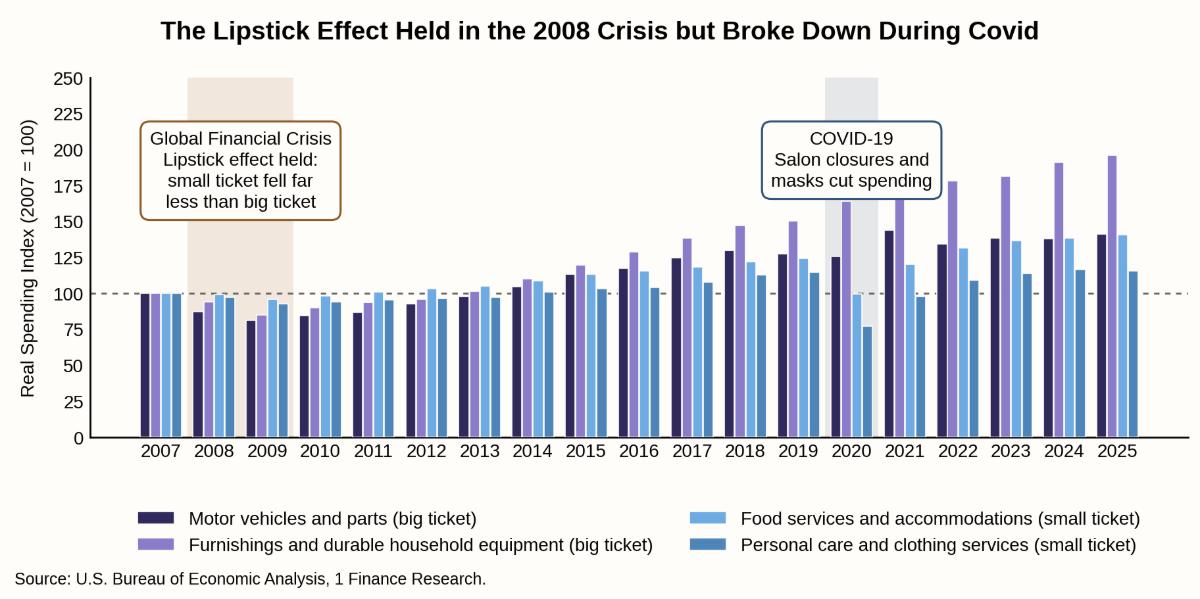
Households also move money around three ways: trading down to a cheaper version within a category, trading across to a different category altogether, or selectively trading up, spending more on one specific item while cutting elsewhere. That last one is premiumisation, skipping a ₹50,000 purchase but still paying ₹2,000 for a premium version of something else.
The sharpest form is selective premiumisation, the same household being price-sensitive on one line and aspirational on another, at once.
Recommended for you
Readers also explored
World GDP Breakdown 2025: Who Powers the Global Economy?
 8 min read
Nifty 50 Companies List 2025 : Top 50 Stocks in India
7 min read
Has the Lipstick Effect Happened in India Before
Once, clearly, in the 2019 consumption slowdown, and it broke in 2020.
In 2019, a shadow-banking credit squeeze and weak rural incomes hit car demand. Domestic passenger vehicle sales fell 12.7% in calendar 2019 to 29,62,052 units, and 18% between April and November 2019, according to SIAM. Over roughly the same stretch, Nykaa's revenue from operations grew about 59%, from ₹1,111 crore in FY2019 to ₹1,768 crore in FY2020, per its 2021 draft red herring prospectus.
The pandemic did the opposite. With masks and lockdowns, there was little reason to buy lipstick, and the category shifted to skincare. Nykaa still grew revenue 38% in FY2021, but that came from the move online rather than from small indulgences replacing big ones.
| India’s Lipstick Effect Has Varied Across Economic Shocks | |||
|---|---|---|---|
| Episode | Big ticket spending | Small indulgences | Lipstick effect? |
| 2019 slowdown | Passenger vehicle sales down 18% (April to November 2019) | Nykaa revenue up about 59% in FY2020 | Yes, broadly |
| 2020 pandemic | Sales fell across durables and travel during lockdowns | Make-up demand fell with the occasion to use it; skincare took its place | No, it broke |
| 2026 | Record car sales and a 14-year August high in Mumbai property registrations | Nykaa beauty GMV up 28%, HUL Beauty and Wellbeing up 12% | No, both sides grew |
Is the Lipstick Effect Taking Hold in India in 2026
Sentiment fits the story. Spending does not.
Since early 2026, the war in West Asia has lifted oil prices and pressured the rupee, which was near ₹95.9 per dollar in late September 2026. Retail inflation has risen for three straight months, from 3.93% in May to 4.82% in August 2026, with food inflation at 5.95%.
The RBI's July 2026 survey shows how households feel about that. Every current-conditions line got worse. The spending lines went the other way.
| Urban Households Felt Worse but Spent More on Non-Essentials in July 2026 | |||
|---|---|---|---|
| Net response (urban) | May 2026 | July 2026 | Change |
| Current Situation Index | 90.7 | 88.3 | Down 2.4 |
| General economic situation | -16.5 | -23.4 | Worse |
| Employment | -14.4 | -21.9 | Worse |
| Price level | -90.7 | -92.7 | Worse |
| Essential spending | 83.2 | 86.7 | Higher |
| Non-essential spending, current | -0.8 | 3.3 | Turned positive |
| Non-essential spending, one year ahead | 15.9 | 18.3 | Higher |
Note: Net response is the share reporting an increase minus the share reporting a decrease. Index equals 100 plus net response. Fieldwork ran from 11 to 20 July 2026 and covered 5,987 respondents in 19 cities. Rural confidence followed the same pattern, with the Current Situation Index at 91.7 and rural non-essential spending at 32.4.
Now, where the textbook story falls apart. Big-ticket categories are growing, not stalling.
| Both Big-Ticket and Small-Ticket Spending Grew in Mid 2026 | |||
|---|---|---|---|
| Category | Period | Year-on-year change | Type of spend |
| Passenger vehicles, domestic | August 2026 | +36.5% to 4,39,309 units | Big-ticket, GST-aided |
| Mumbai property registrations | August 2026 | +11% to 12,503 units | Big-ticket |
| Bank credit for housing | July 2026 | +11.3% | Big-ticket finance |
| Two-wheelers, domestic | August 2026 | +10.5% to 20,34,698 units | Mid-ticket |
| Nykaa beauty GMV | Q1 FY2027 | +28% to ₹ 4,105 crore | Small-ticket beauty |
| HUL Beauty and Wellbeing revenue | Q1 FY2027 | +12.4% to ₹ 4,083 crore | Small-ticket beauty |
| HUL Personal Care revenue | Q1 FY2027 | +3.3% to ₹ 2,624 crore | Everyday essentials |
Note: The August 2025 base for vehicles was depressed because buyers waited for the September 2025 GST rate cut. Mumbai registration data covers the area under the Brihanmumbai Municipal Corporation and includes resale transactions, and the August figure was compiled from the department's daily run rate. Housing credit measures borrowing, not home sales.
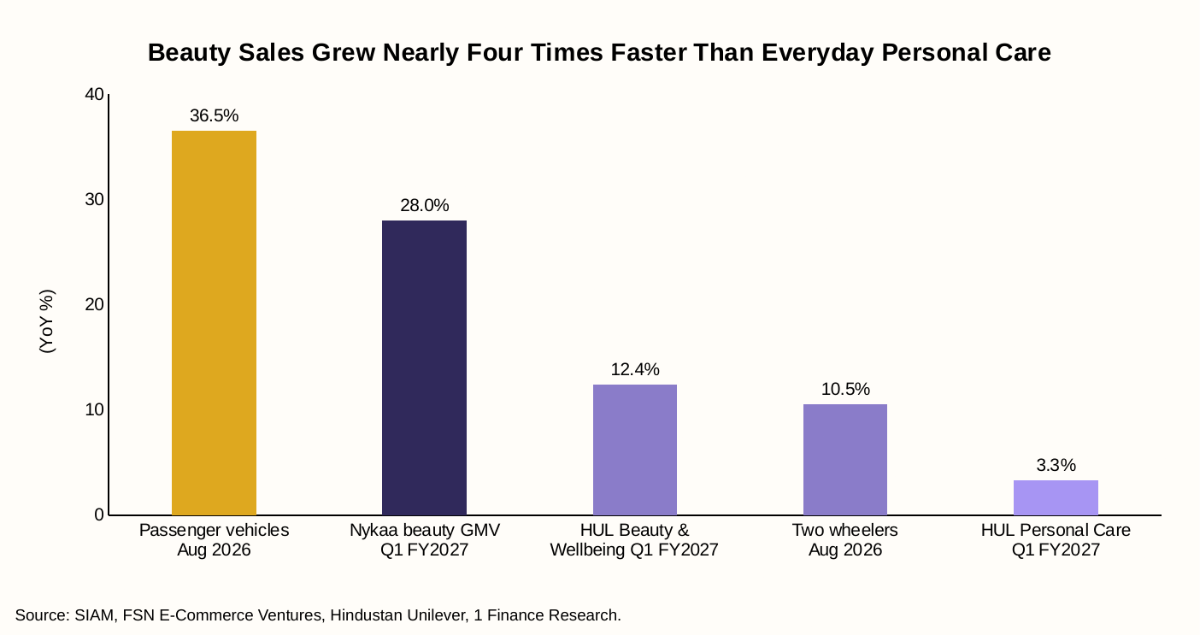
Three forces explain the big-ticket strength, and none of them is pent-up gloom. The September 2025 GST rate cut lowered vehicle prices, and the CPI item index for motor cars and jeeps was still 6.72% below a year earlier in July 2026. The repo rate sits at 5.25% after the 2025 cuts, so loans are cheaper. And the year-ago base was weak.
So the honest reading is this. Confidence has weakened, but households have not been forced to choose between a car and a lipstick. They bought both, because policy made the car cheaper.
Where Households Did Pull Back in 2026
The pull-back shows up where prices went up, not where the ticket size is large.
| Price Pressure Was Concentrated in Jewellery, Not in Beauty | ||
|---|---|---|
| CPI group | Year-on-year inflation, July 2026 | Versus headline 4.45% |
| Other personal effects, mainly jewellery and watches | 43.54% | +39.09 pp |
| Food and beverage serving services, eating out | 7.75% | +3.30 pp |
| Personal care | 2.24% | -2.21 pp |
| Purchase of vehicles | -4.37% | -8.82 pp |
| Motor car and jeep (item level) | -6.72% | -11.17 pp |
Gold is where the squeeze landed. Titan's jewellery revenue grew 39% in Q1 FY27, but the wider market tells a more measured story. World Gold Council data for the same quarter shows Indian jewellery demand fell 15% to 75 tonnes, the second-weakest April–June since 2000, even as spending rose 34% to ₹1.13 lakh crore. Buyers spent more rupees on fewer grams, shifting to lighter, lower-carat pieces, which is closer to trading down within an indulgence than splurging on one, but with buyer growth in the early double digits against average ticket sizes up in the high double digits. Spending rose because bills rose, not because many more people walked in.
Beauty prices, by contrast, were contained. The CPI personal care group rose 2.24% in July 2026, less than half headline inflation. A beauty order is still cheap in a year when a gold purchase is not.
What Is Really Driving Beauty Growth
If 2026 beauty growth is not the lipstick effect, what is it? Premium mix, owned brands and operating leverage, all of which show up in the margin line rather than in a sentiment survey.
| Nykaa Has Added About 2 Percentage Points of Gross Margin Since FY2025 | |||
|---|---|---|---|
| Period | Revenue (₹ crore) | Gross margin | EBITDA margin |
| FY2025 | 7,950 | 43.7% | 6.0% |
| FY2026 | 10,022 | 45.1% | 7.5% |
| Q1 FY2027 | 2,782 | 45.9% | 8.5% |
Three levers sit behind that. House of Nykaa, the company's owned brand portfolio, reached an annualised GMV of about ₹ 3,760 crore in Q1 FY2027, up 39%, with net sales value of ₹ 550 crore. Advertising income from brands paying for visibility carries almost no cost of goods. And premium brands make up a large share of platform sales, which lifts the average bill without lifting fulfilment costs much.
The shape of demand matters too. Nykaa's beauty orders rose from 54.5 million in FY25 to 65.8 million in FY26, about 21% growth, while beauty GMV grew faster at 27%, a sign that shoppers were spending more per order, not just ordering more often. The momentum carried into FY27: beauty GMV rose 28% year-on-year to ₹4,105 crore in Q1, which management credited to premiumisation. Growth came from more people buying more often rather than from bigger baskets. That is what small-ticket indulgence looks like in the data, whatever the macro backdrop.
| Beauty Earns HUL's Best Segment Margin | |||
|---|---|---|---|
| Segment | Revenue Q1 FY2027 (₹ crore) | Revenue growth | Segment margin |
| Home Care | 6,554 | +14.0% | Not disclosed separately |
| Beauty and Wellbeing | 4,083 | +12.4% | 27.6% |
| Foods | 3,480 | +6.8% | 19.9% |
| Personal Care | 2,624 | +3.3% | 19.7% |
One check keeps this honest. Home Care grew faster than beauty at HUL in the same quarter, its best in three years. The June quarter was a decent one for everyday consumption overall, so beauty's outperformance is real against jewellery and against everyday personal care, and much smaller against the rest of the consumer basket.
💡What this looks like in practice Consider a hypothetical Pune household that postpones an ₹80,000 gold jewellery purchase because prices are up more than 40% year on year. At Nykaa's FY2025 average beauty order value of ₹2,021, that amount would fund about 40 beauty orders. Even at the higher Q1 FY2027 average of ₹2,102, up 5% year on year, it would still cover about 38 orders. The household cuts the purchase that got expensive, keeps the one that did not, and buys the car that GST made cheaper. That is selective spending, not the lipstick effect. |
How Macro Stress Travels to Beauty Earnings
A thematic call only holds if each link from the macro shock to the profit line is traceable. For 2026, the chain runs as follows.
- The shock. The West Asia war lifts crude oil prices and pushes the rupee to about ₹ 96 per dollar by late September 2026.
- The squeeze. CPI inflation rises from 3.93% to 4.82% between May and August 2026, and urban households report worse job prospects, with the employment net response at -21.9 in July.
- The reallocation. Categories whose prices jumped, led by jewellery at 43.54% inflation, lose volume. Categories made cheaper by policy, led by vehicles, gain it.
- The beauty line holds. Urban non-essential spending turns positive, and Nykaa and HUL report their fastest growth in several quarters, led by premium products.
- Operating leverage. Revenue grows faster than fixed costs, so Nykaa's EBITDA rose 68% on 29% revenue growth in Q1 FY2027.
Two links can break. A weaker rupee raises the landed cost of imported premium brands, which squeezes retailer margins or forces price rises that test the affordable part of affordable luxury. And if job fears turn into job losses, small treats get cut too. The July survey shows employment sentiment worsening, so that is the link to watch.
What This Means for Investors and Advisors
For investors. Beauty and premium personal care are growing and converting that growth into margin, but 2026 does not prove they are defensive. Big-ticket spending grew alongside them. If you buy the category expecting downturn protection, you are paying for a property this cycle has not tested. Treat it as a premiumisation and online-shift story, check what growth rate the current price assumes, and compare the multiple with the market's before adding.
For advisors. Four conversations are worth having now.
- Clients who say consumption is dead. Show them the July 2026 RBI survey alongside August vehicle and property registration data. Sentiment fell, spending did not.
- Clients are heavy in gold. Jewellery inflation above 40% is doing the work in their returns, and Titan's own update shows buyer growth far below spend growth. Ask whether the allocation is a view on gold or an accident of price.
- Clients are chasing beauty stocks after a strong quarter. Separate the structural shift online and to premium from any cyclical story. The cyclical part is the weaker of the two.
- Clients are worried about the rupee. Imported premium brands carry currency risk. Companies with strong owned brands, such as House of Nykaa or HUL's Minimalist, are better placed than pure resellers.
What to Watch Next
- The RBI's September 2026 consumer confidence round. A further fall in the Current Situation Index with non-essential spending still positive would confirm that sentiment and spending have decoupled.
- Festive-season vehicle sales. Once the GST base effect fades, weaker car volumes alongside steady beauty sales would be the first real test of the lipstick pattern in this cycle.
- Nykaa's Q2 FY2027 results, expected in November 2026. Watch whether beauty GMV growth holds near 28% and whether gross margin stays near 46% as the rupee weakens.
- Gold and jewellery prices. If jewellery inflation cools, watch whether that spending returns and whether anything else gives way to fund it.
Conclusion
India in 2026 is not a lipstick-effect economy. Confidence has fallen, yet households bought record numbers of cars, registered more homes and spent more on beauty at the same time. The categories they cut are the ones whose prices ran away, above all jewellery. For portfolios, the useful conclusion is narrower than the headline. Beauty and premium personal care are good businesses with rising margins, and they should be owned for that, not for downturn protection this cycle has not demonstrated.