The rupee crossing ₹90 to the US dollar was more than a psychological milestone. It marked a sharper phase in a longer depreciation trend, with the currency moving from around ₹90.17 in January 2026 to a record low near ₹96.9 in May, before partially recovering to around ₹95.4 by August.
What makes the 2026 episode important is not just how far the rupee has fallen, but how quickly it moved and what drove the change. The rupee has weakened gradually at several points over the past six years, but it has also experienced sharper event-driven moves when oil prices, global risk sentiment and capital flows changed suddenly.
The question, therefore, is not simply why the rupee is near ₹95, but whether the recent depreciation reflects a manageable adjustment or a sign of deeper external pressure. This article examines the forces behind the rupee's decline, the impact on businesses and households, how the RBI has responded, and what investors should watch next.
India’s Historical Rupee Journey Through Key Economic Cycles
The ₹90 mark reads as a milestone, but it means more when you see the path that led to it. The table below traces the USD/INR through the COVID-19 shock, the post-pandemic recovery, the gradual slide from 2022 to 2025, and the sharper weakening of 2026. Watch the gaps between the dates, not just the levels. That is where the story sits.
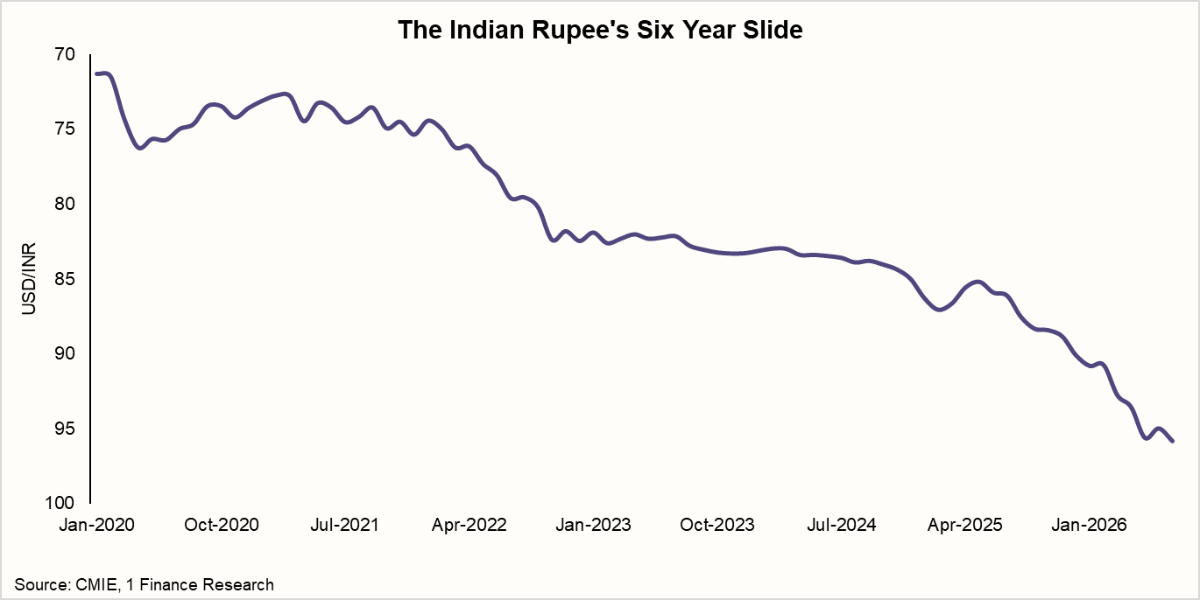
The table below highlights key movements in the USD/INR exchange rate from 2020 to July 2026, showing how the rupee moved through the COVID-19 shock, the post-pandemic recovery, the gradual depreciation during 2022–25, and the sharper weakening seen in 2026.
The rupee lost 24% against the dollar between March 2021 and July 2026
| Indian Rupee Exchange Rate Key Movements | ||
|---|---|---|
| October 2022 | ₹82.8 | |
| March 2020 | ₹76.2 | The rupee weakened sharply during the COVID-19 shock as global risk aversion rose and demand for the US dollar increased. |
| April 2020 | ₹76.7 | Pressure continued as the pandemic drove financial-market volatility and demand for safe-haven assets. |
| April 2021 | ₹74.9 | The rupee strengthened as global financial conditions improved and capital flows recovered. |
| March 2022 | ₹76.9 | The post-pandemic recovery lifted import demand, and global commodity and energy prices rose. |
| October 2022 | ₹82.8 | Russia–Ukraine war, elevated crude prices and aggressive Fed tightening increased dollar demand and pressured the rupee. |
| March 2023 | ₹82.7 | Depreciation continued amid high energy prices, global monetary tightening and a stronger US dollar. |
| March 2024 | ₹83.59 | The rupee held near ₹83 after the 2022 to 2023 slide. |
| March 2025 | ₹87.47 | Still under pressure, though stronger than its January and February levels that year. |
| December 2025 | ₹91.08 | The rupee crossed ₹90 for the first time. |
| January 2026 | ₹92.04 | It entered 2026 above ₹90 and kept weakening. |
| March 2026 | ₹94.6 | The pace of depreciation picked up. |
| May 2026 | ₹96.79 | A sharp move as external and market pressures built. |
| July 2026 | ₹96.5 | Close to its recent lows, with signs of stabilising. |
The pattern is two-speed. From ₹72.79 in March 2021, the rupee slid gradually to ₹82.99 by March 2024, roughly three rupees a year. Then it picked up, reaching ₹86.64 in March 2025, crossing ₹90 in December 2025, and jumping to ₹95.60 by May 2026.
That second phase is the one worth paying attention to. Five and a half rupees in five months is not the same event as ten rupees in three years, even though both show up as a falling line on a chart. Gradual depreciation is an economy adjusting to changing trade patterns, global interest rates and capital flows. A sharp move transmits straight into import bills, inflation and market sentiment before anyone can adapt.
The modest gap between May and July 2026, just 22 paise, suggests the sharp phase has paused. Whether it stays paused is the open question, and the rest of this piece works through what would decide that.
Recommended for you
Readers also explored

The Dollars Came In, The Rupee Kept Falling
 11 min read
India’s Unemployment Rate in 2025
7 min read
Why the Rupee Is Weakening
No single factor sets the rupee's level. The exchange rate reflects the balance between India's demand for dollars and the supply of dollars coming in. When demand outruns supply, the rupee falls. Five channels do most of the work, and the table below sets out how each one transmits and what it implies for USD/INR.
| Key Factors Driving Rupee Weakness | |
|---|---|
| Factor | Implication For The Rupee |
| Crude Oil Prices | • Higher crude prices increase India's import bill and demand for dollars. • This puts pressure on the trade and current account. • Higher oil prices can weaken the rupee, while stable or lower prices can support it. |
| US Dollar And Fed Policy | • Higher US interest rates make dollar assets relatively more attractive. • A stronger dollar can increase pressure on emerging-market currencies. • Higher-for-longer US rates can weigh on the rupee, while Fed easing could provide support. |
| India-US Rate Differential | • A narrower gap between Indian and US interest rates reduces the relative yield advantage of rupee assets. • This can make Indian assets less attractive to some foreign investors. • A narrower differential can add pressure on the rupee. |
| Capital Flows | • FPI inflows increase the supply of dollars and can support the rupee. • Outflows increase demand for dollars as investors convert rupees back into foreign currency. • Sustained inflows can support the rupee, while renewed outflows can accelerate depreciation. |
| Geopolitical Risk | • Geopolitical shocks can push investors towards the US dollar as a safe-haven asset. • At the same time, disruptions to oil supplies can raise crude prices and India's import costs. • This creates double pressure on the rupee and can trigger sharper movements in USD/INR. |
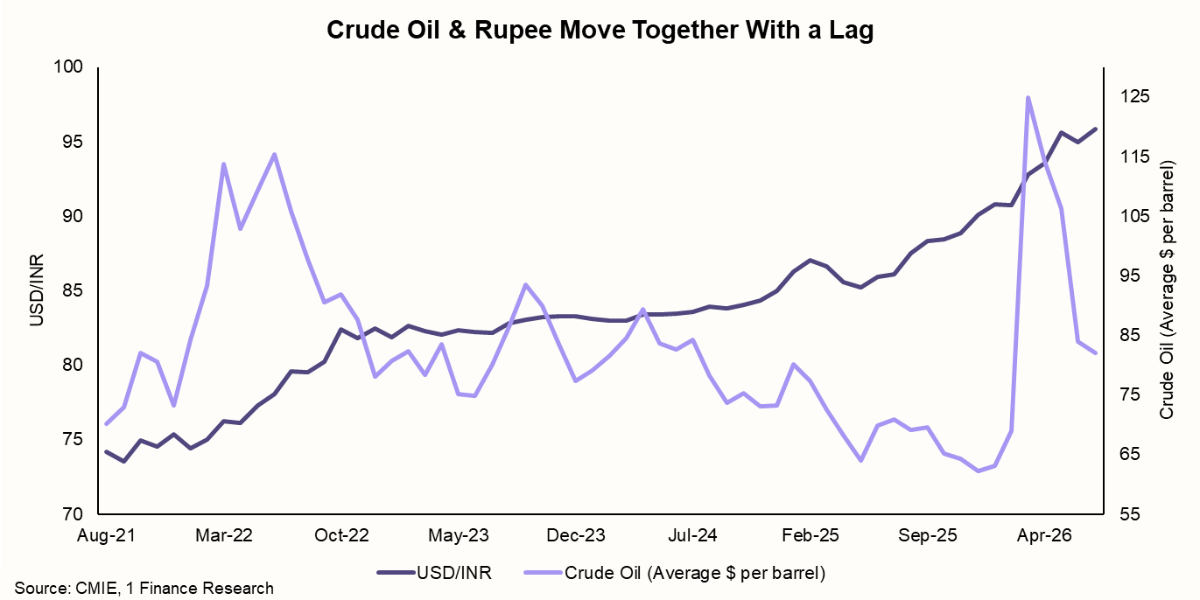
1. Crude Oil Is the Most Direct Channel
India imports roughly 85–89% of its crude requirement, so a sustained rise in oil prices translates almost mechanically into higher dollar demand. The Strait of Hormuz disruption in 2026 was the single biggest driver of the rupee's record low, and elevated crude remains the main upside risk to USD/INR from here. RBI research notes that higher oil prices weigh on the current account deficit and pressure the exchange rate.
2. The Dollar and the Fed
The second driver is the US dollar and Federal Reserve policy. When the Fed keeps interest rates high, US dollar assets become relatively more attractive compared with emerging-market assets. This can encourage global investors to shift capital towards the US, increasing demand for dollars and reducing support for currencies such as the rupee. As a result, a higher-for-longer Fed can add downward pressure on the rupee, while Fed easing can provide some relief.
The Federal Reserve's July 2026 meeting shows why this still matters. The Fed held its target range at 3.50% to 3.75% on a 9 to 3 vote and noted that inflation remained above its 2% goal.
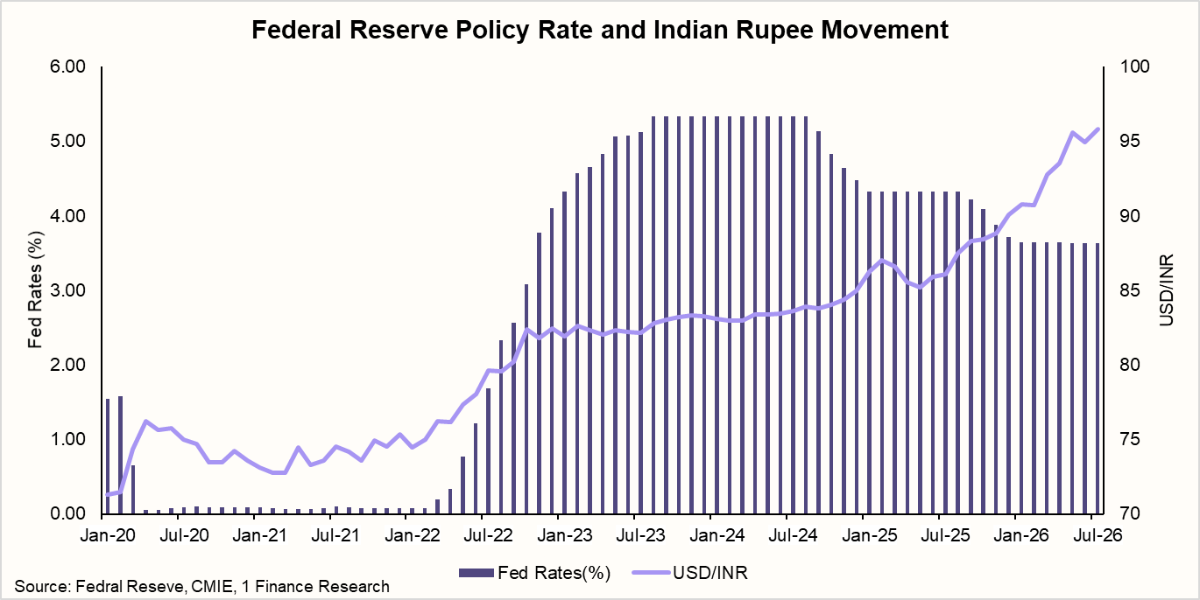
The chart shows this relationship during 2022–23: as the Fed raised rates sharply, the rupee weakened from around ₹76/$ to above ₹82/$. The Federal Reserve's July 2026 meeting shows why this still matters. The Fed held its target range at 3.50% to 3.75% on a 9 to 3 vote and noted that inflation remained above its 2% goal.
3. The India-US Rate Gap
Investors compare what they earn in India against what they earn in the US. If US rates stay high while Indian rates fall or hold, the yield advantage of Indian assets narrows.
Investors compare the returns available in India with those in the US. The rate gap depends on both central banks: when the Fed raises rates while the RBI holds or cuts its repo rate, the gap narrows; when the Fed cuts while the RBI keeps rates higher, the gap widens.
A narrower India–US rate differential reduces the relative yield advantage of Indian assets and can weaken support for the rupee, as investors have less incentive to hold rupee-denominated assets purely for the interest-rate advantage. Conversely, a wider gap can provide some support to the rupee.
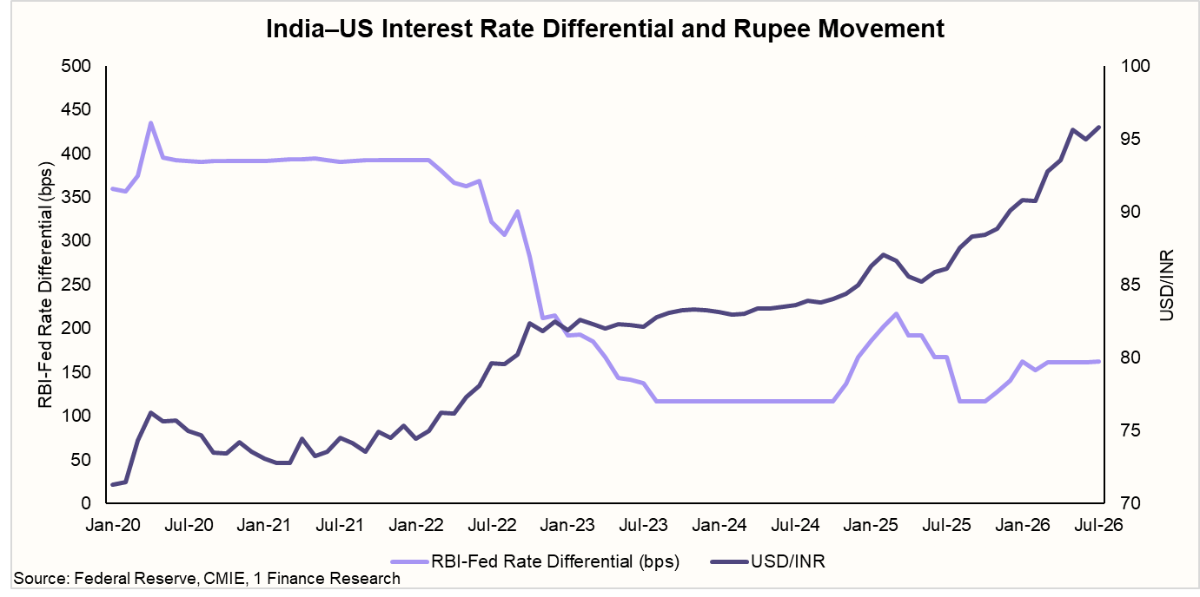
The chart shows this relationship over time. The India–US rate gap narrowed sharply from 2022 as the Fed raised rates and the RBI's rate increases did not keep pace initially. As the differential fell, the rupee weakened significantly against the dollar. The RBI held the repo rate at 5.25% in August 2026 with a neutral stance, against a Fed range of 3.50% to 3.75%.
4. Capital Flows Move Faster Than Trade
When foreign investors buy Indian shares or bonds, they bring in foreign currency and convert it into rupees. That adds dollar supply and supports the currency. Outflows do the reverse. Investors selling Indian assets convert rupees back into dollars, adding to the demand side. This is why the rupee can fall hard even when India's trade position has not changed at all. Capital flows transmit shifts in global risk appetite within days. Net foreign portfolio flows have been negative through most of 2026.
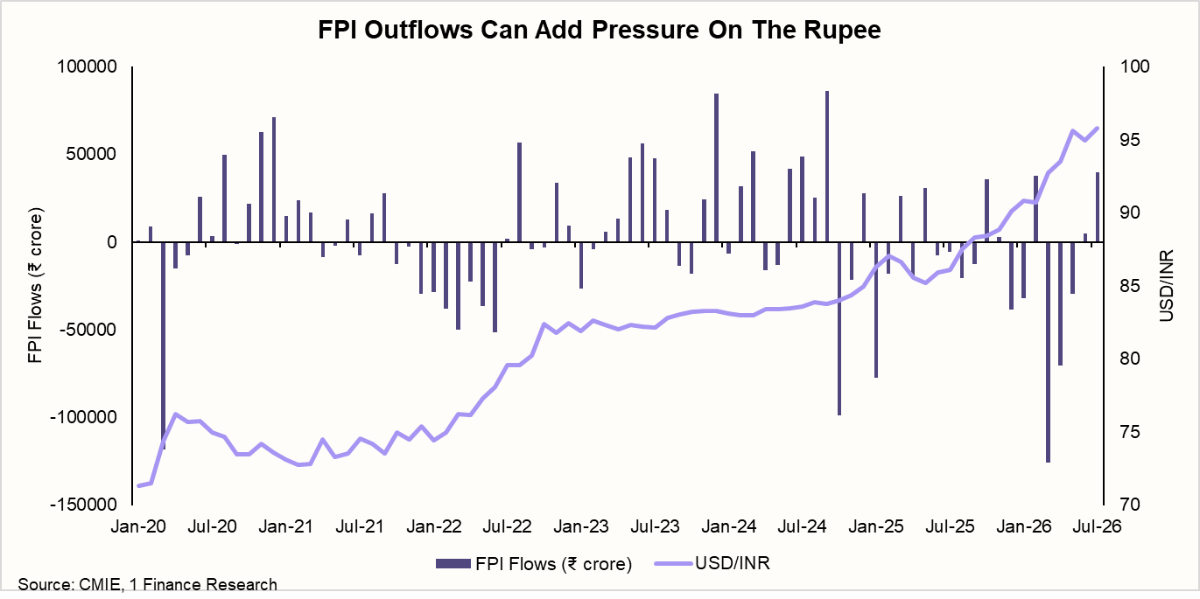
The chart shows this relationship: periods of heavy FPI outflows often coincide with sharper upward moves in USD/INR, particularly during 2025 and 2026. With net foreign portfolio flows remaining negative through much of 2026, sustained outflows have added to the pressure on the rupee.
5. Geopolitical Shocks Hit Both Sides at Once
A conflict pushes investors towards the dollar as a haven while supply disruption pushes oil prices up. For an oil importer that is under pressure from two directions at the same time, more dollars are needed to pay for imports and more dollars are bought as a safety trade. That is why geopolitical events produce sharper currency moves than ordinary shifts in trade or domestic activity.
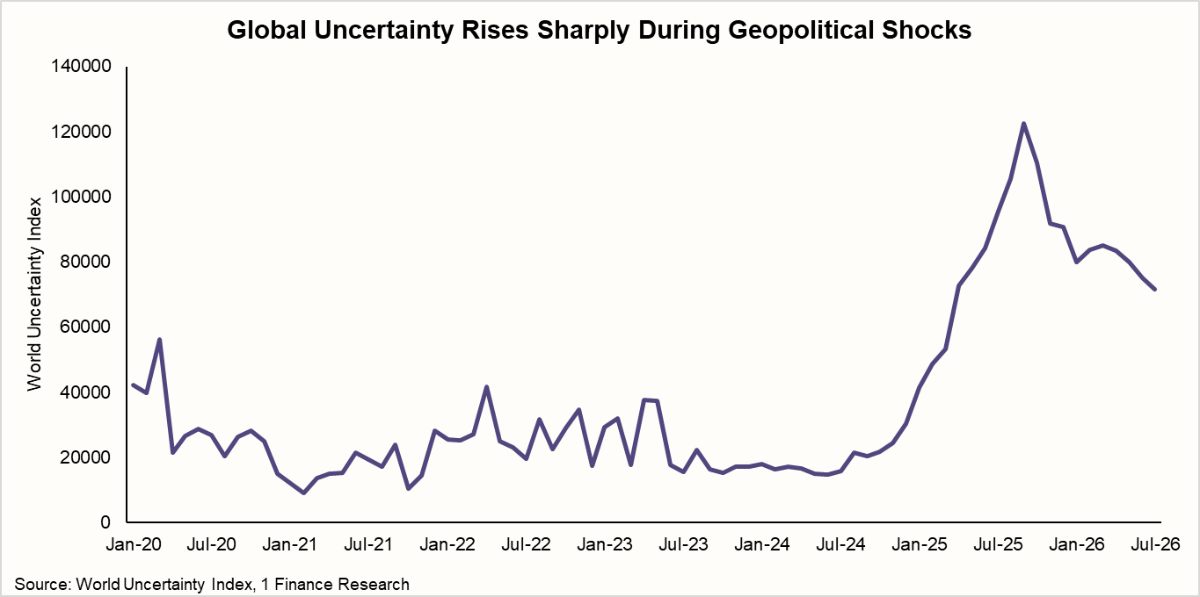
The chart shows that global uncertainty rose sharply through 2025, reaching its highest level around September, largely as US tariff and trade-policy tensions intensified. Geopolitical risks also added to the pressure, particularly the June 2025 Israel–Iran conflict, which raised fears of disruption to oil supplies and the Strait of Hormuz, pushing up energy-market risk. For India, these shocks matter because higher oil prices increase dollar demand for imports, while heightened uncertainty can simultaneously push investors towards the US dollar, creating additional pressure on the rupee.
How India's Trade Position Affects the Rupee
India buys far more goods from abroad than it sells, which creates a standing demand for dollars. The chart below shows imports and exports from FY20 to FY26 and how the gap between them has widened.
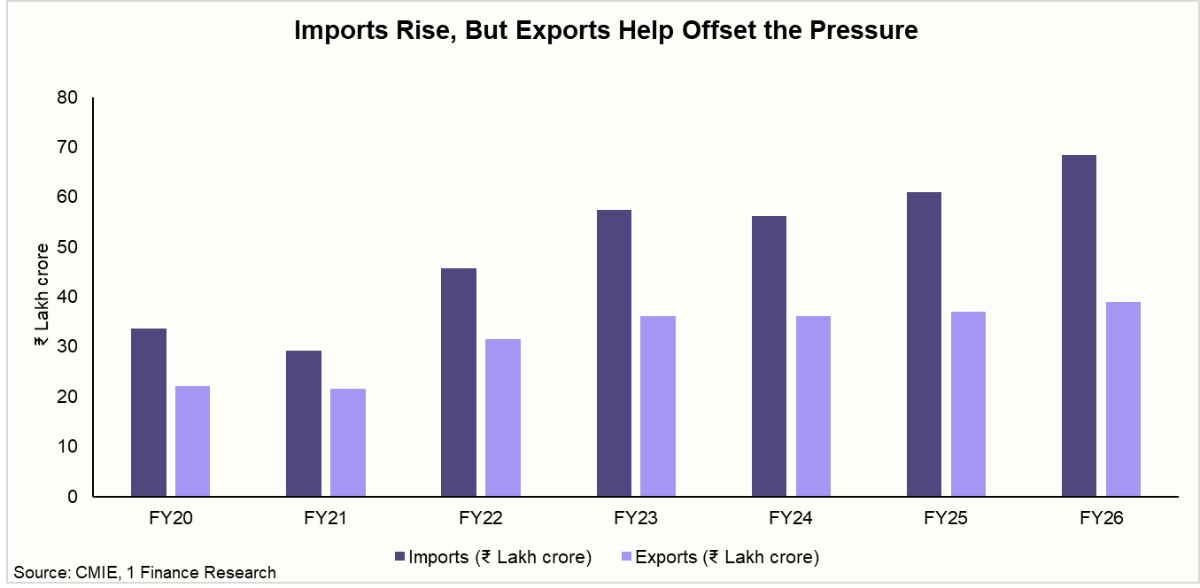
Imports rose from around ₹33.6 lakh crore in FY20 to ₹68.5 lakh crore in FY26, while exports rose from ₹22.2 lakh crore to ₹39.0 lakh crore. The gap widened from about ₹11.4 lakh crore to ₹29.5 lakh crore. Every rupee of that gap is a payment an Indian importer has to make in foreign currency.
The goods deficit does not translate into equal pressure on the rupee, because India earns a large amount of foreign exchange from services. In FY2025-26, goods exports were US$441.78 billion against goods imports of US$774.98 billion, a deficit of US$333.19 billion. Services exports reached US$418.31 billion against services imports of US$204.42 billion, a surplus of US$213.89 billion.
That services surplus covered around 64% of the goods deficit, leaving a combined shortfall of about US$119.30 billion. Add remittances and capital inflows, and the picture changes again. The rupee responds to the whole balance of foreign-exchange demand and supply, not the goods trade number on its own.
How a Weaker Rupee Affects the Indian Economy
A falling rupee is not bad news for everyone. What decides the outcome for any business is simple. Does it earn foreign currency, or does it spend it? Exporters convert the same dollar into more rupees. Importers pay more rupees for the same input. The table below sorts the major sectors by which side of that line they sit on.
| Impact of a Weaker Rupee Across Key Indian Sectors | ||
|---|---|---|
| Sector / Group | Foreign-Currency Exposure | Why It Matters |
| 🟢 IT Services | High export revenue; largely rupee-based costs | • Dollar revenues translate into more rupees • Can support margins when costs remain largely rupee-denominated • Benefit depends on the share of revenue earned overseas |
| 🟢 Pharmaceuticals | Significant export exposure | • Export revenues translate into more rupees • Indian products can become relatively more competitive overseas • Benefit can be reduced by imported APIs and other inputs |
| 🟢 Textiles & Garments | Export-oriented | • Indian exports can become more price-competitive • Can support overseas demand and export revenues • Benefit depends on imported raw-material exposure |
| 🟢 Engineering & Auto Components | Export revenues with some imported inputs | • Export revenues gain in rupee terms • Products can become more competitive globally • Imported components can offset part of the benefit |
| 🟢 Healthcare & Medical Tourism | Foreign-currency earnings from international patients | • Indian healthcare becomes relatively cheaper for overseas patients • Can support foreign-exchange earnings • Benefit depends on the share of international business |
| 🟢 Remittance-Receiving Households | Foreign-currency inflows | • Each dollar, dirham or pound converts into more rupees • Increases the rupee value of remittances received • Supports household purchasing power in India |
| 🔴 Oil & Energy | High dependence on imported crude | • Crude is largely dollar-priced • A weaker rupee raises the rupee cost of imports • Higher costs can feed into fuel prices and wider inflation |
| 🔴 Aviation | Significant dollar-denominated costs | • Aircraft leasing and maintenance costs are often dollar-linked • A weaker rupee increases operating costs • Higher costs may eventually be passed on through fares |
| 🔴 Electronics & Consumer Goods | High imported component / finished-goods exposure | • Imported inputs become more expensive in rupee terms • Companies may face margin pressure if costs cannot be passed through • Consumers may eventually face higher prices |
| 🔴 Students & Travellers Abroad | Foreign-currency expenses | • Tuition and accommodation become more expensive in rupee terms • Overseas travel and spending require more rupees • Household budgets may need to be adjusted |
The takeaway is that depreciation moves money around the economy rather than shrinking it. Exporters and remittance-receiving families gain. Import-dependent businesses and households with overseas spending pay for it.
How the RBI Is Keeping the Rupee in Check
The RBI does not defend a fixed level for the rupee. Its stated aim is to smooth volatility, which means slowing a move rather than reversing it. The tools below do that in layers, from direct dollar sales to rules that make it harder to bet against the currency.
| How the RBI Manages Rupee Volatility | |
|---|---|
| Tool | How it works |
| Spot-market dollar sales | The RBI sells dollars from reserves to meet excess demand, then sterilises the rupee impact through open market operations so domestic rates do not spike. |
| Forex swap auctions | The US$5 billion buy sell swap run in May 2026, as the rupee neared its low, injects or absorbs rupee liquidity without permanently changing reserves. |
| Interest rate and liquidity policy | Higher rates or a tighter liquidity corridor make it costlier to borrow rupees in order to short the currency. |
| Pre-market and NDF intervention | Selling dollars before the market opens, and curbing offshore non-deliverable forward trading, breaks negative sentiment loops. |
| Special dollar window for oil companies | Oil marketing companies buy dollars directly from the RBI or state banks instead of the open market, which avoids sudden demand spikes. |
| Capital flow measures | Easier external commercial borrowing and FPI norms, promotion of rupee-denominated Masala Bonds, and a 2026 cap on banks' net open forex position at US$100 million a day. |
| NRI deposit mobilisation | Special deposit windows, echoing the 1998 Resurgent India Bonds and the 2013 FCNR(B) scheme, draw in NRI dollar liquidity during stress. |
💡 The NRI window has pulled in nearly US$52 billion In June 2026, the RBI opened a special USD-INR swap facility letting banks raise fresh FCNR(B) deposits with a three- to five-year tenor, alongside external commercial borrowing and overseas foreign currency borrowing. As of 13 August 2026, the facility had mobilised US$56.846 billion, of which US$52.300 billion came through FCNR(B) deposits alone. That is roughly the size of a quarter's oil import bill, raised in ten weeks. |
Three Paths the Rupee Could Take From Here
The scenarios below are 1 Finance Research estimates, not forecasts. They reflect how the five drivers could interact over the next six to twelve months, and the probabilities are our own judgement rather than a market-implied number.
| Where Could The Rupee Head Next? | |||
|---|---|---|---|
| Scenario | Range (USD/INR) | Probability | What would drive it |
| Weakens further | ₹97 to ₹101 | 35% | Higher oil and renewed Middle East escalation lift India's dollar demand. Sustained FPI outflows, high US yields or a hawkish Fed add to it. |
| Stays weak or range-bound | ₹92 to ₹97 | 45% | Elevated oil, geopolitical uncertainty and high US yields keep pressure on, while RBI intervention and manageable capital flows cap the volatility. |
| Strengthens meaningfully | ₹88 to ₹92 | 20% | Lower crude and easing Middle East tensions cut dollar demand. A softer US dollar, Fed easing and stronger FPI inflows improve supply. |
What This Means for You
- If you travel abroad, flights, hotels and overseas spending are largely dollar-priced, so the same trip costs more in rupee terms than it did a year ago. Budget from the current rate, not the one you remember.
- If you are funding education overseas, this is the biggest household hit. Tuition, hostel and living costs all rise in rupee terms, and across a multi-year degree that can add lakhs of rupees to the total. Some families are revisiting loan sizing or the destination country.
- If you buy imported goods, electronics, smartphones, imported cars and some medical equipment cost more as importers pass on higher rupee costs. It shows up gradually in retail prices rather than overnight.
- If you fill fuel, crude is dollar-priced, so a weaker rupee lifts fuel costs, and that flows into transport, logistics and the price of a lot of everyday goods.
- If you hold international funds, a weaker rupee raises the rupee value of those holdings. The currency move that hurts your travel budget helps this part of your portfolio.
The Factors to Watch Before the Rupee's Next Move
Four things will decide the near-term path.
- Oil and the Strait of Hormuz is the biggest wildcard. If the situation stays contained, the stabilisation since May likely holds. A fresh escalation could push the rupee back towards its May low or past it.
- The Fed's next move. A hold, which is what is currently signalled, keeps the dollar firm and the rupee under mild pressure. A pivot towards cuts would ease it, but that is not the base case today.
- Foreign portfolio flows are the most volatile input and the hardest to call. A few billion dollars of outflow in a bad month moves the currency more than a quarter of trade data does.
- India's export engines, meaning IT, pharma, engineering and remittance inflows, provide a steady offsetting current. That is the main reason the current account deficit has stayed contained through all of this.
Put together, the drivers point towards continued mild pressure rather than either a sharp new leg down or a strong rebound. The RBI's own posture, holding rates and intervening to smooth rather than reverse, says it is not fighting for a stronger rupee, only for an orderly one. A repeat of the May 2026 spike is possible, but it would most plausibly need a fresh and specific shock rather than a continuation of what is already in place.
Conclusion
The rupee crossing ₹90 is a milestone, not a threshold. Its significance depends entirely on what sits behind it, and right now that is a mix of high oil, firm US rates and negative portfolio flows, offset by reserves, a large services surplus and steady remittances. Those buffers are why this is a difficult stretch rather than a crisis. They are also why the sensible response is to plan around a weaker rupee rather than to wait for the old one to come back.