The MPC meets on 7 October, and most economists now expect the first repo hike since February 2023. A 25 basis point move would take the repo to 5.50% and bring a 125 basis point easing cycle to a close.
For the markets, the MPC meeting is mostly a formality. The 10-year G-sec averaged 7.03% in September, up 53 basis points over the year and 21 basis points in the last month alone. In just three weeks, the RBI has drained a record liquidity surplus from ₹11.16 trillion to ₹4.66 trillion through Variable Rate Reverse Repo (VRRR) auctions, bond sales and currency swaps. Bond markets and the central bank's own operations have tightened ahead of the MPC.
So whether the RBI hikes is the smaller question. The bigger ones are how far this cycle runs and how quickly it reaches the three places clients will feel it: their home loan EMIs, their fixed deposits and their debt funds.
What Pushes the RBI to Move and What Holds It Back
This decision is closer than it looks. The case for holding rates is more than routine caution, so we weigh both sides one factor at a time before making our call.
| Five of Seven Factors Point to a Hike | ||
|---|---|---|
| Factor | Why it matters | Suggests |
| Retail inflation | CPI has climbed from 0.04% in October 2025 to 4.82%, and has been above the 4% target for three months. Core inflation, which excludes food and fuel, has also risen to 4.3%, so the pressure is spreading | Hike |
| Wholesale prices | WPI is at 9.92%, twice the retail rate. Businesses are paying much more for inputs and will pass some of that on to consumers | Hike |
| Rupee | The rupee is near 96 per dollar, down about 5% since late February, and the early September recovery has already reversed | Hike |
| Liquidity | Banks still hold ₹4.66 trillion of surplus cash, keeping short-term rates below the repo and weakening the RBI's control over them | Hike |
| US rates | The Fed raised rates on 16 September and signalled more, which makes Indian assets less attractive to foreign investors | Hike |
| Growth | GDP is growing at 7.8%, but a rate hike on top of an oil shock could slow demand | Pause |
| Past reversal | In 2018, the RBI hiked twice and reversed both within months. It will want to avoid repeating that | Pause |
We expect the RBI to raise the repo rate by 25 basis points in the October meeting, and the rupee is what tips the decision. Defending the currency by selling dollars from reserves is costly when US rates are rising, and it rarely works for long. A rate hike makes that defence more convincing.
Liquidity Is Still in Surplus and That Blunts the Hike
The RBI created most of today's liquidity itself to defend the rupee. Its FCNR(B) swap window, opened in June, drew $133 billion of deposits. Every dollar banks swapped to the RBI came back as rupees, and the surplus peaked near ₹11 trillion in early September.
September has gone into draining the surplus, using three tools that work over different time frames:
- VRRR auctions absorb cash for a day to a week at 5.24%. The money returns when each auction matures, so they hold the surplus down rather than remove it.
- OMO bond sales remove cash permanently. The RBI is selling ₹1 trillion of government bonds in three tranches, which also adds to upward pressure on yields.
- Dollar swaps of at least $10 billion take out rupees for one to six months while supporting the currency.
Recommended for you
Readers also explored

A Mid-Year Check: Whether India is in Flux
 4 min read

Nifty 50 Companies List 2025 : Top 50 Stocks in India
7 min read
The drain was sharpest between 15 and 21 September, when the surplus fell from ₹9.85 trillion to ₹4.92 trillion. It stood at ₹4.66 trillion on 29 September. Without these operations, it could have reached ₹15.5 trillion.
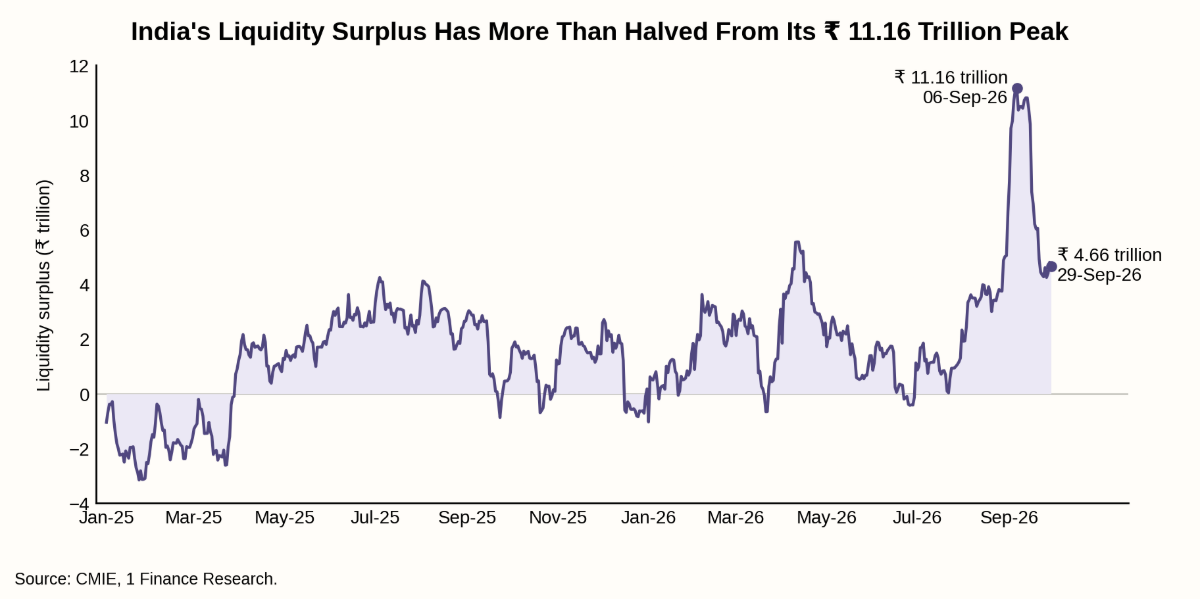
Even after the drain, a ₹4.66 trillion surplus is large. With banks holding more cash than they need, the overnight call rate has traded below the repo, at 5.16% in early September against a 5.25% repo. A 25 basis point hike raises the whole corridor, taking the floor to 5.25% and the repo to 5.50%. But while the surplus stays this big, short-term rates will keep trading below the new repo, and the hike will only partly reach the money market until the RBI drains further.
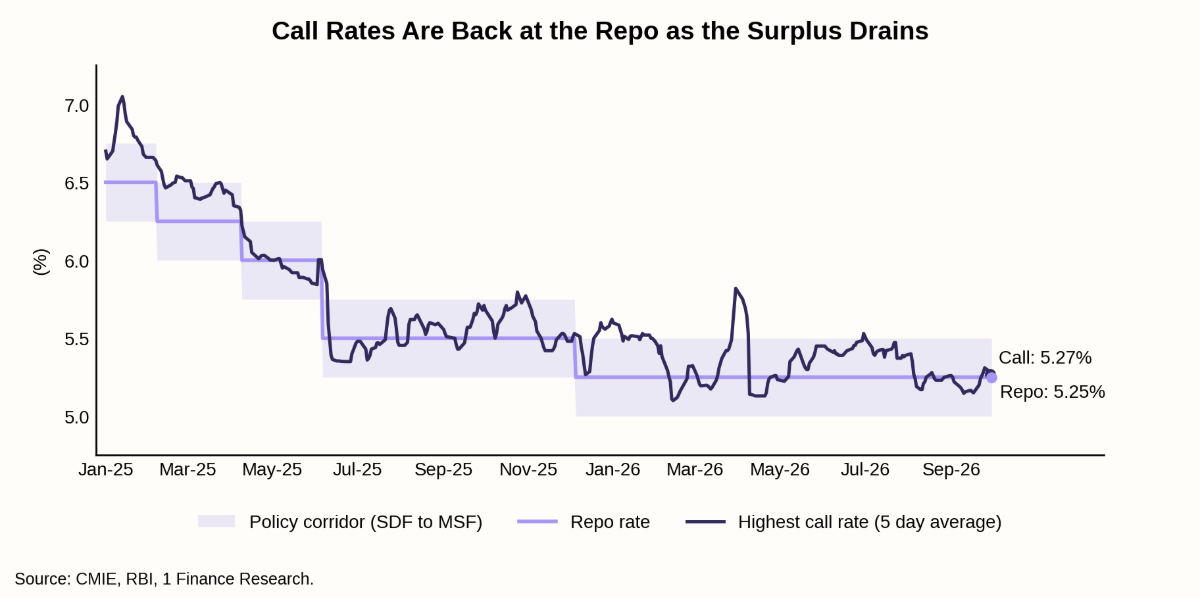
The rupee sits at the centre of this. A surplus pushes rates down and makes betting against the rupee cheaper. A hike, together with continued draining, raises that cost, and dollar-rupee swap rates are already up about 20 basis points. The risk is that bond yields and bank funding costs rise with it.
The swaps also leave a bill for later. When the FCNR(B) deposits mature, banks return rupees and take back dollars, draining liquidity and adding dollar demand from 2027 onward.
The Wholesale Inflation Says This Is Not a One Hike Cycle
The consensus after October is modest. Twenty-nine of 53 economists expect a second hike by December, with the repo then holding at 5.75% until mid-2028.
We think that understates the pressure. WPI inflation rose to 9.92% in August against CPI of 4.82%, a gap of more than five percentage points between what producers pay and what households pay.
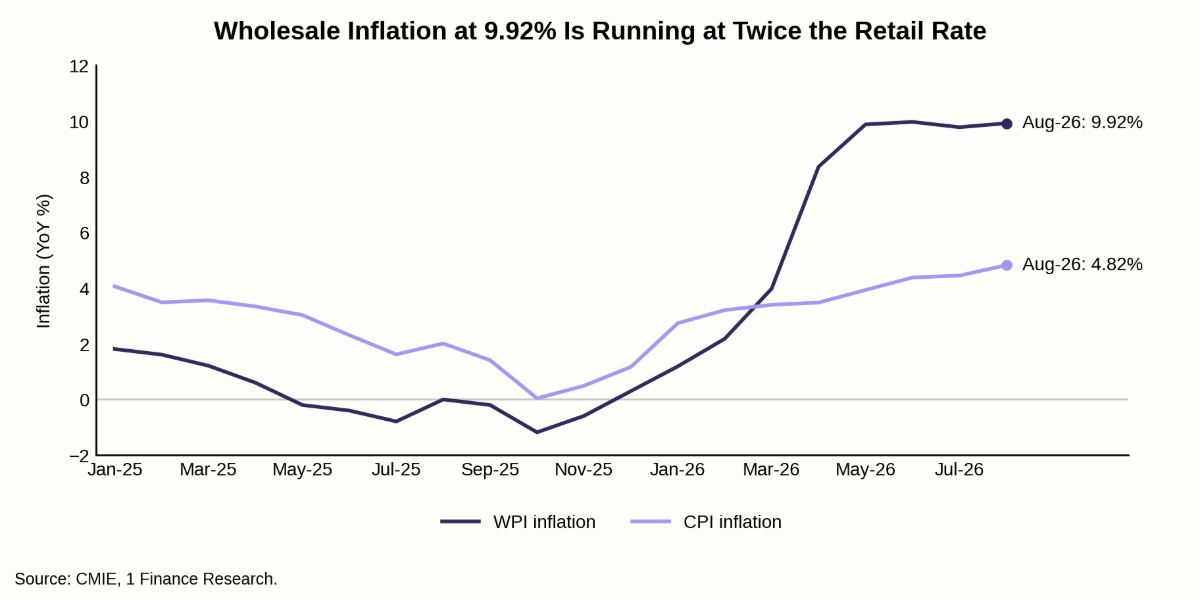
That gap closes only if crude falls and the rupee stabilises, or if costs pass through to retail over the next two to three quarters. Margins can absorb some of it, but not five points.
Globally, the Fed has hiked to 3.75% to 4%, and US 10-year yields sit near 5.23%. India is following this turn, late, with a currency that has already paid for the delay. We flagged the end of global easing as a High impact risk on our Risk Radar in August. It has now arrived.
The next question is how much of this cycle reaches clients, and how fast.
Rate Hikes Travel Further Than Cuts
A repo move doesn't reach every client equally. How much passes through depends on the loan's benchmark, the bank's funding costs and when the rate resets.
| How Different Interest Rates Respond to Repo Rate Hikes and Cuts | |||||
|---|---|---|---|---|---|
| Rate | What it Represents | Tightening Cycle (Apr 2022 → Feb 2023) +250 bps | Transmission | Easing Cycle (Jan 2025 → Dec 2025) -125 bps | Transmission |
| EBLR (External Benchmark Lending Rate) | Loans directly linked to the RBI repo rate | +250 bps | 100% | −100 bps | 100% |
| 1-year MCLR (Marginal Cost of Funds based Lending Rate) | Loans linked to the bank’s cost of funds | +120 bps | 48% | −55 bps | 44% |
| WALR – Fresh Loans (Weighted Average Lending Rate) | Average lending rate on newly sanctioned loans | +173 bps | 69% | −105 bps | 84% |
| WALR – Outstanding Loans (Weighted Average Lending Rate) | Average lending rate on existing loans | +95 bps | 38% | −81 bps | 65% |
| Fresh Deposit Rate | Interest rate offered on new term deposits | +222 bps | 89% | −95 bps | 76% |
| Outstanding Deposit Rate | Interest paid on existing term deposits | +99 bps | 40% | −41 bps | 33% |
The tightening cycle shows that new money reprices much faster than existing money. Fresh deposits and fresh loans respond relatively quickly, while rates on outstanding deposits and loans adjust more gradually. This creates a lag between the policy move and its full impact on the banking book.
The easing cycle reveals another feature: lower policy rates do not immediately translate into lower funding costs across the system. Deposits already raised at higher rates remain on banks' books, limiting how quickly lending and deposit rates can reset.
Home Loans Reprice First
A client with a home loan will feel this hike before anyone else.
By March 2026, 67.6% of outstanding floating-rate bank loans were linked to an external benchmark (EBLR), up from 61.7% in March 2025. EBLR loans must reset at least once every three months. A repo hike on 7 October will therefore reach most floating-rate borrowers by January, or sooner.
| Loan Details (Illustrative Example) | |
|---|---|
| Inputs | Value |
| Outstanding principal | ₹ 50,00,000 |
| Current interest rate | 8.50% |
| Revised interest rate | 8.75% (+25 bps) |
| Tenure | 240 months (20 years) |
The conversation to have before the resets land is whether to absorb a higher EMI or extend the tenure. Most banks extend tenure by default, which keeps the EMI flat but costs far more in total interest.
| How a 25 bps Hike Affects Home Loans (Illustrative Example) | |||
|---|---|---|---|
| Loan Details | Existing loan (8.50%) | Higher EMI, Same Tenure | Extend Tenure, Same EMI |
| EMI | ₹ 43,391 | ₹ 44,186 (+₹ 795) | ₹ 43,391 (Lowest EMI) |
| Tenure (months) | 240 | 240 | 253 |
| Total interest | ₹ 54.14 lakh | ₹ 56.05 lakh | ₹ 59.53 lakh |
| Change in total interest | – | +₹ 1.91 lakh | +₹ 5.40 lakh |
Deposit Advice Now Runs Opposite to the Last Two Years
Through the easing cycle, the right call on a maturing deposit was to lock in a long tenor before rates fell further. That advice is now backwards.
Fresh deposits captured 97% of the last hiking cycle, while outstanding deposits captured 75%, and only as they matured. A client who locks a five-year FD this month at a card rate of around 6.5% fixes the entire position at the bottom of the cycle. If the repo reaches 6.25% by the end of FY27 and deposit rates follow with their usual lag, that FD will look expensive by spring and stay that way until 2031.
Better positioning is short tenors, rolled at maturity, so the client captures each reset as it happens. Laddering still works, but the rungs should be shorter than they were a year ago.
Clients who find this uncomfortable should know where the real payoff lies. Our Debt Market Outlook found that savers do best in the pause after a hiking cycle, when rates are high and stable.
| The Pause After a Hiking Cycle Has Paid Savers Almost Twice as Much | ||
|---|---|---|
| Category | Hiking cycle (2022–2023) | Pause (Feb 2023–Feb 2025) |
| Liquid funds | 4% to 5% | 7% |
| Short duration funds | 4% to 5% | 8% |
| Dynamic bond funds | 4% to 5% | 9% |
Staying short through the hikes is what leaves a client with capital free to lock in when the pause arrives.
Debt Funds Have Already Taken Most of the Hit
Debt funds are where the transmission story runs the other way, and why we have favoured carry over duration all year.
The repo fell 125 basis points through the easing cycle. The 10-year G-sec fell only about 45 basis points, bottoming at 6.30% in May 2025 and turning higher while the RBI was still cutting. The long end trades on government supply, global yields and the rupee more than on the policy rate.
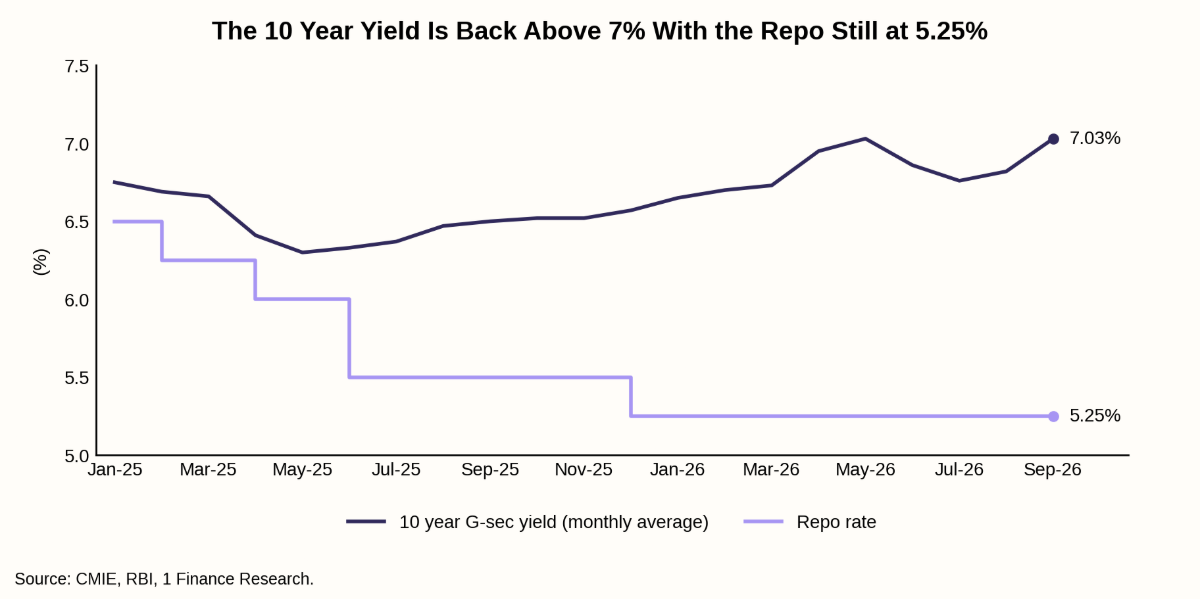
It has also moved ahead of the MPC. The 10-year averaged 7.03% in September, up 53 basis points over the year, with the repo unchanged since December. Debt funds price their bonds at current market rates every day (mark-to-market), so when yields rise, bond prices and the fund's NAV fall right away, and long duration funds fall the most.
The 3- to 5-year segment offers a reasonable real return with far less rate sensitivity. At the 30% slab, a 7.5% debt fund return falls to roughly 5.2% after tax, so the carry has to be genuinely high to beat a well-laddered deposit.
2018 Shows How Fast a Currency-Driven Cycle Can Reverse
In 2018, the RBI faced a weakening rupee and rising oil prices, and hiked 25 basis points in June and again in August, taking the repo to 6.50%. The external pressure then faded. The RBI cut in February 2019 and again in April, reversing the full 50 basis points within eight months of the last hike.
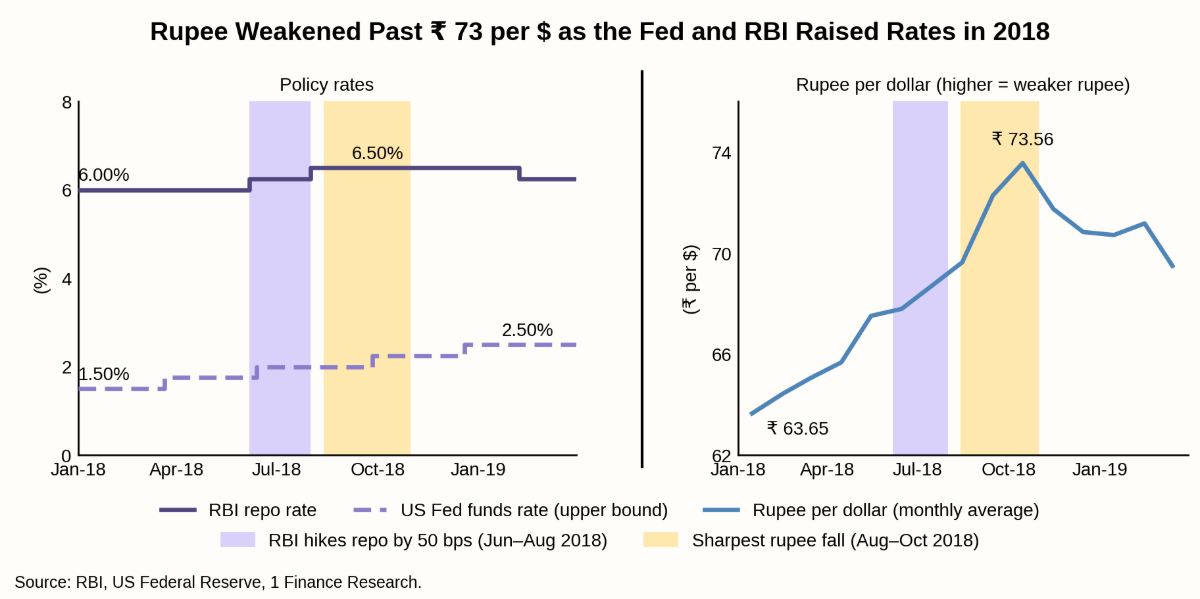
The two episodes differ in important ways. Price pressure today is far heavier, and the Fed is at the start of its hiking cycle rather than the end. Only the rupee has moved less so far.
| The 2026 Pressures Are Stronger Than the Ones That Reversed in 2018 | ||
|---|---|---|
| 2018 cycle | 2026 today | |
| Trigger | Weak rupee, rising oil | Weak rupee, oil above $100, Fed hikes |
| Repo before hikes | 6.00% | 5.25% |
| Hikes delivered | 50 bps (June, August) | 25 bps expected on 7 October |
| WPI inflation at peak | 5.8% (June 2018) | 9.92% (August 2026) |
| CPI inflation at first hike | 4.9% | 4.82% |
| Rupee move | 12% fall, January to October 2018 | 6% fall this year |
| Fed | Fourth year of hiking | First hike in three years |
| Outcome | Fully reversed by April 2019 | - |
Still, the shape is familiar. A cycle driven by a currency and an oil shock can unwind quickly once the shock passes, and ours is no exception.
That argues for keeping fixed income positioning flexible. Short tenors, rolling deposits and carry over duration all work whether this cycle stops at 5.75% or reverses next year. Positions that only pay off if rates keep rising are as fragile as the ones that needed them to keep falling.
What Advisors Should Do Before the Resets Land
| Area | Key takeaway |
|---|---|
| RBI decision | A 25 bps hike on 7 October is our base case, with a second likely by December |
| Bond markets and liquidity | Markets have moved ahead of the RBI. The 10-year G-sec averaged 7.03% in September, and more than half of a record ₹11.16 trillion liquidity surplus has been drained in three weeks |
| Home loans | EMIs will rise by January. Paying the higher EMI costs far less than extending the tenure |
| Fixed deposits | Keep new deposits short and lock in only once the hiking cycle pauses |
| Debt funds | Favour the 3 to 5 year segment. The long end has already taken most of the hit |
| Overall positioning | Stay flexible. The 2018 hiking cycle reversed within eight months, so positions should work whether rates stop at 5.75% or turn lower next year |
October’s MPC decision will make headlines, but bond yields and liquidity have already done much of the tightening. What matters now is how quickly the hike reaches clients' loans, deposits and funds, and how prepared they are when it does.
Our advice is simple. Pay down floating-rate debt where possible, keep deposits short and debt funds in the 3 to 5-year range, and stay flexible enough to lock in higher rates once the cycle pauses.