India's insurance reset is changing four parts of the business at once: policyholder protection, affordability, ownership and distribution economics.
The changes began with IRDAI's product and policyholder framework in 2024, followed by zero GST on individual life and health insurance from 22 September 2025. The Insurance Laws Amendment Act took effect on 5 February 2026, raising the foreign-ownership ceiling to 100% and reducing the capital requirement for foreign reinsurers. The corresponding FEMA rules were notified on 2 May 2026. On 23 September 2026, IRDAI proposed further changes to distribution costs.
Why does this matter beyond the policyholder?
Indian insurers already managed ₹74.44 lakh crore of investments as of March 2025. The reforms could influence how much new premium enters that pool, how long policies remain in force, how much capital insurers can deploy and how efficiently insurance is distributed.
What IRDAI Changed Between 2024 and 2026
India's insurance market has grown, but insurance protection remains relatively shallow. The reform agenda addresses several structural issues at once: customer protection, affordability, access to capital, reinsurance capacity and distribution economics.
| India Insurance Reforms | ||||
|---|---|---|---|---|
| Date | Reform | Before → After | Why it changed | How it works / who it affects |
| 2024 | Policyholder & product rules | Health moratorium: 8 years → 60 months | Strengthen policyholder protection | Clearer product and service rules |
| 22 Sep 2025 | Goods and Services Tax (GST) on individual insurance | 18% → 0% for individual life and health, including family floaters | Improve affordability | Removes GST from eligible retail premiums |
| 5 Feb 2026 | Foreign ownership | 74% → 100% Foreign Direct Investment (FDI) | Attract capital and global expertise | Expands scope for foreign equity and underwriting capacity |
| 5 Feb 2026 | Foreign reinsurance capital | Minimum Net Owned Funds (NOF): ₹5,000 crore → ₹1,000 crore | Lower reinsurance entry barriers | Makes entry easier for foreign reinsurers |
| 5 Feb 2026 | Share-transfer approvals | IRDAI approval threshold: 1% → 5% | Reduce ownership-transfer friction | Greater flexibility for qualifying share transfers |
| 2 May 2026 | FDI operating framework | 74% → 100% automatic route, subject to conditions | Operationalise the new FDI regime | Enables higher FDI under Foreign Exchange Management Act (FEMA); LIC remains capped at 20% |
| 23 Sep 2026 | Distribution economics | Existing Expenses of Management (EoM) framework → proposed tighter EoM and commission limits | Address distribution costs and incentives | Could improve cost efficiency and customer value; proposal only |
The common thread is not simply deregulation. The reforms try to make insurance easier to buy, easier to distribute, easier to capitalise and easier to scale. The harder question is whether those changes produce policies that stay in force and generate sustainable returns.
💡Did you know?
From 26% to 100% in 11 years: India progressively opened its insurance sector to foreign capital, with the latest reform allowing 100% foreign investment. |
Where India's Insurance Money Actually Goes
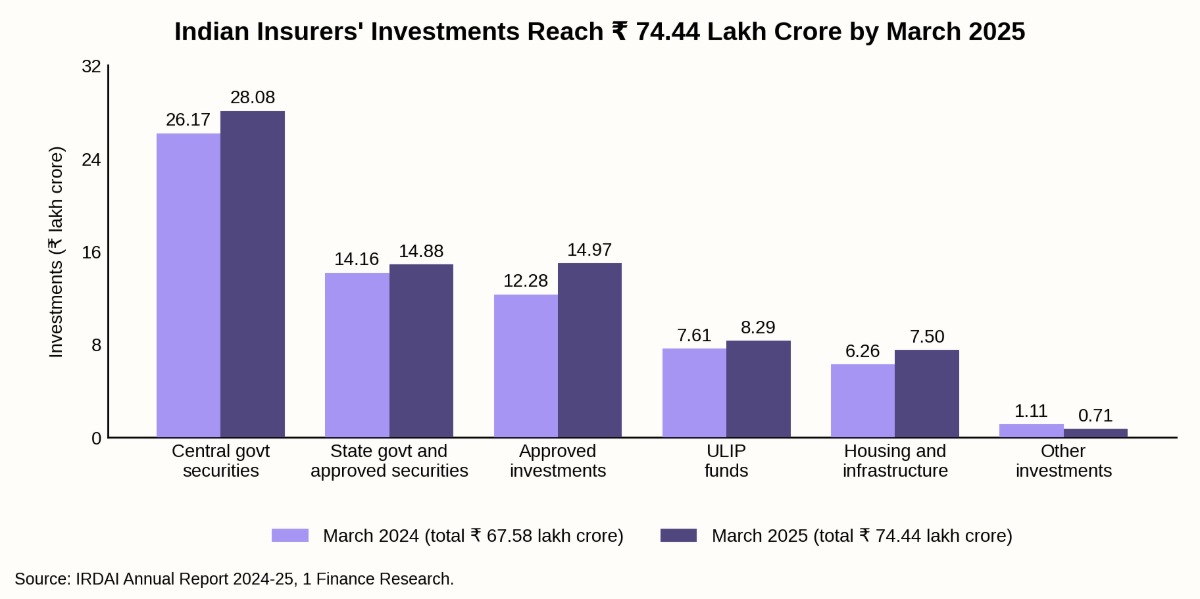
Indian insurers managed investments of ₹74.44 lakh crore at the end of March 2025, 10.14% more than a year earlier. Life insurers held 91.07% of it.
In the chart below, look at two things. Government securities form the two tallest groups. The approved investments bucket, which includes corporate bonds and listed equity, grew fastest at 21.9%.
But the size of the investment pool tells only half the story. The underlying insurance market remains relatively shallow.
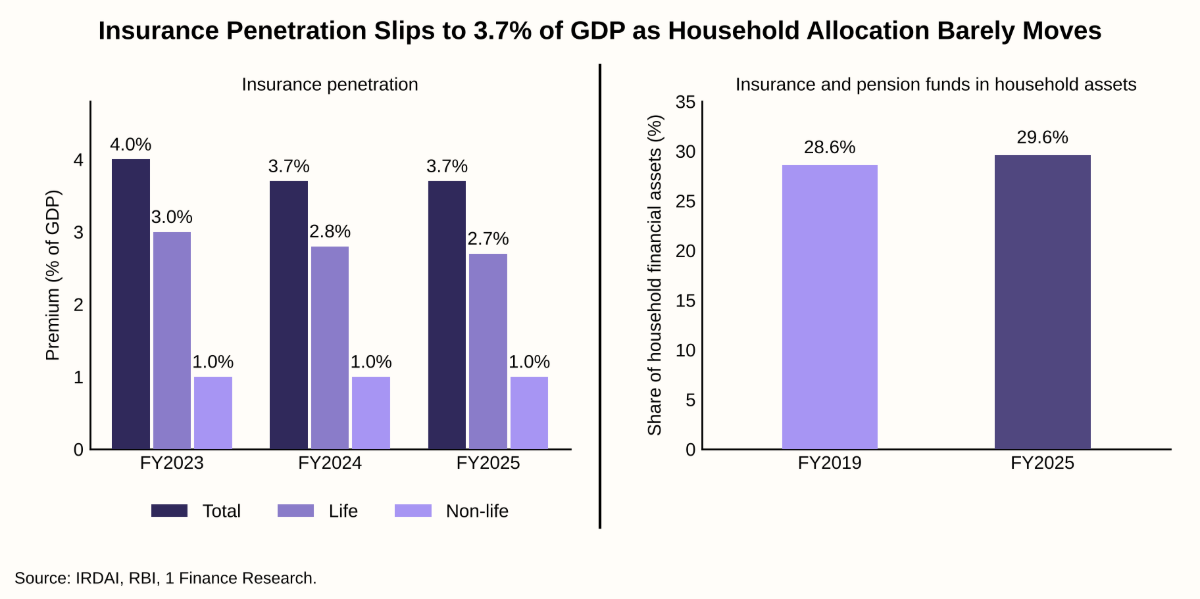
Insurance penetration, premium as a share of GDP, fell from 4.0% in FY23 to 3.7% in FY24 and held at 3.7% in FY25. The decline sits in life insurance, which slid from 3.0% to 2.8% to 2.7%, while non-life stayed at 1.0%. The household allocation has moved little, as insurance and pension funds made up 29.6% of household financial assets in FY25, against 28.6% in FY19, the last pre-pandemic year. The opportunity is therefore to deepen insurance protection, not simply expand financial savings.
Why Buying Insurance Goes Wrong
An insurance policy is a contract you judge years after you sign it. Exclusions, waiting periods, riders, surrender terms and claim conditions decide what it actually pays. So judge a policy on the protection it buys and what it costs to leave early, never on a projected maturity value.
Mis-selling sits where that complexity meets information gaps and sales incentives. Treat it as a policyholder-protection risk that any distribution model can carry. IRDAI's 2024-25 annual report asked insurers to trace its root causes.
The macro link is persistency, the share of policies still paying premium after one, three or five years. Cover that lapses is money that leaves the pool. In FY25, life insurers paid ₹2,33,299 crore in surrenders and withdrawals, equal to 59% of the ₹3,97,764 crore of new business premium they wrote. New individual policies fell 7.39%, from 291.77 lakh in FY24 to 270.22 lakh in FY25, with LIC's count down 12.80% while private insurers' rose 5.18%.
💡What This Looks Like in Practice (Illustrative Example) Take two households buying the same 15-year policy at ₹50,000 a year. One keeps paying and puts in ₹7,50,000 over 15 years, which the insurer can invest in long bonds. The other stops after two years, having paid ₹1,00,000, and loses the cover. That household takes back a surrender value, so cash leaves the pool as well as stops arriving. The insurer also forgoes ₹6,50,000 of scheduled premiums and the 13 years of cash flow it had planned around. Across lakhs of lapses, its liabilities run shorter than planned, and less of its book can sit in long-term bonds. |
How a Rule Change Becomes a Capital Flow
Each reform reaches the investment pool through its own channel, and each channel can stall.
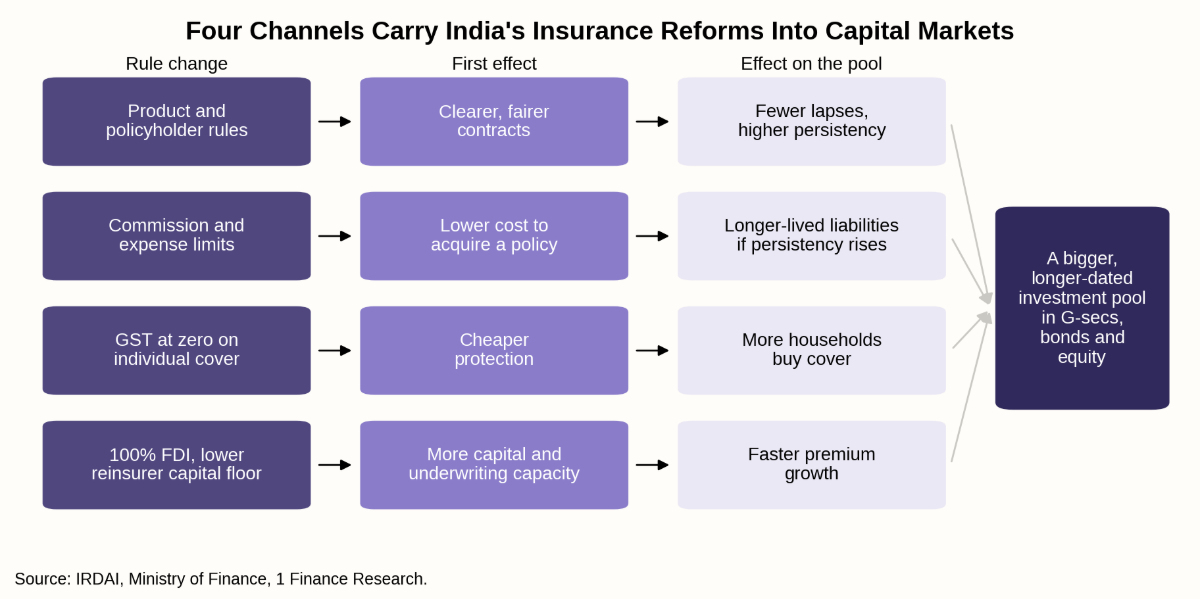
Capital. 100% FDI and the lower reinsurer capital floor let foreign owners add equity and reinsurance capacity. More capital supports more underwriting and faster premium growth. The channel stalls if foreign money buys existing stakes without adding fresh capacity.
Affordability. GST exemption removes the tax on individual life and health premiums and can improve affordability. How far prices actually fall depends on how insurers pass the change through after losing input tax credit. FY26 covered only about six months of the exemption, so annual data cannot yet show its effect on demand. Provisional, unaudited figures for April to August 2026 show industry new business premium up about 20.4% to ₹1,96,823 crore, a series that includes volatile group single premiums.
| 💡Did you know? GST on individual life and health insurance, including family floater plans, moved from 18% to zero on 22 September 2025 under Notification 16/2025-Central Tax (Rate). Employer group health, group term and group credit life cover still pay 18%. |
Acquisition cost. Expense and commission reform is intended to reduce distribution costs and improve customer value. Whether this lifts persistency will depend on pricing, product suitability, distributor incentives and service quality. In FY25, life insurers' commission rose 18% against premium growth of 6.73%, while 8 of 25 life insurers breached their expense limits. IRDAI's 23 September 2026 consultation paper proposes a glide path that would bring the life insurance Expense of Management ceiling to 15% of Gross Direct Premium Income (GDPI) within two years and 12.5% within five years. FY25's industry EoM ratio was 15.60% of gross premium, a different denominator. The paper also proposes explicit commission caps by channel and product. Comments close on 25 October 2026.
Liability duration. Policies that stay in force are long-dated liabilities, and long-dated liabilities let insurers hold long-dated bonds. A reform that raises premiums without raising persistency grows the balance sheet but leaves its liabilities short.
Where Insurance Money Lands in Indian Markets
At the end of June 2026, the total outstanding stock of central government dated securities was ₹124.33 lakh crore (provisional). Insurance companies held 25.65% of that stock, second only to commercial banks at 32.95%; the RBI held 17.25%. Their holding is therefore approximately ₹31.89 lakh crore.
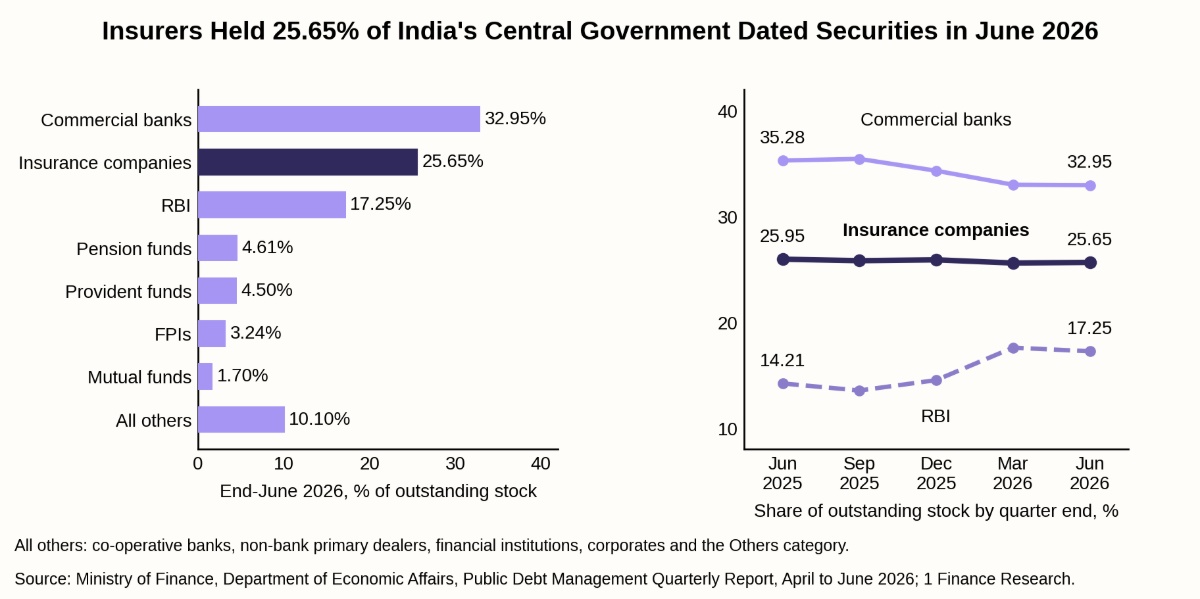
Across the five quarters to June 2026, insurance companies' share stayed between 25.59% and 25.95%, while commercial banks' fell from 35.28% to 32.95% and the RBI's rose from 14.21% to 17.25%. Insurance companies were already a structurally important holder, not a marginal buyer; the series does not show that the reforms caused this.
Securities with more than 20 years to maturity were 25.9% of the stock, up from 24.2% a year earlier, and April to June issuance averaged 17.27 years to maturity. Insurance liabilities can be long duration, so long-dated government securities are relevant to insurers' asset-liability matching. In outright trading, insurance companies made 2.8% of purchases and 2.3% of sales and are listed among net buyers.
The mechanism from reforms to this market is untested. New premium expands the investment pool; persistency sets how long the associated liabilities stay in place. The Insurance Laws Amendment Act (ownership, capital) and the proposed EoM limits (distribution costs) have not been shown to change the pool's size or duration, and insurers differ in asset allocation. The test is whether insurance companies' share and the maturity of their holdings move with persistency; June 2026 is the baseline.
Does Premium Growth Reach Shareholders
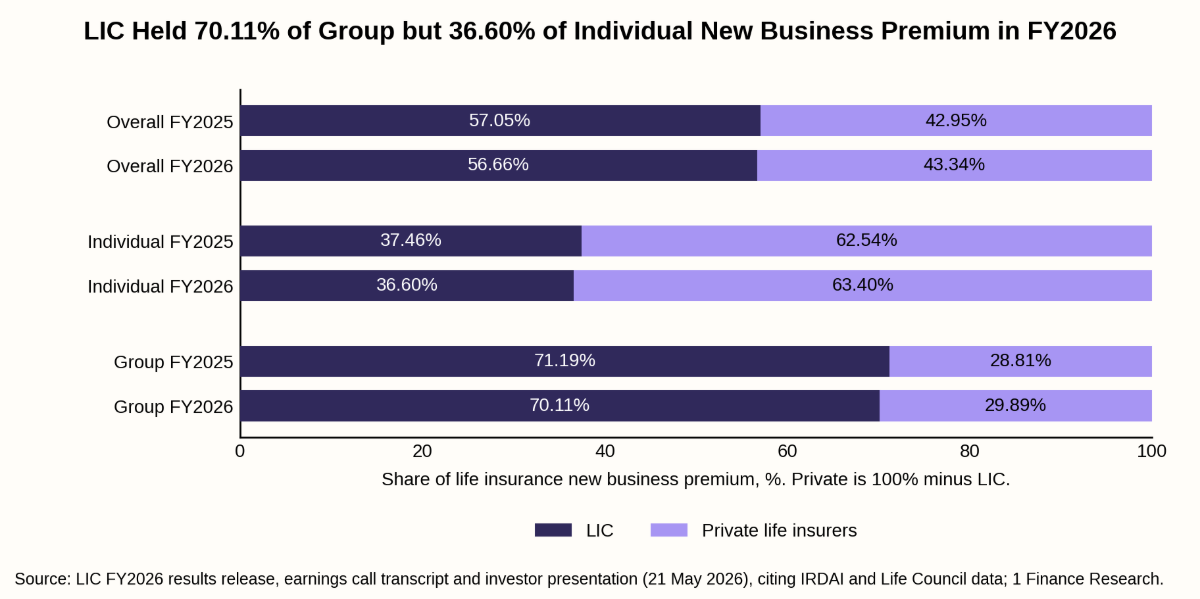
Premium growth reaches shareholders only when it comes with margin and staying power. LIC held 56.66% of life new business premium in FY2026 (57.05% in FY2025), but 70.11% in group and 36.60% in individual business, so headline share depends on business mix.
Public sector general insurers, including the two specialised insurers, held 34.57% of FY2025 non-life premium. Excluding the specialised insurers, their claims ratio (net incurred claims to net earned premium) was 97.30%, against 77.50% for private general insurers and 68.06% for standalone health insurers. A claims ratio is not a combined ratio: public sector general insurers' ₹18,366 crore underwriting loss was met by ₹19,444 crore of investment income. National, Oriental and United India reported solvency ratios of −0.67, −1.03 and −0.65 at March 2025, against the 1.50 control level.
The insurer is growing. What should you check next?
| What to Check When Premiums Grow | ||
|---|---|---|
| Segment | Metric | What it tells you |
| Life | Annualised Premium Equivalent (APE) | Measures new business growth. It gives full weight to regular premiums and a smaller weight to single premiums, making different types of new business easier to compare. |
| Life | Value of New Business (VNB) and VNB margin | Shows the expected value created by new policies. VNB margin, calculated against APE, helps compare the quality of new business. |
| Life | Persistency at 13th, 37th and 61st month | Shows whether customers continue their policies over time. Higher persistency generally means more durable business. |
| General & health | Loss ratio | Shows how much of earned premium is absorbed by claims. It should be read alongside expenses to assess profitability. |
| General & health | Expense ratio and combined ratio | Shows the cost of running the insurance business. A combined ratio above 100% means an underwriting loss before investment income. |
| All insurers | Solvency ratio | Shows whether the insurer has enough capital to meet its obligations. 1.50 is the regulatory control level. |
What the Insurance Reset Means for Advisors and Investors
- Read persistency with growth. Check 13th, 37th and 61st month persistency next to premium growth and VNB margin. Treat growth as durable only when persistency holds.
- Compare final prices, not the GST rate. Compare the final premium, coverage, exclusions and waiting periods across at least two insurers before choosing a policy.
- Test what distribution costs buy. Read commission and expenses alongside persistency and VNB margin. Accept high acquisition cost only where the business stays in force and earns a margin.
- Screen general insurers on capital first. Check the solvency ratio against the regulatory control level, then the loss and combined ratios. Prefer insurers that clear all three.
- Follow the capital. Track insurance companies' share of central government dated securities, and the maturity of their holdings, in each DEA quarterly report. Look for changes that move in step with premium growth, persistency and foreign capital.
What to watch next
Three items will test the reset beyond the distribution paper. Bima Sugam is targeted to open by November 2026. The foreign reinsurer branch amendment and the Public Insurance Registry are still proposals. IRDAI's 2025-26 annual report will bring the first audited full-year data on GST relief.
Conclusion
The reforms affect premium growth, policy duration and capital deployment. The industry already had ₹74.44 lakh crore of investments as of March 2025, while insurers held 25.65% of central government dated securities as of June 2026. But these figures are a baseline, not evidence of a reform effect.
The first test is persistency. If policies stay in force as premium and foreign capital grow, the investment pool can become larger and longer-duration. If lapses rise, that benefit will be weaker.