India's tech industry closed FY26 with an estimated $315 billion in revenue, up 6.1% from $297 billion in FY25, according to Nasscom. In our previous India’s IT sector for FY2026 blog, we saw the macroeconomic factors that could affect the IT sector in FY2026. On the ground, the picture was more uneven; TCS's full-year revenue actually declined around 2.5% in constant currency terms, even as the sector-wide number grew. A softer rupee flattered some of that headline growth, while US clients pulled back on discretionary spend and AI capex began redirecting global tech budgets away from the traditional outsourcing model this industry was built on.
Hiring told its own story. The sector added only about 135,000 net jobs in FY26, roughly the same as the year before, even as revenue grew at its fastest pace in three years. The market reacted accordingly; Indian IT stocks saw a sharp sell-off through the year, wiping out nearly $44 billion in market value, as FIIs pulled back from the sector and investors weighed how AI and a cautious US demand environment are reshaping its economics.
Nasscom expects FY27 growth to land in a similar range, around 6%, though it has flagged that the ongoing AI transition could weigh on that near term. Here's what's behind FY26's numbers, the macro forces driving them, and what FY27 is likely to look like.
How India's IT industry is structured
India's technology industry is not one business; it is five, each with its own clients, growth drivers, and pace of change. Nasscom's FY26 estimates split the $315 billion total into IT services at $149 billion, engineering R&D at $63 billion, business process management at $59 billion, software products at $23 billion, and hardware at $21 billion.
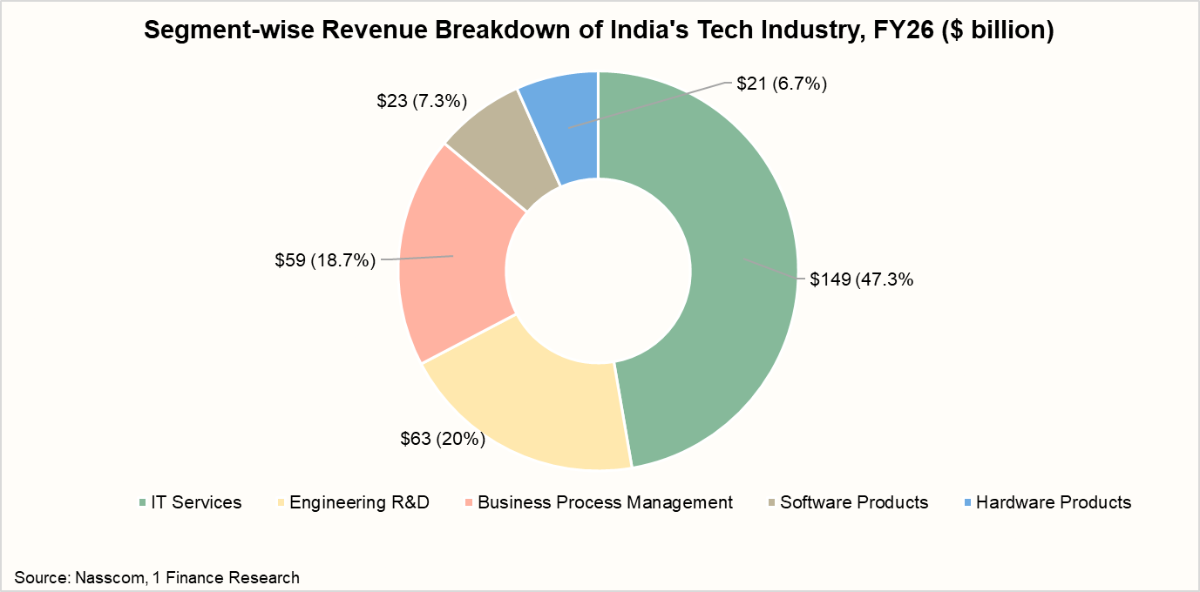
IT services still accounts for the largest single share of industry revenue. But it is the smaller segments, engineering R&D and GCCs in particular, that Nasscom points to as the sector's real growth engines this year, as clients push work up the value chain and away from routine, headcount-driven delivery.
How The Market Is Pricing Indian IT Stocks
The market has priced in far more pain than the guidance numbers alone would suggest. The Nifty IT index is down close to 29% in calendar year 2026, compared with roughly 8 to 9% for the broader Nifty 50 over the same stretch. The index has now fallen 43% from its December 2024 peak, and five major IT companies together account for less than 7.6% of the Nifty 50's weight, the lowest combined share since at least 2002.
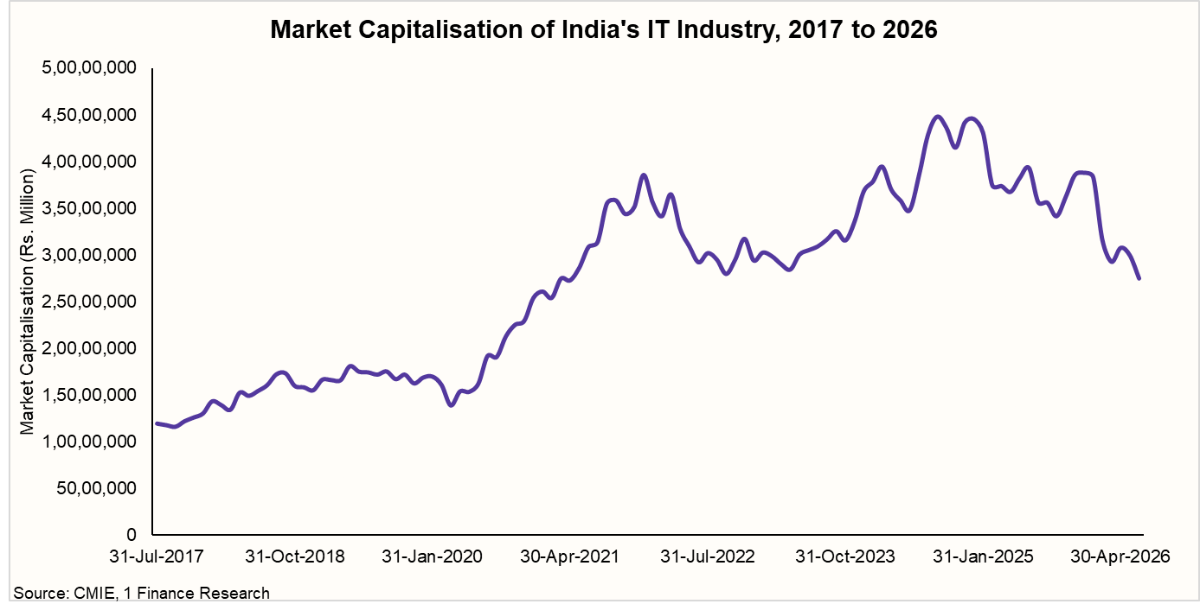
The market cap decline tells the same story in absolute terms: India's IT industry's total market capitalisation peaked at ₹44.76 lakh crore in August 2024, and has since fallen to ₹27.47 lakh crore by June 2026, a decline of 38.6% in under two years. The current level sits below where the sector stood through most of 2023, erasing nearly all the gains made since the late-2023 recovery.
Institutional selling has reinforced the trend: Foreign portfolio investors were net sellers of IT stocks worth roughly ₹74,698 crore through 2025, among the sharpest sectoral outflows that year. Domestic institutional investors have periodically stepped in to buy the dips, but the broader pattern through 2026 has stayed the same, FIIs pulling back from Indian IT even as they've kept buying elsewhere in the market.
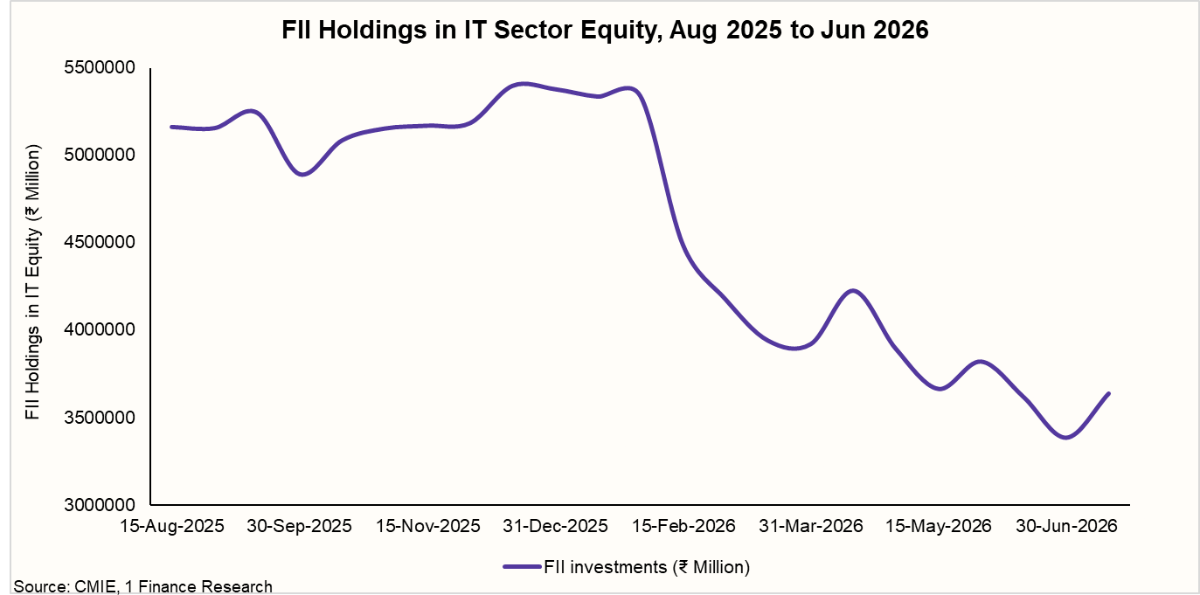
- FII holdings in the IT sector equity remained relatively high and stable between August 2025 and January 2026, peaking around December 2025.
- Following January 2026, holdings experienced a sharp and consistent downward trend through June 2026, despite minor intermediate fluctuations.’
Nifty IT vs Nifty 50: Why India's Tech Sector Is Declining
For most of the last decade, Nifty IT has stayed well ahead of the broader market, through the post-Covid rally, a flat patch in 2022 and 2023, and a fresh high in early 2025. But this time the fall has gone deeper than any of the earlier dips. Nifty IT has now slipped back close to Nifty 50's level, something that hasn't happened since before the 2020 rally kicked off. For a sector that's spent years as the market's star performer, that's a big shift in how investors see it right now.
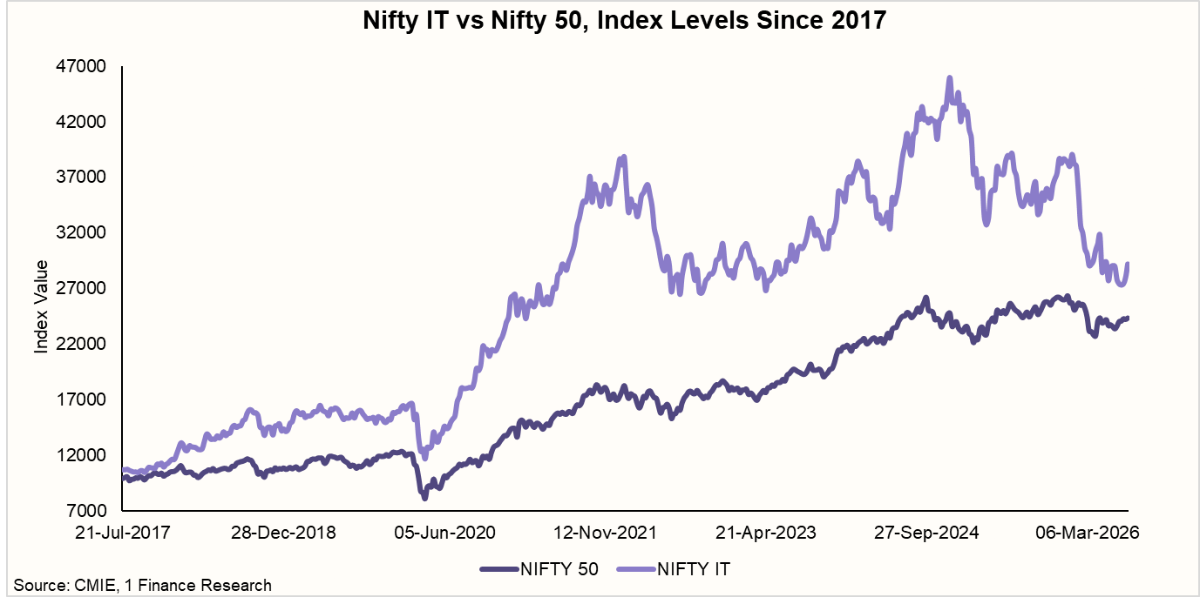
The gap between what the numbers show and what the market believes is the real story here. Revenue is still growing, but investors are pricing in the AI and margin risk faster than it's showing up in company results, which sets up the next section directly: why hiring hasn't kept pace with revenue even as the sector grows.
How The Us Economy And Visa Policy Are Shaping Indian It
The AI story starts in the US, not India, and that's worth keeping in mind throughout this blog. America's hyperscalers, Amazon, Microsoft, Google, and Meta, are set to spend roughly $725 billion combined on AI infrastructure in 2026, up 77% from about $410 billion in 2025. Compare that to Nasscom's estimate of India's own AI-linked revenue for FY26, just $10 to 12 billion, and the scale gap is stark. The US is where AI capital is actually being deployed and built. India's IT sector sits downstream of that, its fortunes tied to how much of this spending eventually flows into contracts for Indian providers.
💡India's AI Revenue, FY26 estimate $10 - $12 Billionof $315B total industry revenue, about 3.5% |
The broader US economy is holding up better than feared: US GDP growth is expected to land between 2% and 2.5% for 2026, better than 2025's slower pace as the tariff drag fades and business investment, increasingly AI-driven, picks up. But the composition matters, a growing share of this growth is coming from AI capex rather than the broad-based enterprise tech spending that used to flow straight into Indian outsourcing contracts. So a healthier US economy doesn't automatically mean healthier demand for traditional Indian IT.
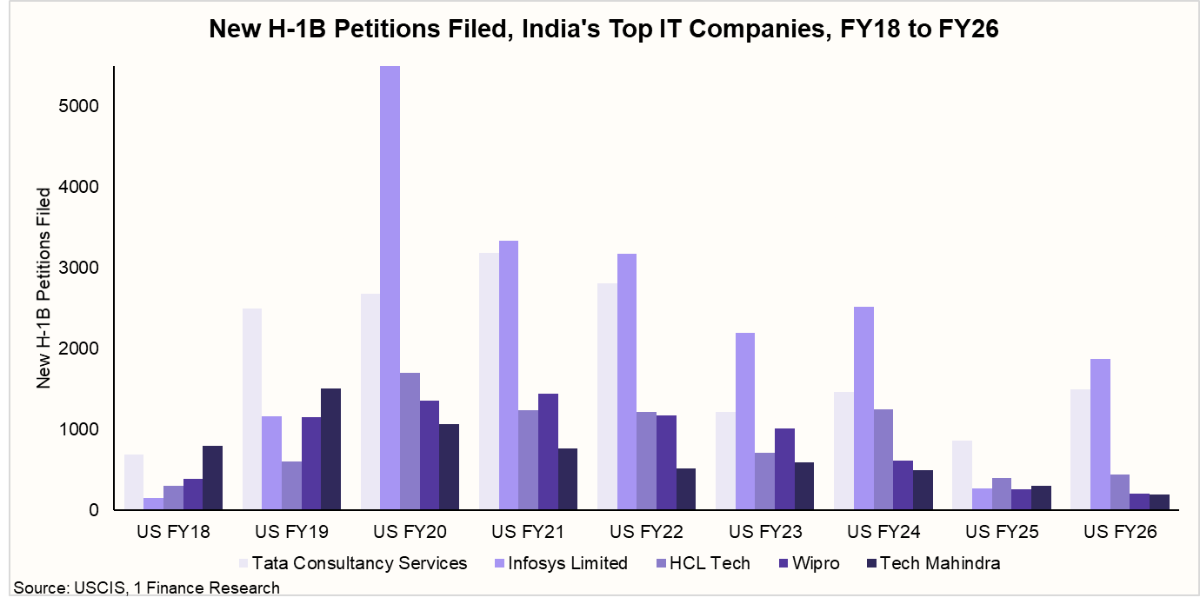
US visa policy is squeezing the older delivery model even further: New H-1B petitions now carry a one-time $100,000 fee, alongside a merit-based lottery replacing random selection for the FY2027 cap season, together estimated to cost exposed firms around 100 basis points of margin and roughly 6% of EPS. Indian IT has already cut its H-1B reliance sharply since FY21, softening the direct hit, and there's a flip side too, as H-1B tightens, US majors like Google, Amazon, and Microsoft are hiring more directly out of India instead, arguably the bigger structural story.
Currency adds a fourth layer on top of this: Indian IT companies earn most of their revenue in foreign currency, mainly US dollars, then report it back in rupees, which makes them naturally exposed to currency swings. USD-INR moved from near 90 in January 2026 to an all-time high above 99 in March, before settling into the mid-90s, driven by a lingering US tariff overhang, sustained FII outflows, and an oil price spike tied to Middle East tensions.
A weaker rupee mechanically inflates reported revenue and margins, even when underlying dollar demand hasn't actually grown, part of why some headline growth numbers look stronger on paper than the real business underneath them.
Services PMI Trends And What They Signal For IT
Here's a quick pulse check on both economies. The US ISM Services PMI came in at 54.0 in June 2026, still comfortably in growth territory, its 24th straight month above 50, though it's eased a bit from May's 54.5. India's HSBC Services PMI is running much hotter, 57.4 in June, and it touched as high as 59.8 in May.
Both economies' services sectors are growing; that's worth saying upfront- this isn't about US weakness. But India's just growing faster, and has been for months now. New orders, exports, hiring, they're all outpacing the steadier, more modest US expansion. That fits everything else we've seen in this blog: domestic IT demand outpacing exports, GCCs scaling up, India's own economy becoming a real growth engine rather than just riding on US client budgets.
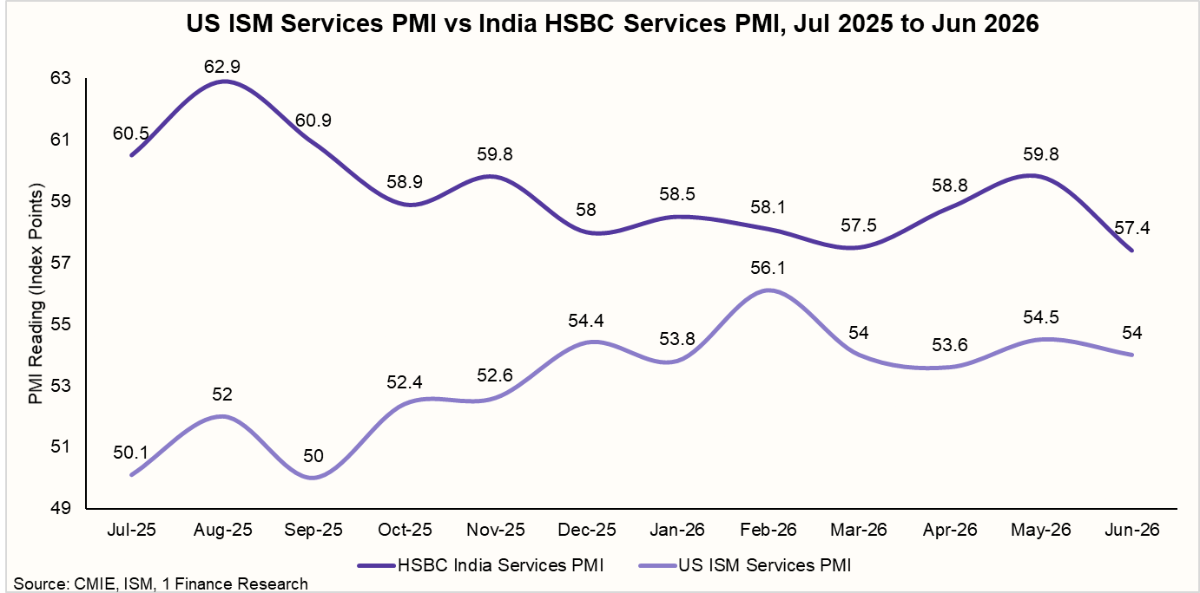
The takeaway isn't that the US has slowed down; it hasn't. It's that India's own momentum has become a genuine growth driver in its own right.
How GCCs Are Driving India's IT Sector Growth
GCCs cut across several sub-segments rather than sitting in a category of their own. They're the in-house technology and operations arms multinationals run out of India, and Nasscom has repeatedly flagged them as a structural growth driver alongside engineering R&D.
A GCC isn't a vendor relationship; it's a multinational's own team in India doing the same high-value work as its headquarters, just located here instead of outsourced. That makes GCCs a separate, expanding demand source, one that's held up far better through this year's slowdown than traditional outsourced work.
The scale is hard to overstate. GCCs added over 600,000 jobs in India between 2019 and 2024, with employment projected to reach 2.8 to 4 million by 2030.
| India's GCC Count Crosses 2,100, Up 32% Since FY2021 | ||
|---|---|---|
| Year | Number of GCCs | GCC Units |
| FY2021 (Reported) | 1,600+ | 2,700+ |
| FY2026 (Estimated) | 2,110+ (precisely 2,117) | 3,720+ (precisely 3,728) |
This is why GCCs matter so much to FY27's outlook. While IT services firms guided cautiously, GCC demand kept climbing largely independent of that cycle, a big reason India's domestic and GCC-linked growth has outpaced its export engine this year.
AI and jobs in Indian IT
The clearest sign AI has moved from pilot projects to real decisions isn't in a Nasscom survey, it's in this year's actual layoff numbers. TCS cut roughly 12,200 jobs, about 2% of its global workforce, citing AI rollout and tighter client budgets. Fuller FY26 disclosures put the total reduction at over 23,000 roles, the largest single-year cut in TCS's history, as it pivots to what it calls an "AI-first" model.
The pattern isn't limited to one company: Wipro cut its fresher hiring guidance nearly in half, to 7,500 to 8,000. Infosys let go of several hundred recently onboarded campus recruits, even while still targeting 20,000 freshers for the year. Together, the top five IT majors reduced headcount on a net basis in FY26, reversing two straight years of hiring growth.
But this isn't AI simply destroying jobs: TCS's own leadership has pushed back on that framing, and its numbers back it up somewhat, after bottoming out mid-year, the company added freshers back in the most recent quarter. What's happening looks more like re-shaping than shrinking, companies are trimming bench strength built for the old headcount-linked model, while still hiring for AI and cloud-specific skills.
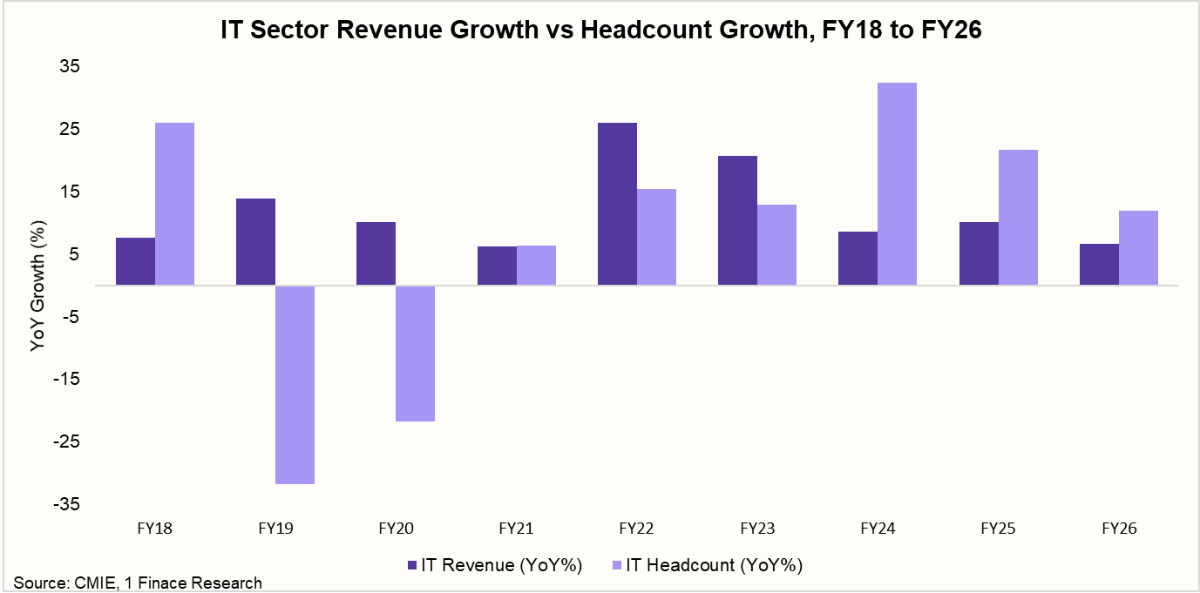
Read alongside the GCC section, gaining hundreds of thousands of roles while services majors cut headcount, the picture gets clearer. AI isn't shrinking the sector's job base overall, it's redirecting where those jobs sit.
India's IT Sector Outlook For FY27
Pulling everything together, FY27 looks set to extend the same story FY26 told, real growth, but growth that looks structurally different from a decade ago. The tables below lay out what's working in the sector's favour and what's still weighing it down.
| What's working in the sector's favour | |
|---|---|
| Driver | Why it matters |
| GCC expansion | Global capability centres continue to be Nasscom's single biggest growth engine, pulling higher-value work into India regardless of what's happening with traditional IT services demand |
| Engineering R&D momentum | Global ER&D spend is headed toward $2.5 trillion by 2030, and Indian providers are capturing a growing share through full-stack, platform-based engagements |
| Domestic demand acceleration | The domestic market grew 7.9% in FY26, nearly 1.5 times faster than exports, a genuinely new growth lever for a sector historically built around exports |
| US majors hiring directly in India | As H-1B gets harder to secure, Google, Amazon, and Microsoft have been expanding India-based hiring instead, a structural shift toward India as an onshore delivery hub, not just a services vendor |
| What's still weighing the sector down | |
|---|---|
| Headwind | Why it matters |
| AI-driven business model pressure | The shift from headcount-linked billing to outcome-based pricing is compressing the traditional staffing-pyramid model, and it's the main reason hiring has decoupled from revenue growth |
| H-1B fee hike and new lottery system | The $100,000 one-time fee and merit-based FY2027 cap season lottery are estimated to cost exposed firms roughly 100 basis points of margin and about 6% of EPS |
| US tariff and trade uncertainty | Discretionary tech spend from US clients remains the most exposed part of the demand base, and trade uncertainty has already pushed the sector's recovery back four to five months |
| Market has already priced in caution | Nifty IT is down close to 29% in CY2026, and the top five IT majors have lost more than 46% of their combined market cap since August 2024, so even a modest earnings beat now carries a high bar to shift sentiment |
Taken together, these tables tell a fairly consistent story, the tailwinds are structural and durable, GCCs, ER&D, and domestic demand aren't going away. The headwinds are largely transitional, tied to a specific US policy cycle and an AI adjustment period the sector is still working through. The next section pulls this into a final view on where that leaves the sector heading into FY27.
Concluding Remarks
India's IT sector enters FY27 from a position of underlying strength, not weakness. Revenue is still growing, exports are expanding, and two genuinely new engines, GCCs and domestic demand, are now pulling more weight than they ever have before. That's not a sector in decline; it's a sector whose growth no longer looks like it did a decade ago.
The central tension for FY27 is straightforward to name: growth is real, but it's shifting toward higher-value, higher-skill work even as the traditional, headcount-led model that built this industry fades. That's why revenue keeps climbing while hiring stays flat, why the market has already priced in more caution than the guidance numbers show, and why AI and the US visa overhaul matter more as structural signals than as one-off shocks.
What separates the well-positioned players from the exposed ones going into FY27 comes down to three things: exposure to GCC and platform-based revenue over pure staffing models, how much of a client base still runs through discretionary US IT spend, and how fast a company can convert AI-driven productivity gains into new, higher-value work rather than simply cutting costs. The companies leaning into GCCs, ER&D, and outcome-based delivery look set to keep growing through this transition. The ones still relying on scale and headcount to drive revenue are the ones the market has already started to punish.