EPF Wage Ceiling Hike 2026 and What It Does to Your Payslip
The 2026 Employees’ Provident Fund (EPF) wage ceiling is ₹25,000 a month, up from ₹15,000, effective 17 September 2026. Employees in covered establishments with a PF wage up to that level now have compulsory provident fund, pension and insurance cover. The government expects more than 51 lakh additional workers to join the Employees’ Provident Fund Organisation (EPFO).
Most coverage stops at the payslip. The bigger story is macro. We estimate that about ₹29,400 crore a year will move into retirement savings. Roughly ₹14,700 crore of that comes out of the take-home pay of workers earning ₹15,000 to ₹25,000 a month, and employers add the rest. The first larger deductions land in the October and November festive season, and the reclassification of workers will make EPFO payroll data look stronger than the job market really is.
This blog sizes that shift, compares it with the last revision in 2014, traces it through consumption, savings, bonds, employer costs and jobs data, and sets out what to watch over the next six months.
What Is the EPF Wage Ceiling
The Employees' Provident Fund (EPF) is a compulsory retirement savings scheme for salaried employees in India, run by the Employees' Provident Fund Organisation (EPFO). You and your employer each put 12% of your PF wage into it every month, and the money earns interest until you retire or change jobs.
The Employees’ Provident Fund (EPF) wage ceiling does two jobs. It decides who must join EPF, since membership is compulsory for a new joiner whose PF wage is at or below ₹25,000. It also caps the wage on which compulsory contributions are calculated.
PF wage is not your CTC or gross salary. It is mostly basic pay plus dearness allowance, and under the Code on Social Security, 2020, allowances above half of total pay also count as wages.
Your deduction feeds three schemes. Employees’ Provident Fund (EPF) is your savings, Employees’ Pension Scheme (EPS ) your pension, and Employees' Deposit-Linked Insurance Scheme (EDLI) your life cover. Together, they are one of the largest channels of household financial savings in India.
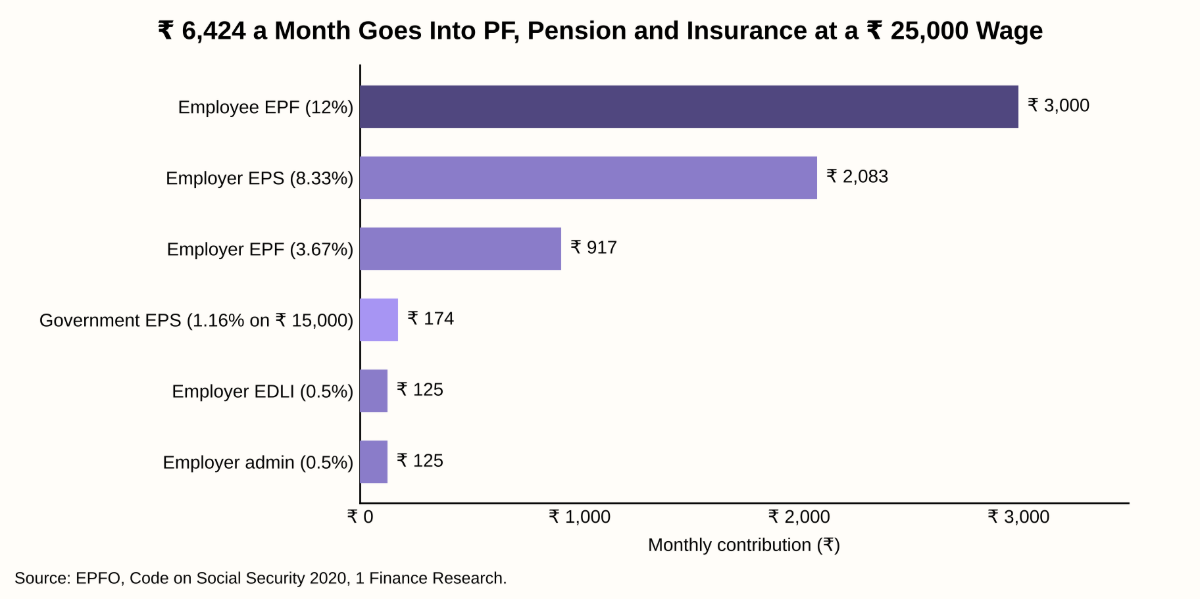
At the new maximum PF wage of ₹25,000, about 25.7% of the wage flows into these schemes each month once the employer's EDLI and admin charges and the government's pension subsidy are added.
What Changed on 17 September 2026
On 16 September 2026, the Union Cabinet approved raising the wage ceiling for mandatory EPFO coverage from ₹15,000 to ₹25,000 a month. Employees whose PF wage is up to ₹25,000 must now be enrolled in EPF, EPS and EDLI, and contributions are calculated on wages up to the new limit. The government expects more than 51 lakh additional workers to be covered.
The Labour Ministry notified the change the next day through S.O. 5109(E), under Chapter III of the Code on Social Security, 2020. It took effect on 17 September 2026 and is the first revision since 1 September 2014.
| Every EPF Limit Tied to the Ceiling Rises by Two-Thirds | ||
|---|---|---|
| Before | After | |
| Coverage ceiling | ₹15,000 | ₹25,000 |
| Maximum employee contribution | ₹1,800 | ₹3,000 |
| Maximum EPS pensionable wage | ₹15,000 | ₹25,000 |
| Maximum employer EPS contribution | ₹1,250 | ₹2,083 |
| Workers newly covered | - | 51 lakh+ |
| Annual government support | ₹10,250 crore | ₹11,339 crore |
The five-year outlay is ₹56,696 crore. The government's 1.16% EPS subsidy is still calculated on wages up to ₹15,000, so the extra cost comes from newly covered workers rather than a richer subsidy. Our cross-check: 51 lakh workers × ₹174 a month × 12 comes to about ₹1,065 crore, close to the ₹1,089 crore increase in support. The bigger long-term question is the EPS pension liability, not the annual outgo.
| 💡The ₹15,000 ceiling stayed frozen for 12 years. As of September 2026, EPFO has about 7.98 crore contributing members across 7.68 lakh establishments, and EPS pays around 82 lakh pensioners. |
How Much Money Moves From Spending to Savings
We estimate that the newly covered workers alone will move about ₹29,400 crore a year into EPF and EPS. Half of it comes out of their take-home pay and half is added by employers.
| The Hike Redirects About ₹29,400 Crore a Year Into Retirement Accounts | |
|---|---|
| Flow (illustrative, newly covered workers only) | Per year |
| Employee contribution, 12% | ₹14,700 crore |
| Employer contribution, 12% | ₹14,700 crore |
| Total into EPF and EPS | ₹29,400 crore |
| Employer EDLI and admin charges, 1% | ₹1,200 crore |
| Government EPS subsidy | ₹1,100 crore |
Scale it against the economy, and it is small. The employee share is under 0.1% of private consumption. That is about 1% of EPFO's ₹28.34 lakh crore corpus (March 2025), or nearly 9% of the ₹3.36 lakh crore it collected in contributions in FY25, and a little over 1% of household net financial savings, which the RBI puts at about 7% of gross national disposable income for FY25. The concentration is what matters: all of it comes from workers earning ₹15,000 to ₹25,000 a month.
What it does to one payslip
For a newly covered worker, take-home pay falls by 12% of the PF wage, but twice that amount reaches their retirement accounts, because the employer matches it.
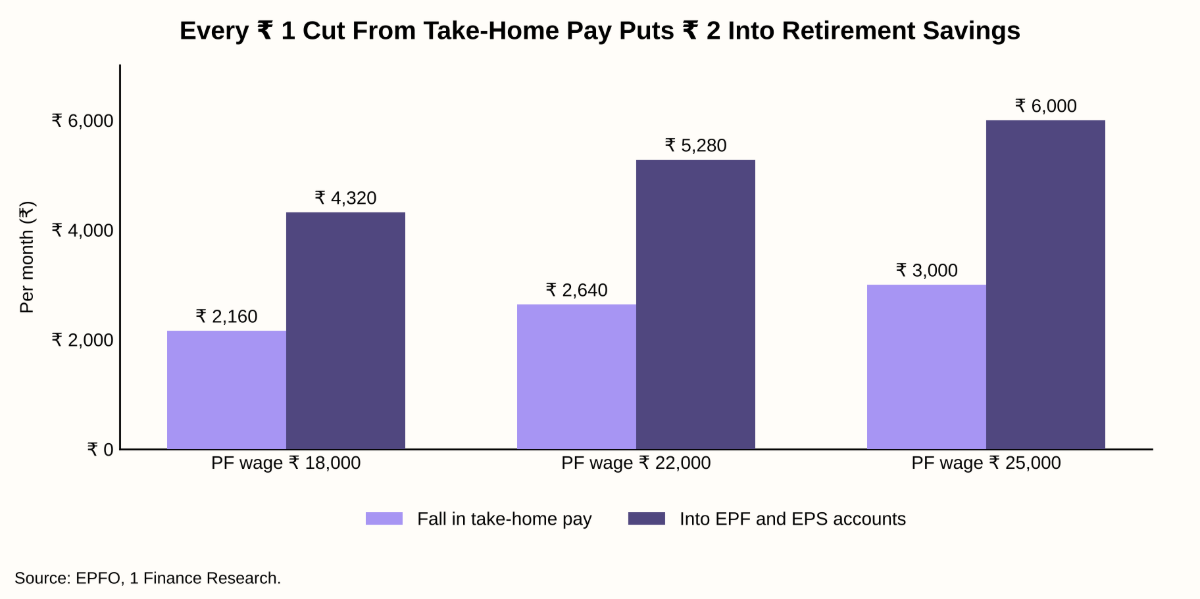
💡 What this looks like in practice (illustrative example): A supervisor in Pune with a PF wage of ₹22,000 was not covered before. She now pays ₹2,640 a month. Her employer adds ₹807 to her EPF and ₹1,833 to her pension. Her take-home falls by ₹2,640, while ₹3,447 a month builds in her EPF account, plus pension accrual.
Existing members whose contributions were capped at ₹15,000 see a smaller change: their deduction rises by up to ₹1,200 a month, matched by the employer.
The pension gain builds slowly. EPS pension is pensionable salary × years of service ÷ 70, so the higher cap pays off only over a full career.
| Your EPS Pension Grows With Service, Not Overnight | ||
|---|---|---|
| Years of service | Monthly pension at ₹15,000 cap | Monthly pension at ₹25,000 cap |
| 10 | ₹2,143 | ₹3,571 |
| 20 | ₹4,286 | ₹7,143 |
| 30 | ₹6,429 | ₹10,714 |
What Happened the Last Time the Ceiling Was Raised
The 2014 revision was the bigger shock. It lifted the ceiling 131%, from ₹6,500 to ₹15,000, after a 13-year freeze, and came with a ₹1,000 minimum EPS pension. This one lifts it 67% after a 12-year freeze.
EPFO has more than doubled in size since the last revision. On average, 3.76 crore members contributed in FY16, the first full year at the ₹15,000 ceiling. By September 2026, that number was about 7.98 crore.
The more important point is about real value. Adjusted for consumer prices, ₹15,000 in September 2014 is worth roughly ₹26,300 in August 2026 prices. The new ceiling restores most of the lost ground but not all of it.
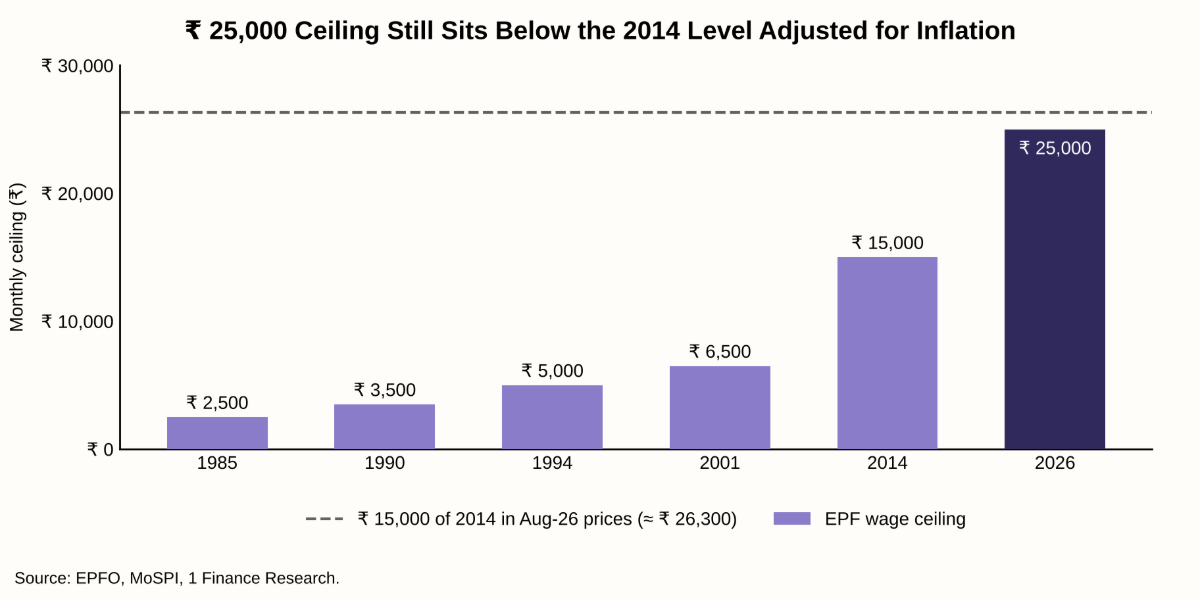
Inflation adjustment uses MoSPI's linked CPI (Combined) series, base 2024=100, linking factor 0.5267, and is approximate.
This raises an open question for the next revision. Should the ceiling be indexed to CPI or to minimum wages, rather than reset once a decade in a single large step that lands on payslips all at once?
How the EPF Wage Ceiling Hike Flows Through the Economy
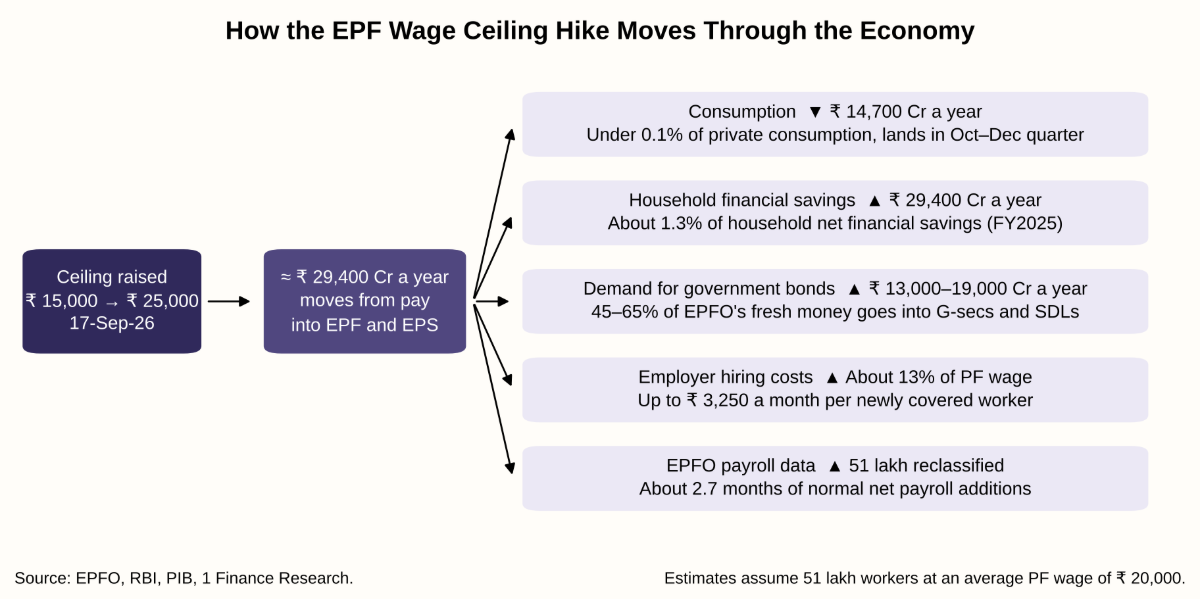
The chain is simple. Higher mandatory deductions cut disposable income today and raise financial savings tomorrow. That shift touches five places, and they differ a lot in size.
- A Small Hit to Consumption, Landing at a Bad Time
The employee share of about ₹14,700 crore a year is well under 0.1% of private consumption. But it falls on households that spend nearly all of what they earn, and the timing is awkward.
The first full-month deductions at the new ceiling land in October and November payslips, the peak of festive spending. CPI inflation rose to 4.82% in August 2026, its highest since December 2024, and the RBI expects it to peak at about 5.9% in the October to December quarter. Real take-home pay in this band is squeezed from two sides at once. Entry-level FMCG, two-wheelers, value retail and quick-service restaurants are the categories to watch. - A Lift to Household Financial Savings
This is forced saving where voluntary financial saving is thinnest. It is also long-duration saving, locked in until retirement or a job change, which is the kind of domestic capital that funds investment. Steady Demand for Government Bonds, as Yields Climb
EPFO is a buy-and-hold investor that puts most fresh money into government paper. About 57% of its investible corpus sat in state development loans and central government securities as of March 2024.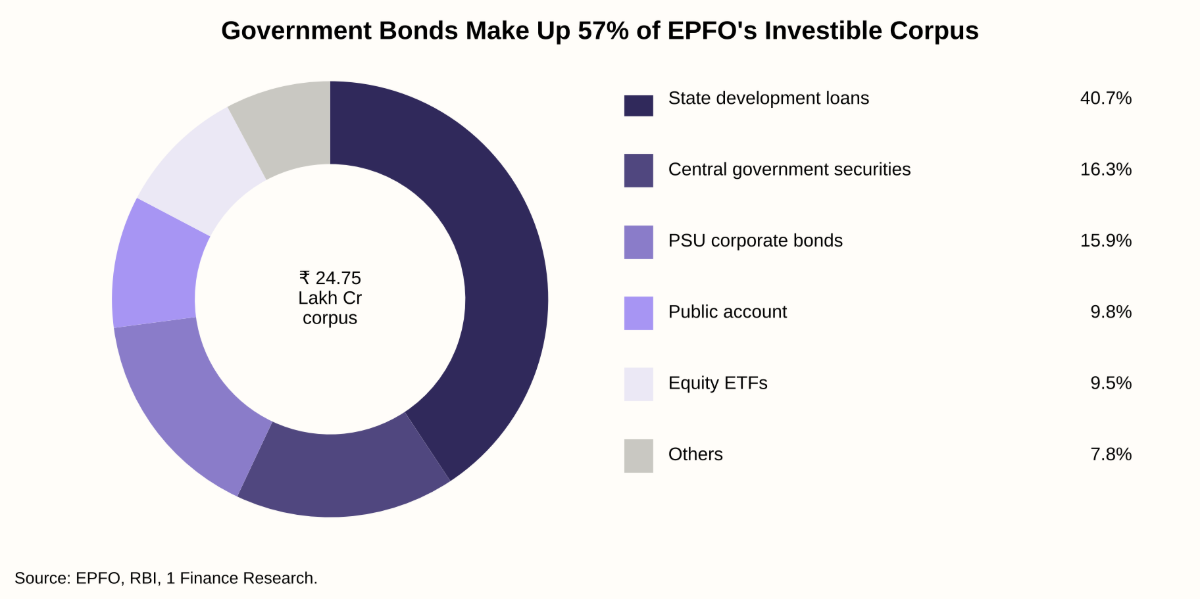
EPFO's investment pattern sends 45% to 65% of fresh money into government securities, so the hike could add roughly ₹13,000 to ₹19,000 crore a year of steady demand. That is small against central and state borrowing, but it arrives as the 10-year yield touched 7.21% on 1 October 2026, a two-year high, and the MPC meets on 5 to 7 October with most economists expecting a 25 basis point hike. Price-insensitive domestic demand is supportive at the margin, mostly for state loans.
- Higher Hiring Costs for Labour-Heavy Employers
For each newly covered worker, employers now pay about 13% on top of the PF wage, including EDLI and admin charges. At a ₹25,000 PF wage, that is about ₹3,250 a month. Employers have three options: absorb the cost, restructure pay within the Labour Codes' rule that wages must be at least half of total pay, or shift hiring towards contract staff. The third is the risk worth watching, since manpower suppliers and contractors already account for about 40% of EPFO's monthly net additions. - Why the Jobs Data Will Look Better Than It Is
EPFO's net payroll additions will jump in the coming releases because workers are being reclassified into the system, not because they were newly hired. The 51 lakh newly covered workers equal nearly three months of normal payroll additions.
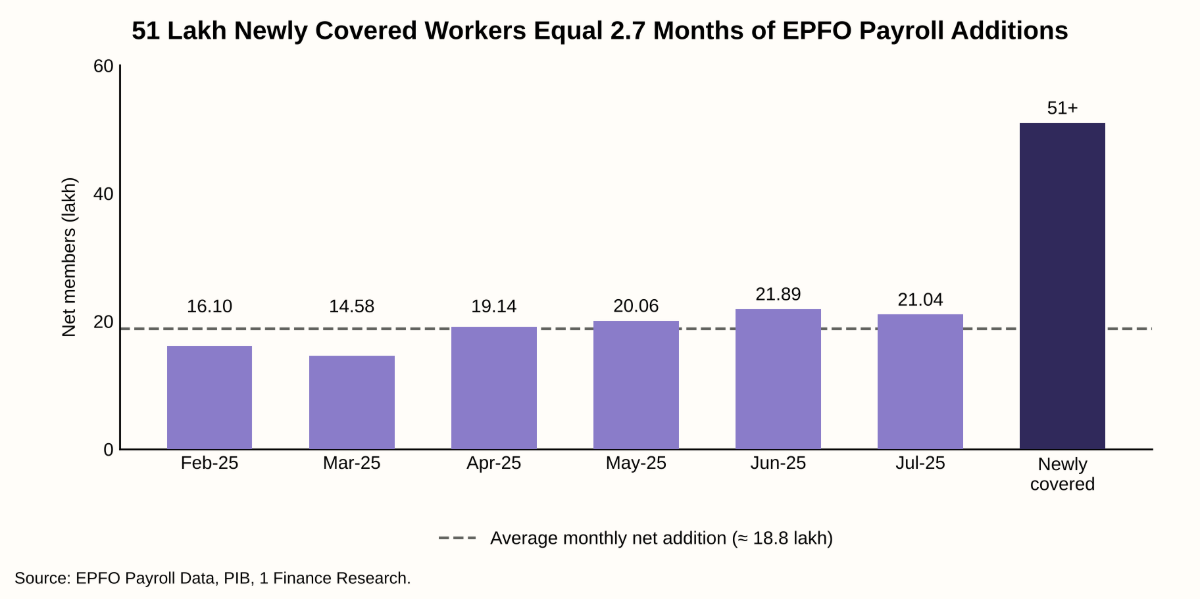
Monthly figures are provisional EPFO releases for February to July 2025.
The September 2026 payroll release, due around late November, will be the first affected. Three checks help read it correctly:
Who Gains and Who Pays
| The Costs Come Now, the Gains Come Over a Career | ||
|---|---|---|
| Group | Near term | Longer term |
| Workers earning ₹15,000 to ₹25,000 | Lower take-home pay | Larger retirement corpus, pension and insurance cover |
| Labour-intensive MSMEs (textiles, security, retail, logistics) | Wage bill up about 13% per newly covered worker | Risk of a shift to contract hiring |
| Mass consumption companies | Mild demand drag in the festive quarter | Neutral |
| Bond market | Steadier domestic demand for government paper | Supportive at the margin |
| Government | About ₹11,339 crore a year in EPS support | Larger EPS pension liability |
The row that matters most is the MSME one. If employers respond by moving workers onto contract rolls, the hike could shrink direct formal hiring even as it widens social security on paper.
What to Watch Over the Next Six Months
| The Effects Arrive in a Clear Sequence Through the Rest of FY27. | |
|---|---|
| What | Why it matters |
| RBI MPC decision | Whether the 5.9% Q3 inflation path is revised, and the start of a hiking cycle |
| September CPI | First read on the festive-quarter inflation squeeze |
| First full payslips at the new ceiling | Take-home falls just as festive spending peaks |
| EPFO circulars and EPS and EDLI scheme amendments | How existing members, past EPS service and the ₹7 lakh EDLI cap are treated |
| EPFO payroll data for September | First month inflated by reclassification |
| Festive sales data for mass categories, Q3 company results | Size of the consumption drag |
| MSME industry response | Signs of a shift to contract hiring or legal challenge |
Follow each of these releases as it lands on our live economic calendar.
What This Means for Salaried Employees and Advisors
For salaried employees
- Check your October payslip. If your PF wage is up to ₹25,000 and PF is not being deducted correctly, your employer may be in default.
- Read the lower take-home as savings, not a loss. The money is going into your EPF and pension accounts, matched by your employer.
- Rework your monthly budget for the smaller in-hand salary before the festive season, not after it.
For advisors
- Clients in the ₹15,000 to ₹25,000 band may need a revised monthly cash-flow plan, especially if they carry EMIs.
- Higher EPF accumulation raises the fixed-income share of a client's overall portfolio, which can justify a little more equity elsewhere.
- Correct the EPS pension myth with the formula. The gain builds over decades of service.
- Treat EPFO payroll headlines between November 2026 and early 2027 with caution, and lean on PLFS for the real hiring picture.
Conclusion
The EPF wage ceiling hike transfers about ₹29,400 crore a year from today's spending to tomorrow's savings at the bottom of the formal wage ladder. It is small for the economy, large for the households involved, and badly timed for festive demand in a quarter of rising inflation. It will also make the next few months of EPFO jobs data look better than the labour market really is.