India's markets sent two signals this quarter that look like they belong to different economies.
The first came from the money market. On September 4, overnight money traded at 4.40%, below even the RBI's 5.00% floor. Lenders such as mutual funds and smaller cooperative banks, which cannot park cash with the RBI, had so much of it that they lent it out for less than the central bank's own deposit rate.
The second came from the stock market. Companies raised a record ₹94,205 crore through IPOs between April and September, even as foreign investors pulled ₹1.27 lakh crore out of Indian equities.
Cheap money and a booming IPO market inside a falling stock market look unrelated. They share one cause: a flood of cash in the banking system, much of it created by the RBI itself while defending the rupee.
That flood is now being drained. The RBI raised the repo rate to 5.50% on October 7 and, within two days, announced another bond sale and a tighter daily CRR rule. The real question for investors is no longer whether the RBI hikes again. It is what happens to borrowing costs, inflation, valuations and the IPO pipeline as the cheap money disappears.
Key Takeaways
| Factor | Key Takeaway |
|---|---|
| Repo Rate | Hiked 25 bps to 5.50%, and rate cuts are now off the table. With cash in surplus, overnight rates stayed below the repo, so the hike barely reached borrowers at first. |
| Liquidity | Over ₹1 lakh crore of OMO bond sales since mid-September cut the surplus from ₹11.16 lakh crore to ₹3.36 lakh crore. The call rate is already about 30 bps higher. |
| CRR Rule | The CRR stays at 3%, but from October 16 banks must hold 99% of it every day, up from 90%. That removes the slack that kept overnight money cheap. |
| Inflation | CPI hit a 23-month high of 5.54% and WPI reached 11.39%. The shock is on the supply side, and producers are absorbing most of it for now. |
| IPO Market | A record ₹94,205 crore was raised in H1 FY27. A ₹2.78 lakh crore pipeline, nearly five months of mutual fund inflows, now meets tighter money. |
The Hike Was Only Half the Decision
A rate hike works only if it changes what banks pay for money. In October, it barely did.
On October 7, the MPC voted unanimously to raise the repo rate by 25 bps to 5.50%, its first hike since February 2023. It also moved its stance from neutral to calibrated tightening, which rules out rate cuts for now. The next move is either another hike or a pause.
| Policy Rate | Before October 7 | After October 7 |
|---|---|---|
| SDF (floor) | 5.00% | 5.25% |
| Repo rate | 5.25% | 5.50% |
| MSF (ceiling) | 5.50% | 5.75% |
The catch is that the repo rate is not the price of money. Banks borrow from each other overnight at whatever rate the market sets inside the RBI's corridor, between the SDF floor and the MSF ceiling. One thing decides where that rate sits: how much spare cash the system holds. Scarce cash pushes it toward the ceiling. Excess cash drags it toward the floor.
In mid-September, cash was in excess. The call rate sat at 5.09% and the TREPS rate at 5.07%, below the repo rate and hugging the floor. Raising the corridor in that market does not raise borrowing costs by 25 bps. It simply moves overnight rates from the old floor to the new one.
The hike becomes real only when the surplus goes. Once overnight rates climb from about 5.1% to the new 5.50% repo rate, borrowers face roughly 40 bps of tightening, not 25. That is why the RBI's next moves matter more than the hike itself.
The RBI Is Now Draining the Cash That Kept Loans Cheap
The RBI has stopped relying on the rate and started removing the cash.
The surplus had grown so large that the RBI's own floor stopped working. At the peak in early September, overnight rates sat more than 80 bps below the repo rate, and that cheap money flowed straight into cheaper short-term loans. To fix it, the RBI is using two tools that work in different ways.
- Bond sales take cash out for good. In mid-September, the RBI launched a ₹1 lakh crore programme of OMO sales in three tranches. The last, on September 28, drew ₹67,655 crore of bids for ₹25,000 crore. Banks pay for these bonds with spare cash, and that cash does not come back. Another ₹25,000 crore sale was announced on October 9.
- The CRR rule takes away flexibility. From October 16, banks must hold at least 99% of their required reserves every day, up from 90%. That 9-point cushion was what let banks lend out spare reserves overnight. Without it, there is less cheap money to go around.
The drain is already visible. The surplus has fallen from ₹11.16 lakh crore on September 6 to ₹3.36 lakh crore on October 13, and the call rate has climbed back to 5.34%.
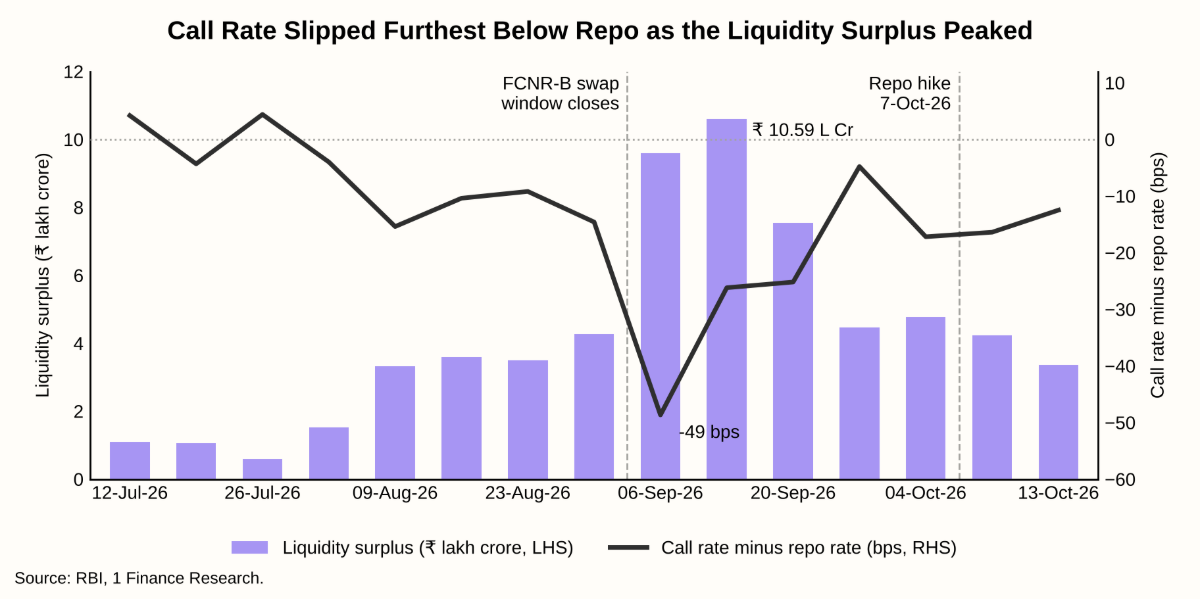
The chart makes the link plain. When the surplus swelled, market rates fell furthest below the repo rate. As it shrank, they climbed back. The last 16 bps of that gap should close once the CRR rule takes effect. Banks will then be paying the full repo rate for overnight money, and they will pass it on. That is when October's hike finally reaches borrowers.
The Price Rise Still Making Its Way to Shoppers
September's inflation numbers say less about what households are buying and more about what producers are paying.
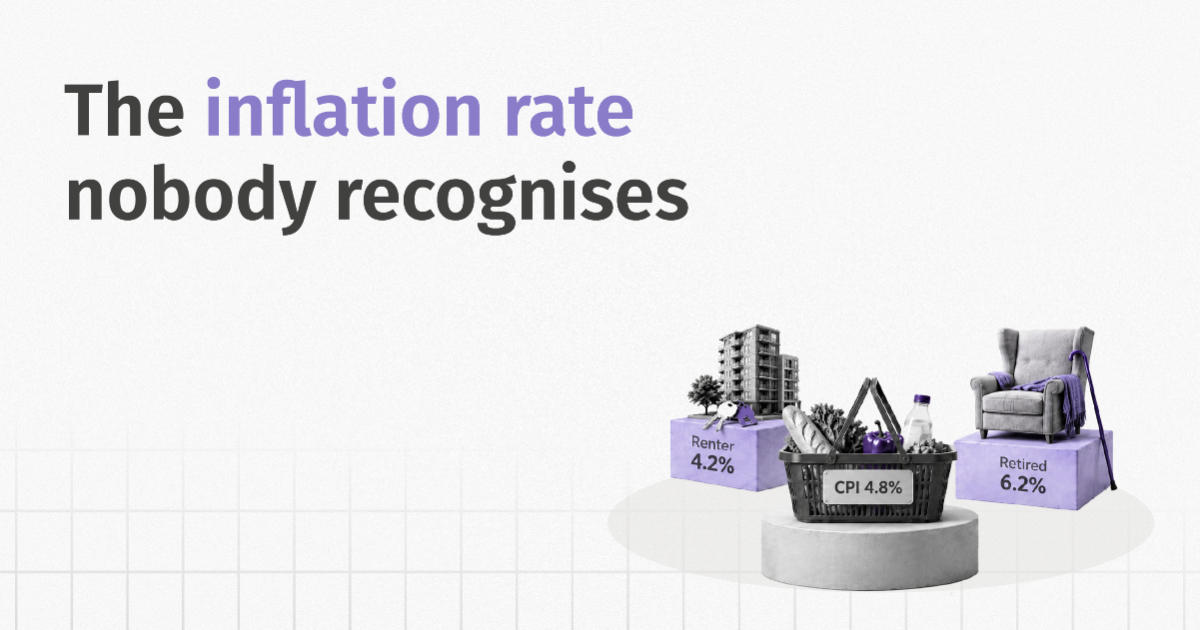
Retail inflation rose to 5.54%, a 23-month high, led by food at 7.74%. Wholesale inflation climbed to 11.39%, roughly double. That gap tells us producers are carrying most of this year's cost increase themselves, for now.
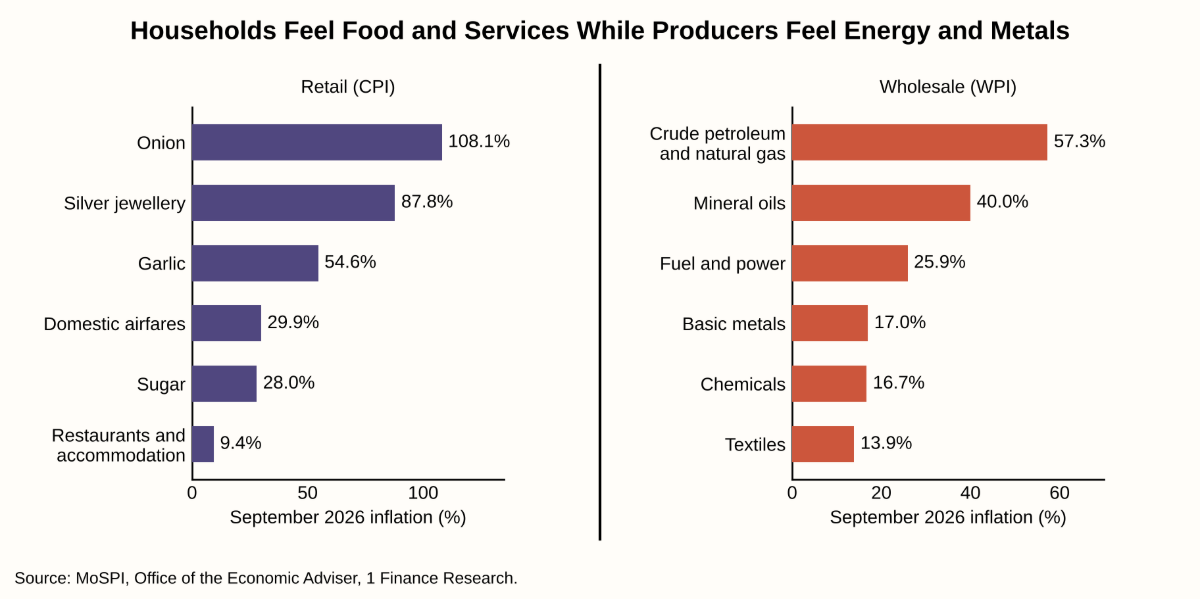
Put the two lists side by side, and they barely overlap. Households are paying more for onions, garlic, sugar, eating out and flights. Producers are paying more for crude, fuel, metals and chemicals. Those inputs end up inside almost everything households buy. Most of their cost simply hasn't reached the shelf yet.
The shock is coming from supply, not spending. Trace each driver back, and almost every one starts with something going wrong on the supply side.
| Driver | Type | Evidence | How long it lasts |
|---|---|---|---|
| Food (onion, garlic, sugar) | Supply | Weak rabi crop, June rainfall deficit | Fades as kharif arrives from late October |
| Energy (crude, fuel, power) | Supply | Hormuz disruption, Brent above $100 | As long as crude stays high |
| Imported inputs (edible oil, metals, chemicals) | Supply, worsened by a weak rupee | Global vegetable oil prices up 18.3%, rupee near 96 | Sticky, moves with global prices and the rupee |
| Services (restaurants, airfares) | Mixed | Jet fuel costs plus festive travel demand | The one to watch, since services inflation tends to persist |
The strongest proof is what isn't rising. Core inflation excluding gold and silver is just 3.2%. If demand were strong, firms would pass on their 10% rise in input costs without hesitation. They aren't, because they expect buyers to push back. This is the harder kind of inflation to manage: prices rise even as demand softens.
Supply shocks follow a familiar path. They usually unfold in three phases.
- The spike. Prices of the directly affected items jump, and headline inflation rises. We are here now.
- The spread. Over the next two to three quarters, input costs seep into other goods and services. Real incomes shrink, spending slows, and growth cools while inflation stays sticky.
- The fall. Once supply recovers, inflation drops fast, often faster than central banks expect, and policy has to turn just as quickly.
Raising rates won't bring onion prices down or calm the oil market. Central banks hike anyway, for two reasons: to stop the second phase from becoming permanent through wages and expectations, and to defend the currency so imported inflation doesn't get worse.
India has seen this play out before. After the 2022 Russia–Ukraine shock, wholesale inflation peaked near 16% and retail near 7.8%. The RBI raised rates by 250 bps over ten months, and by mid-2023 wholesale inflation had turned negative while retail fell below 5%. The difference this time is that the RBI has less room to wait. Food and energy have spiked together, the rupee is weaker, and foreign investors are leaving.
What Comes Next and How It Reaches Clients
The RBI is heading into the second phase with almost no buffer.
At the start of the year, the repo rate sat 2.5 percentage points above inflation. That cushion shrank month after month as prices rose. By September it had turned negative, and even after the October hike it is close to zero.
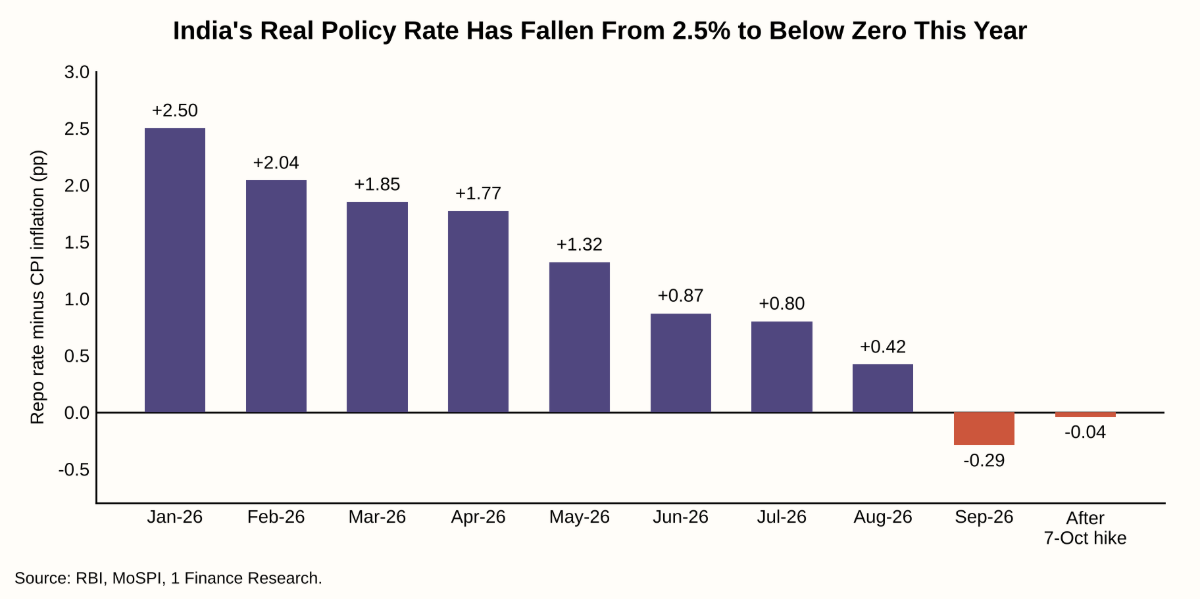
A real rate near zero means borrowing is effectively free once inflation is taken into account. No central bank fighting above-target inflation is comfortable there. That, more than any single inflation print, is why we expect the RBI to hike again.
Inflation should peak soon, but stay above 5%.
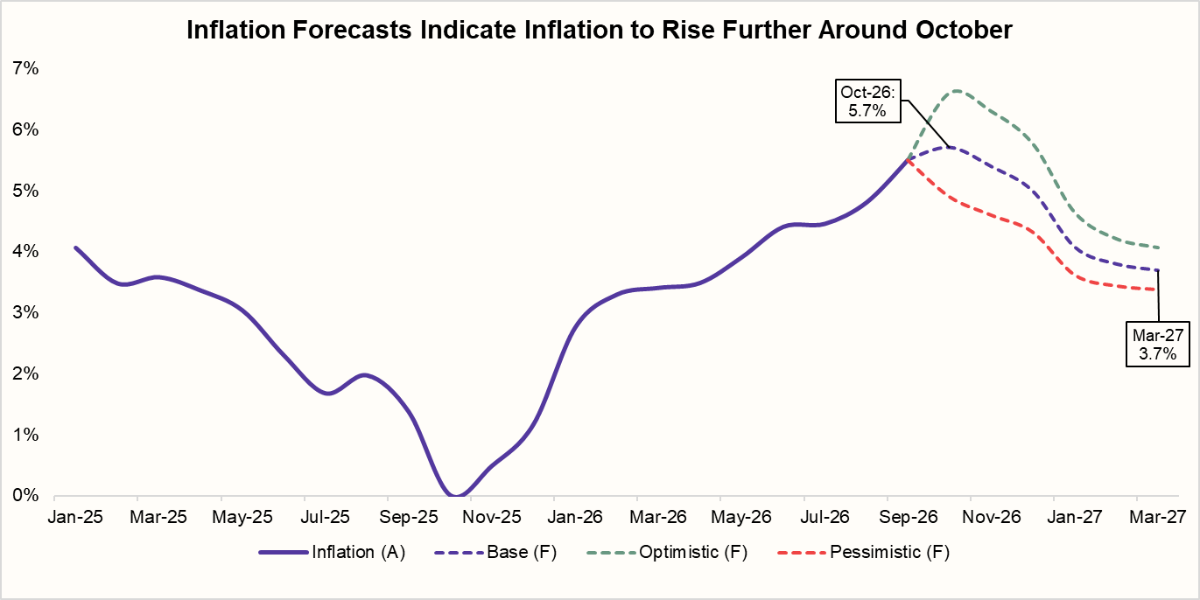
| Period | Our expectation | What drives it |
|---|---|---|
| October–November | Peak, around 5.5–6.0% | Onions stay high into early October, last year's GST-cut base effect drops out, festive demand |
| December–January | Easing, around 5.0–5.5% | Kharif arrivals cool vegetables, but factory costs keep passing through |
| February–March | Sticky near 5% | Pump price revisions, the rabi crop and the rupee |
The mix will change even as the headline eases. Food inflation fades on its own with the new harvest. What replaces it, higher prices for manufactured goods and possibly fuel, is slower to arrive and slower to leave. We don't expect inflation to return to the RBI's 4% target this financial year.
Growth will absorb the cost. The RBI already expects GDP growth to slow from 7.2% in July–September to 6.8% by January–March, and a supply shock adds to that by eating into real incomes. The second half of FY27 is shaping up as slower growth, higher rates and inflation above target. It is an uncomfortable mix, but historically it gives way to sharp rate cuts once supply recovers.
How this reaches clients
- Household budgets. Relief on food from December, offset by dearer goods, travel and eating out. A fuel price revision would raise commuting and delivery costs overnight.
- Savers. With inflation at 5.5%, a 6% deposit is barely holding its value, and after tax most savers are losing ground. Fresh deposits and short-duration funds should pay more by December.
- Bond investors. The supply-shock pattern matters most here. If inflation drops quickly once food and energy normalise, as it did in 2023, bond yields could fall sharply in 2027. Today's high yields may look like an opportunity in hindsight.
- Borrowers. Plan for another 25 bps reset on repo-linked loans after December. Relief is more likely in late 2027 than early 2027.
- Equity investors. The pain is uneven. Companies that buy energy, metals and chemicals but sell into price-sensitive markets face a margin squeeze this earnings season. Producers of those inputs, and companies with pricing power, are better placed. Oil marketing companies carry the largest hidden strain until pump prices are revised.
Domestic Money Is Holding Up the Market
Foreign investors are selling India hard. Domestic savers are buying everything they sell, and more.
Foreign investors sold ₹35,861 crore of Indian equities in September and another ₹44,166 crore in the first days of October, more than all of September in a fraction of the time. Their 2026 outflows now exceed ₹3 lakh crore, almost double the ₹1.66 lakh crore they pulled out in all of 2025. The selling sped up after the hike, as US 10-year yields climbed above 5.2%.
Domestic institutions have absorbed all of it. They bought over ₹64,000 crore in September, their 38th straight month of net buying, and about ₹6.21 lakh crore in 2026, roughly twice what foreigners sold. Mutual funds alone bought 3.5 times what foreign investors sold between June and October, fuelled by about ₹30,000 crore a month of SIPs.
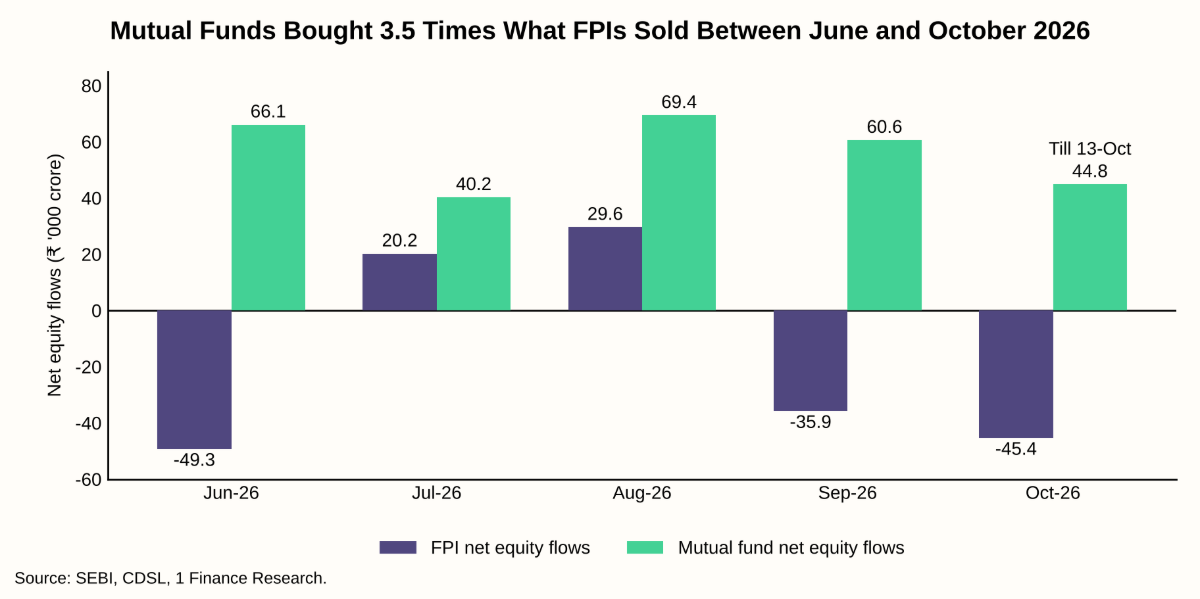
That cushion is what sets India apart this year. In the US, IPOs raised $32.8 billion in July–September, but $26.5 billion of it came from one deal, SK hynix. Strip that out and the quarter raised just $6.2 billion, as 19-year-high bond yields and renewed Fed hikes forced issuers to wait. India faced the same global rate shock, and its IPO market kept going because domestic money kept coming.
The foreign selling isn't about India. A common explanation is that global funds are leaving India to chase North Asia's AI stocks. The data doesn't support it. In September, foreigners pulled $23.5 billion out of Asian equities, and South Korea, home of SK hynix, accounted for over 70% of it.
| Foreign Money Is Leaving All of Asia, Not Just India | |||
|---|---|---|---|
| Market | August 2026 | September 2026 | What it shows |
| Taiwan | +$11.15 bn | −$1.4 bn (approx.) | AI-led buying lasted one month |
| South Korea | −$8.65 bn | Over −$16 bn | Fourth and fifth straight months of selling |
| India | +$3.10 bn | −$3.75 bn | Brief summer buying, then reversed |
| Seven major Asian markets | +$4.72 bn | −$23.49 bn | A region-wide exit, not a rotation |
The money is leaving Asia altogether, for US bonds paying above 5.2%. India's outflows are part of that wave and are unlikely to reverse until US yields fall. Until then, the market rests on domestic flows, and those flows rest on domestic liquidity, which is exactly what the RBI is now draining.
The IPO Boom Peaked With the Cash Flood
India's IPO boom and its cash flood peaked in the same month. In September, 34 mainboard IPOs raised ₹39,380 crore, the biggest month of 2026, while the banking surplus hit ₹11.16 lakh crore. Now that the cash is draining, the boom faces four pressures at once.
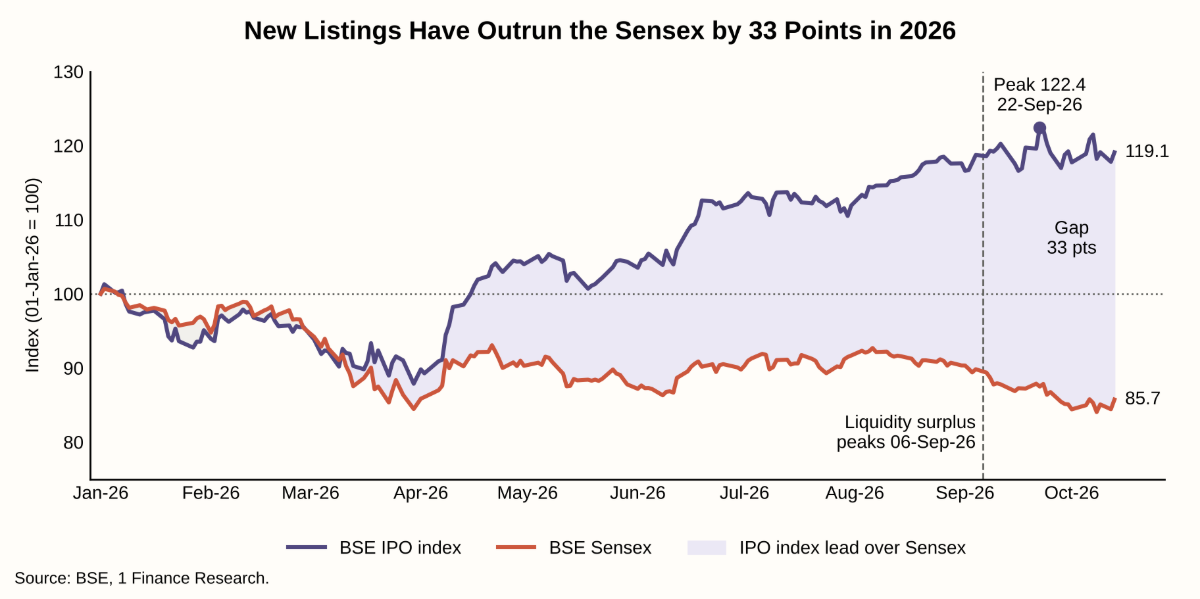
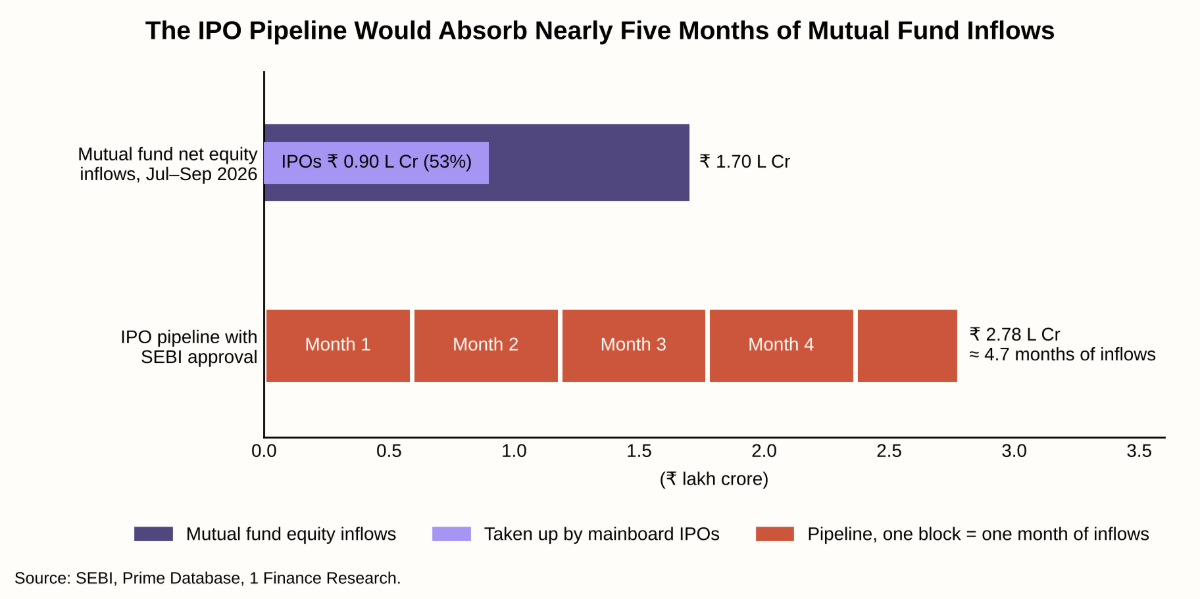
1. New issues are taking money from listed stocks. Mutual funds invested ₹1.70 lakh crore in equities between July and September. Mainboard IPOs raised about ₹90,400 crore in the same months, more than half as much. Money that would have bought existing shares bought new ones instead. That solves one of the year's puzzles: why the BSE IPO index is up 19% while the Sensex is down 14%. The listed market lost its marginal buyer to the primary market.
And the queue is long. About 145 companies with SEBI approval want to raise around ₹2.78 lakh crore, nearly five months of mutual fund equity inflows at this year's pace. Much of it is existing owners selling, not companies raising capital. NSE's ₹22,563 crore IPO, the largest of the half-year, was entirely an offer for sale. That money pays for exits, not expansion, so it adds shares to the market without adding to future earnings.
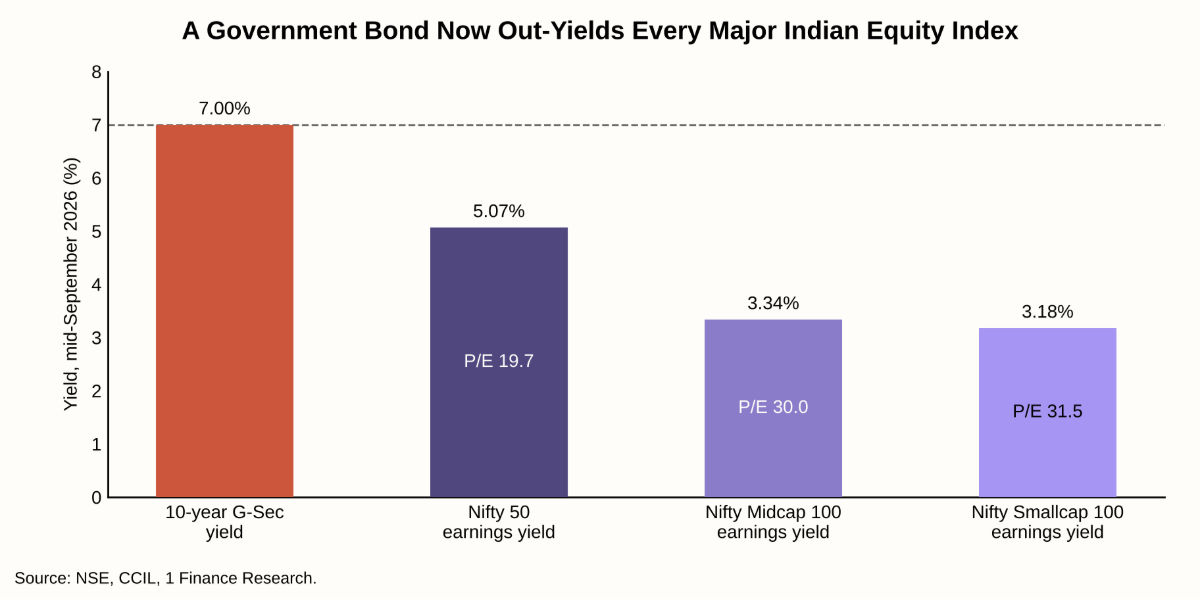
2. Bonds now compete with every stock. Selling bonds to drain cash pushes long-term yields up. In mid-September, a 10-year government bond paid about 7.0%, while the Nifty 50 earned about 5.1% on its price. Mid-caps and small-caps, where most new listings sit, earn closer to 3.2%. Owning a small-cap now means giving up almost 4 percentage points of risk-free return and betting that growth makes it back.
3. That growth is getting harder to deliver. Factory-gate prices are rising at 9.76% while core retail inflation is 3.2%, so firms are swallowing costs they can't pass on, just as borrowing gets dearer. For a company valued at 30 times earnings, a margin squeeze hits twice: lower profits, and a lower multiple on those profits. New listings, priced for growth that hasn't arrived yet, have the least room for error.
4. Mega-issues can tighten money by themselves. Large IPOs lock up cash during subscription, and leveraged bids from wealthy investors are funded with short-term loans. At ten times subscription, Jio Platforms' $3.8 billion issue alone would draw about ₹3.6 lakh crore of bids, roughly the size of today's entire banking surplus. In September's flooded market, nobody would have noticed. In a drained one, a mega-issue can push up short-term rates for the week it is open.
The first cracks are showing. The BSE IPO index peaked on September 22, as the surplus topped out, and has gone nowhere since. It still leads the Sensex by 33 points only because the wider market has fallen faster. NSE's own shares are already below their issue price.
What to expect. Not a sudden halt, but fewer, smaller deals at lower prices. Three things will set the pace: short-term rates after October 16, Q2 margins through November, and the December policy meeting. If all three turn against the market, the largest issues, Jio Platforms among them, will likely wait for 2027. SIP flows will keep the window open, but buyers, not sellers, will set the price.
What Decides the Next Three Months
The squeeze has one more step to go. After that, inflation decides.
On October 13, the call rate was 5.34%, still 16 bps short of the new 5.50% repo rate, with ₹3.36 lakh crore of surplus left. The CRR rule from October 16 should close most of that gap. From there, the RBI's next move depends on inflation, which is running ahead of plan. September CPI came in at 5.54%, above the RBI's own 5.2% forecast for the full year. A second hike at the December 2–4 meeting is our base case.
| Scenario | Probability | What triggers it | Rates | IPO market |
|---|---|---|---|---|
| Second hike in December (base case) | 55% | CPI stays above 5% in October and November, and WPI keeps running ahead of retail | Repo to 5.75%, call rate settles near repo | Large issues still list, on tighter pricing and thinner listing gains |
| Pause | 30% | Onions cool with kharif arrivals, Brent falls back below $90, and October CPI eases toward 5% | Repo holds at 5.50%, call rate near repo | Pipeline continues at today's pace |
| Hike plus CRR increase | 15% | Surplus stays stubborn after the new CRR rule, or the rupee breaks past 96 | Repo to 5.75%, short-term rates jump toward the 6.00% ceiling | The biggest issues, such as Jio Platforms, get pushed back |
Whichever path plays out, the cheapest money of 2026 is behind us. The only open question is how much more expensive it gets.
What This Means for Investors and Advisors
The message for clients is simple. Cheap money is over for now, inflation will stay above target, and the market is leaning on domestic savers. That rewards patience with new money and discipline with old gains.
For investors
- Phase new debt money in. Overnight rates are still climbing, and a December hike is likely, so fresh deposits and short-duration funds should pay more over the next two months.
- Judge returns after inflation. With inflation at 5.54% and set to stay above 5%, a 6% deposit barely keeps pace.
- Read the IPO document, not the subscription number. Check how much of an issue is fresh capital and how much is an offer for sale.
- Plan for higher EMIs. Repo-linked loans reset after October's hike, and our base case adds another 25 bps in December.
For advisors
- Review exposure to recent listings. The IPO index's 19% gain has carried some portfolios. With momentum fading and liquidity tightening, bring them back to target allocations.
- Stagger debt, then add duration as inflation peaks. That captures today's high yields without locking in just before a likely December hike, and positions portfolios for lower yields once the supply shock fades.
- Watch domestic flows. Mutual fund buying is what holds the market up against foreign selling. A slowdown in SIP inflows would be the earliest warning sign.
- Prepare borrowers early. Talk through higher EMIs before the bank's reset letters arrive.