The 57th GST Council meeting, held in New Delhi on 8 October 2026, recommended a broad package of GST process reforms. It proposed removing GST arrest powers, raising the prosecution threshold to ₹5 crore, cutting the maximum general penalty to ₹10,000 and moving specified refunds to system-based processing.
None of it is law yet. Most changes need a CGST Act amendment, and the Council has proposed two refund start dates, 1 November 2026 and 1 April 2027. Below, we explain how GST works, how much it collects and refunds, what the Council proposed, and what it means for investors and advisors.
How GST Works in India
Goods and Services Tax (GST) is India's single indirect tax on goods and services, in force since 1 July 2017. A sale within a state is split equally between Central GST (CGST) and State GST (SGST). A sale across states, or an import, carries Integrated GST (IGST), later shared with the consuming state. Most goods now sit in two main slabs, 5% and 18%, since 22 September 2025.
Businesses register once turnover crosses ₹20 lakh, or ₹40 lakh if they supply only goods, with lower limits in some states. Each seller then pays GST on its sale minus the tax already paid on its purchases, called input tax credit (ITC). For example, a shop pays ₹18 GST on stock it buys and charges ₹36 GST when it sells. It deducts the ₹18 and pays only ₹18. If that credit is blocked, it pays the full ₹36, so the same goods are taxed twice and prices usually rise.
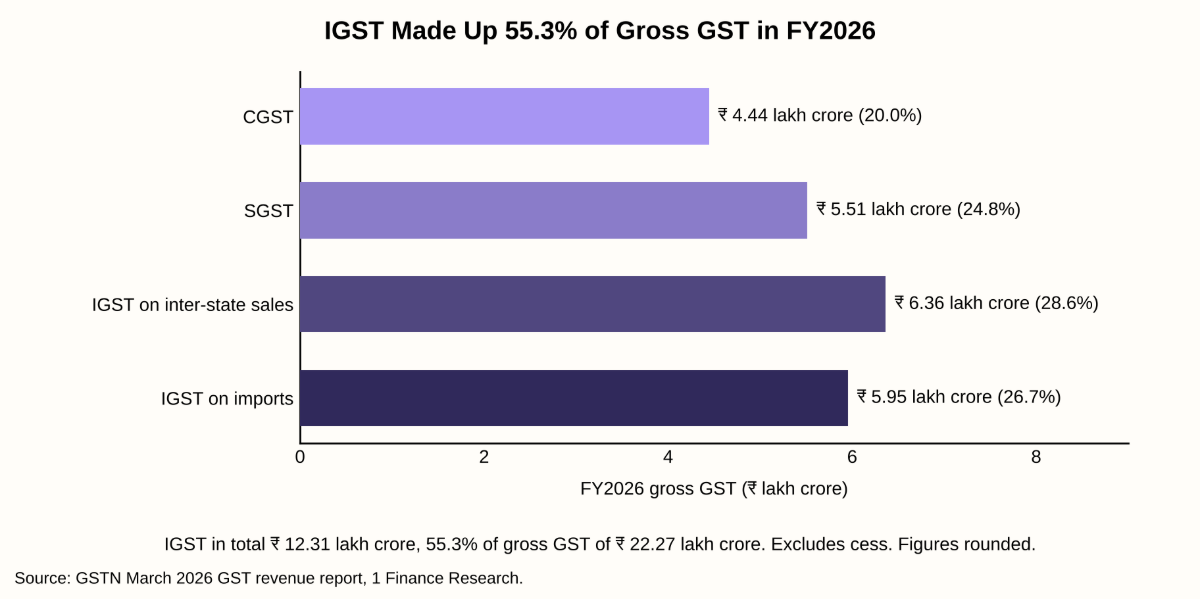
IGST is the tax on a sale from one state to another, or on an import. The Centre collects it and later settles the state's share with the state where the goods or services are consumed. The buyer can still claim it as credit. In FY26, IGST made up ₹12,31,485 crore, or 55.3% of gross GST. When a business pays more GST on inputs than it charges on output, the extra credit piles up as cash locked with the government. Blocked credit and slow refunds are exactly what the 57th meeting targets.
GST Collection in FY26 and FY27 So Far
GST refunds are growing faster than collections. In FY26, India collected ₹22,27,096 crore in gross GST, up 8.3%, while refunds rose 17.8% to ₹2,92,330 crore. The gap held in the first half of FY27, from April to September 2026. Gross GST rose 11.6% to ₹12,46,278 crore, and refunds rose 18.8% to ₹1,80,163 crore.
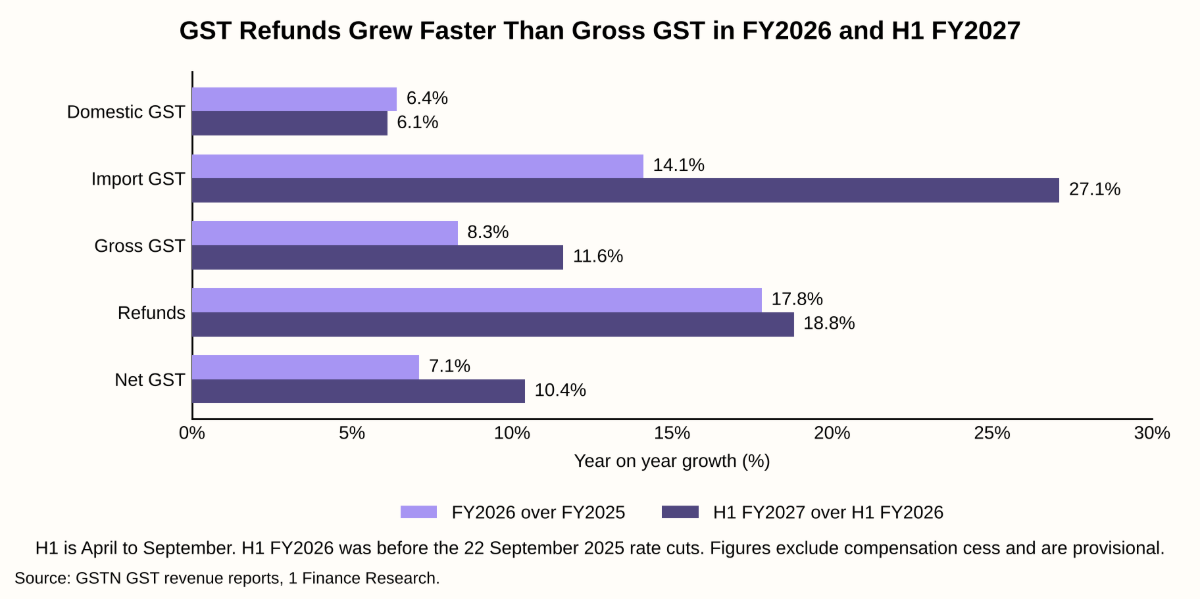
Note: Growth is year on year. H1 FY27 is compared with April to September 2025, before the 22 September 2025 rate cuts. Figures exclude compensation cess and are provisional.
Imports drove the growth in collections. Import GST rose 14.1% in FY26 and 27.1% in H1 FY27, while domestic GST grew 6.4% and 6.1%. Refunds took between 13.1% and 16.6% of gross GST each month in H1 FY27. That is the cash the refund reforms aim to release faster.
57th GST Council Meeting Highlights
The Council, chaired by Union Finance Minister Nirmala Sitharaman, moved from rates to processes. After the 56th meeting cut rates, the 57th focused on how GST is filed, refunded and enforced. Its recommendations take effect only through Act amendments, rules, notifications or circulars.
The main proposals fall into six groups:
- Enforcement. Withdraw arrest powers, raise the prosecution threshold to ₹5 crore and cap the general penalty at ₹10,000.
- Disputes. No show cause notice below ₹10,000 of tax, a 5% penalty in some non-fraud cases and a ₹40 crore cap on pre-deposit for penalty-only appeals.
- Refunds. System-based processing for specified refunds and a shorter acknowledgement window.
- Input tax credit. New refunds of accumulated credit and fewer blocked credits.
- Registration and returns. Automatic approval of most registration changes and a new return correction mechanism.
- Small businesses. A late fee waiver and an optional quarterly payment scheme, both for turnover up to ₹5 crore.
Input tax credit fraud was rising fast before the meeting. Cases detected by Central Board of Indirect Taxes and Customs (CBIC) central tax formations rose about five times, from 5,966 in FY22 to 30,162 in FY26, and nearly doubled in FY26 alone. The amount detected reached ₹74,782 crore in FY26, up 27% on FY25.
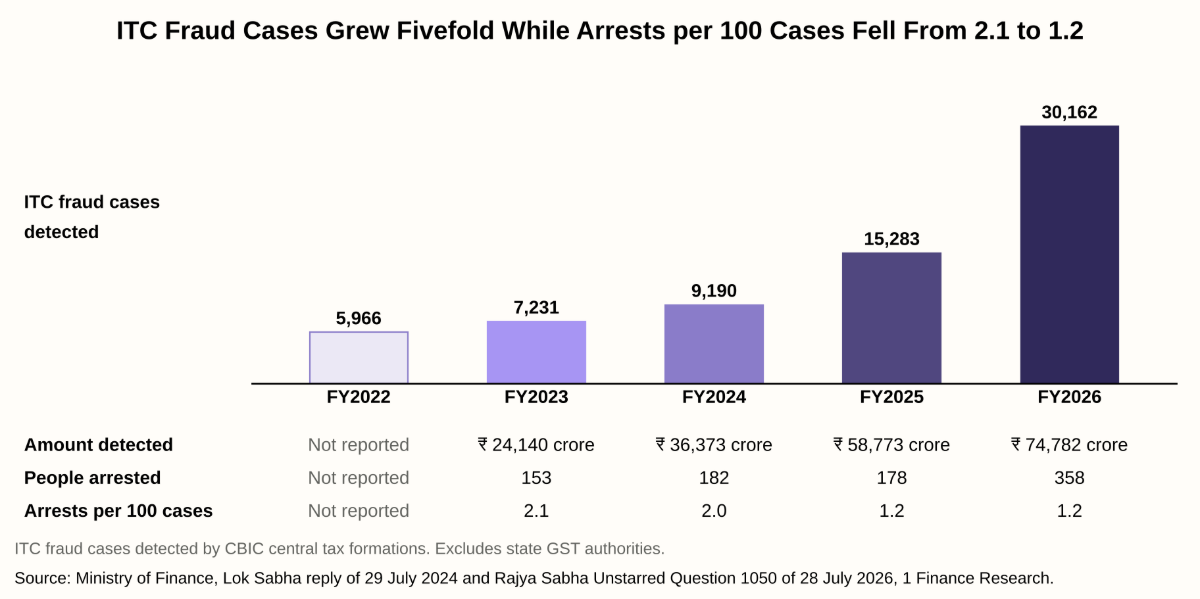
Note: Covers ITC fraud cases at CBIC central tax formations only, not state GST authorities. FY24 figures match in both parliamentary replies.
| 💡Did you know? Section 69 of the CGST Act gives officers the power to arrest for specified GST offences, and the 57th meeting recommended omitting it. Arrests were low relative to cases detected. In FY26, central tax officers arrested 358 people while detecting 30,162 ITC fraud cases, about 1 arrest for every 100 cases. |
Old vs New GST Rules
The 57th meeting proposes 14 selected GST changes. Read the status column first, because nothing below is in force until that step is done.
The 57th GST Council Proposes 14 Selected Changes to Enforcement and Refunds
| The 57th GST Council Proposes 14 Selected Changes to Enforcement and Refunds | |||||
|---|---|---|---|---|---|
| Area | Before | Proposed | Change | Status | Who benefits |
| Arrest powers | Section 69 allows arrest | Section 69 omitted | Power withdrawn | Act amendment | Taxpayers under investigation |
| Prosecution threshold | ₹2 crore for most offences; ₹1 crore for fake invoicing | ₹5 crore | 2.5 times; 5 times for fake invoicing | Act amendment | Smaller cases stay civil |
| Maximum general penalty | ₹25,000 | ₹10,000 | 60% lower | Act amendment | Businesses with minor lapses |
| Show cause notice floor | None | ₹10,000 of tax across all GST heads and cess | New floor | Act amendment | Small taxpayers |
| Non-fraud penalty | 10% of tax or ₹10,000, whichever is higher, under Sections 73 and 74A | 5% if tax and interest are paid within 30 or 60 days of the order; ₹10,000 minimum dropped | Up to half | Act amendment | Businesses that settle quickly |
| Pre-deposit, penalty-only appeals | No cap | ₹40 crore (₹20 crore CGST, ₹20 crore SGST or UTGST) | New cap | Act amendment | Large penalty disputes |
| Refund acknowledgement | 15 days | 10 days, deemed issued if missed | 5 days faster | Rule change | All refund claimants |
| Cash ledger refund | Processed by an officer | Full amount sanctioned by the system | No officer step | Rule change | Businesses with surplus cash |
| Provisional refund | 90% by an officer using a system risk score | 90% by the system for export and inverted duty claims | No officer step | Phased | Exporters and inverted duty manufacturers |
| Input services credit refund | Not refundable in inverted duty cases | Refundable | New refund | Credit from 1 November 2026 | Manufacturers with costlier inputs |
| Capital goods credit refund | Not refundable | Refundable over 60 months in export and inverted duty cases | New refund | Credit from 1 April 2027 | Capital-heavy exporters |
| Blocked credits | Specified items blocked under Section 17(5) | Specified restrictions removed | More credit | Act amendment | Employers, telecom firms, consumer brands |
| E-way bill checks | Any proper officer in any state | Specific intelligence, Joint Commissioner approval, supplier's or recipient's state only | Narrower power | Act amendment | Transporters |
| Late fee | Applies from day one | Waived for turnover up to ₹5 crore if filed within the due month | Waiver | Pending notification | Small businesses |
Most enforcement changes need a CGST Act amendment. The refund changes mostly remove an officer from steps the system already scores, so the gain is time. In a later phase, low-risk export refunds could be sanctioned in full by the system.
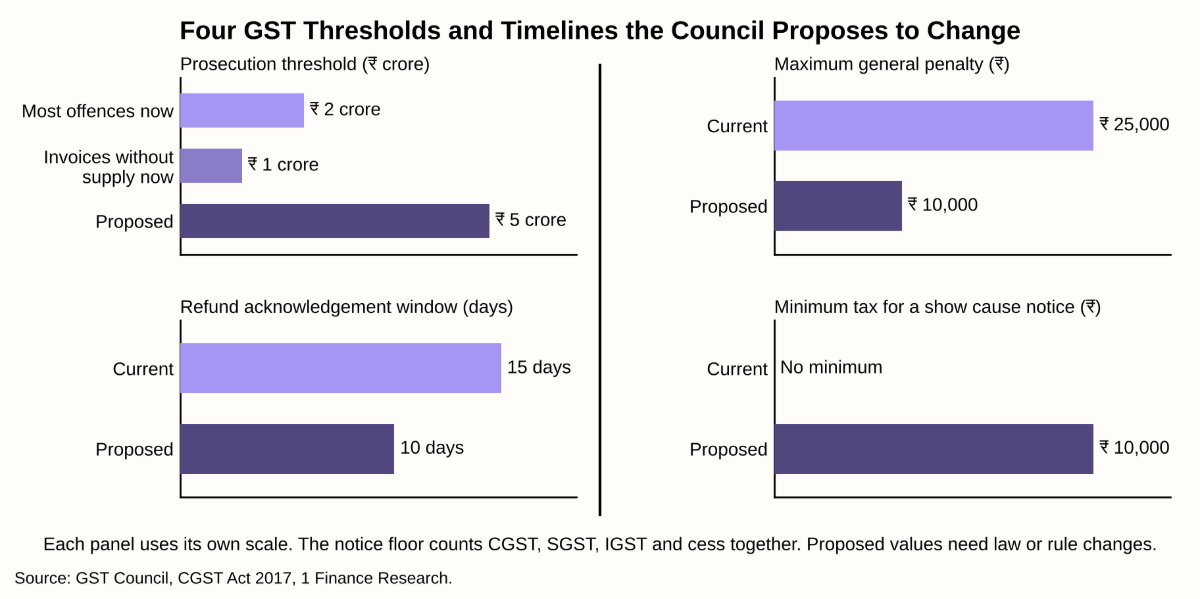
| 💡₹2 crore to ₹5 crore for most offences The release says ₹1 crore to ₹5 crore, but most offences already need over ₹2 crore of tax. Only issuing invoices without supply sits at ₹1 crore today. |
GST Impact on Investors and Advisors
The 57th meeting changes cash flow and compliance risk more than tax rates. Investors reading company results and advisors guiding clients should watch the same sectors from Q4 FY27 onwards, because the effect differs sharply between them.
GST Proposals Help Exporters Most and Cost Delivery Platforms
| GST Proposals Help Exporters Most and Cost Delivery Platforms | |||
|---|---|---|---|
| Sector | Proposed change | Likely direction | What to track |
| Exporters and inverted duty manufacturers | Faster system refunds; refunds of credit on input services | Positive for cash flow | Receivable days, GST refunds receivable, finance costs |
| Capital-heavy exporters | Capital goods credit refundable over 60 months from 1 April 2027 | Positive, gradual | Capex timing, refund balances |
| Telecom tower and pipeline owners | Credit unblocked on towers and pipelines outside factories | Positive, subject to final law | Effective tax cost of new capex |
| E-commerce and quick commerce platforms | 5% without credit on specified delivery services | Negative for margins | Delivery fees, contribution margin |
| Recyclers and scrap buyers | Reverse charge and 2% TDS on specified scrap | Negative for working capital | Working capital days, compliance costs |
| Restaurants, hotels and gyms | Limited credit within the same line of business | Mildly positive | Margins on outsourced services |
| EV fleet operators | Optional 5% rate with restricted credit | Positive option | Ride and rental pricing |
One caution when reading GST data. The September 2025 rate cuts lower the tax collected per rupee of sales, so compare growth across that date with care.
For investors and advisors, the practical checklist is the same:
- Separate proposal from law. Change tax planning or earnings estimates only after a notification or Act amendment.
- Treat refunds as cash, not profit. A faster refund releases cash once. It does not change the tax a business owes or its margins.
- Check who qualifies. The system's risk score decides who gets fast refunds, so not every exporter in a sector gains equally. Clean claims matter.
- Flag the capex date. Only capital goods credit taken on or after 1 April 2027 would qualify for the new refund, which shapes when exporters buy equipment.
- Budget for new costs. Delivery platforms, logistics partners and recyclers face higher costs, which should show up in margins before contracts renew.
- Prepare small businesses. Firms with turnover up to ₹5 crore may gain the late fee waiver and, later, the optional quarterly payment scheme.
The main risks are about execution. Portal changes can slip, final rules can narrow, and fake invoicing could rise if data checks lag.
GST Reform Timeline
The reforms will arrive in steps. The table shows which dates are fixed and which are still proposals.
| The GST Reforms Arrive in Steps Through FY28 | ||
|---|---|---|
| Date | Milestone | Status |
| 1 July 2017 | GST launches, replacing excise duty, VAT and service tax | In force |
| 1 October 2023 | Prosecution threshold rises to ₹2 crore for most offences | In force |
| 22 September 2025 | Most goods move to two main slabs of 5% and 18% | In force |
| 8 October 2026 | 57th Council meeting recommends process reforms | Recommended |
| 1 November 2026 | Input services credit taken from this date becomes refundable in inverted duty cases | Proposed |
| February 2027 | CGST Act amendments, likely through the Finance Bill | 1 Finance estimate |
| April 2027 | Capital goods credit taken from this date becomes refundable over 60 months; the return correction mechanism starts | Proposed |
Conclusion
The 57th GST Council meeting proposes a GST that relies more on trust and ties up less cash. The stakes are large. Refunds reached ₹2,92,330 crore in FY26, 13.1% of gross GST. The gain now depends on the Act amendments and on refunds actually moving faster from 1 November 2026 and 1 April 2027.