Indian markets already have enough to worry about. Foreign investors have pulled a record ₹3.12 lakh crore out of Indian equities this year, the RBI has started hiking rates, and the 10-year G-sec yield is near 7.47%, its highest since March 2023. Into that mix comes a G7 government paying 5.05% to borrow for a decade.
France matters to India for reasons that have little to do with bilateral trade. It is pushing up yields on rich-world bonds, which makes Indian debt look less rewarding to foreign buyers. It sits inside the European fund complex that holds a quarter of all foreign money in Indian markets. And its presidential election in April-May 2027 lands weeks after the India-EU trade deal is due to take effect. Our view is that France will stay a live source of global market stress until that election, and Indian portfolios should be positioned for a long squeeze rather than a crisis.
Key Takeaways
|
France Fails the Test That Protects Other Rich Borrowers
Debt levels alone don’t explain bond stress. Japan’s government debt is about 199% of GDP and the US’s is about 127%, yet neither faces France’s pressure. France fails on three counts.
Who lends. Foreigners now hold 59.7% of French government debt, up from 50.9% in early 2023. When they sell, there is no large domestic buyer to take their place.
Which currency. France borrows in euros, which it cannot print. Japan and the US borrow in their own currencies, so they can create the money to repay. France relies on the European Central Bank, which serves 21 countries and cannot easily rescue one of them.
Who governs. No bloc has held a parliamentary majority since the 2024 snap election. The 2026 budget passed only because it was forced through without a vote.
The numbers reflect this. The deficit is 5.4% of GDP, against Italy’s 2.9%, and gross debt reached 115.7% of GDP at the end of 2025. French private debt is 214.3% of GDP, against 153.5% for the euro area, so there’s little domestic money to fund the state. In five of the last ten months, France has paid more than Italy to borrow.
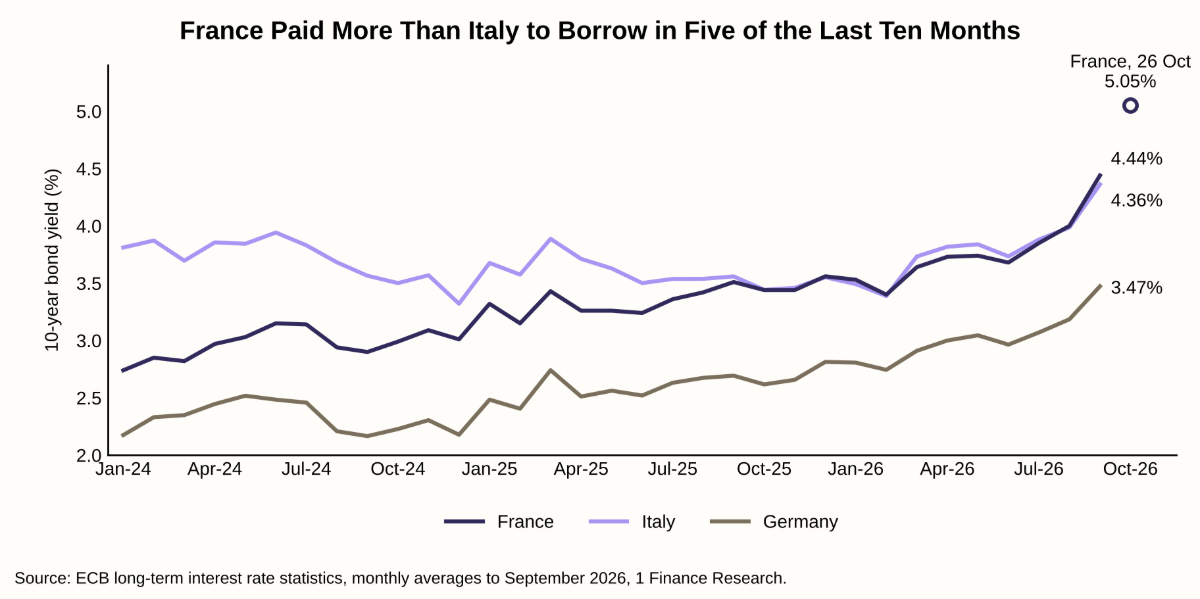
Ratings are lagging the market. Fitch and S&P rate France A+, and Moody’s, at Aa3 with a negative outlook, held off on 23 October. The clearer signal may be the polls, where Jordan Bardella has led first-round scenarios ahead of the 18 April 2027 vote.
Stress Will Last Until the Vote
The cleanest way out for France would be a credible budget that cuts spending. Nothing in the parliamentary arithmetic suggests that is coming. The more likely path is a 2027 budget forced through with Article 49.3, a deficit target that stays near 5%, and bond investors who keep demanding a premium until they see who wins in May.
The ECB will not short-circuit that process. Euro-area inflation is running at 3.8%, so it cannot cut rates to help, and ING estimates that the bond selloff has already tightened French financial conditions by the equivalent of a 50 bps hike. Its emergency tool, the Transmission Protection Instrument, requires a country to comply with EU fiscal rules, which France currently does not. ING expects the ECB to defend other eurozone bond markets before it buys French debt. That keeps the stress contained to France, but it also means France has no backstop until it fixes its own budget.
| Scenario | Likelihood | What triggers it | French 10-year spread over Germany | What it means for India |
|---|---|---|---|---|
| Slow squeeze | High | No new shock; budget forced through, no real spending cuts, ECB holds | 150 to 200 bps | Bond yields stay high, foreign investors keep selling, no sudden shock |
| Sharp shock | Medium | Government falls, S&P cuts France, or a spending-led winner clashes with Brussels | Above 200 bps | Faster foreign selling, rupee weaker against the dollar, possible delay to the India-EU trade deal |
| Spending cut agreed | Low | Parties agree to cut spending | Falls back below 150 bps | Bond yields ease and European investors return |
The election shock deserves more weight than markets are giving it. Jordan Bardella, leader of the far-right National Rally, has led first-round polls ahead of the 18 April 2027 vote. Italy's 2018 standoff took its spread to about 325 bps before Rome backed down. A French version would hit a bigger market, with a larger foreign investor base, and with the ECB less able to help.
France Is Making Indian Bonds Look Less Rewarding to Foreign Buyers
The most direct channel to India runs through bond yields. Every global investor deciding whether to hold Indian government bonds compares them with what rich-world sovereigns pay. In January 2024, India's 10-year yield was 446 bps above France's. By September 2026, that premium had shrunk to 262 bps, and with India near 7.47% and France at 5.05% as of Oct 2026, the gap is now closer to 240 bps.
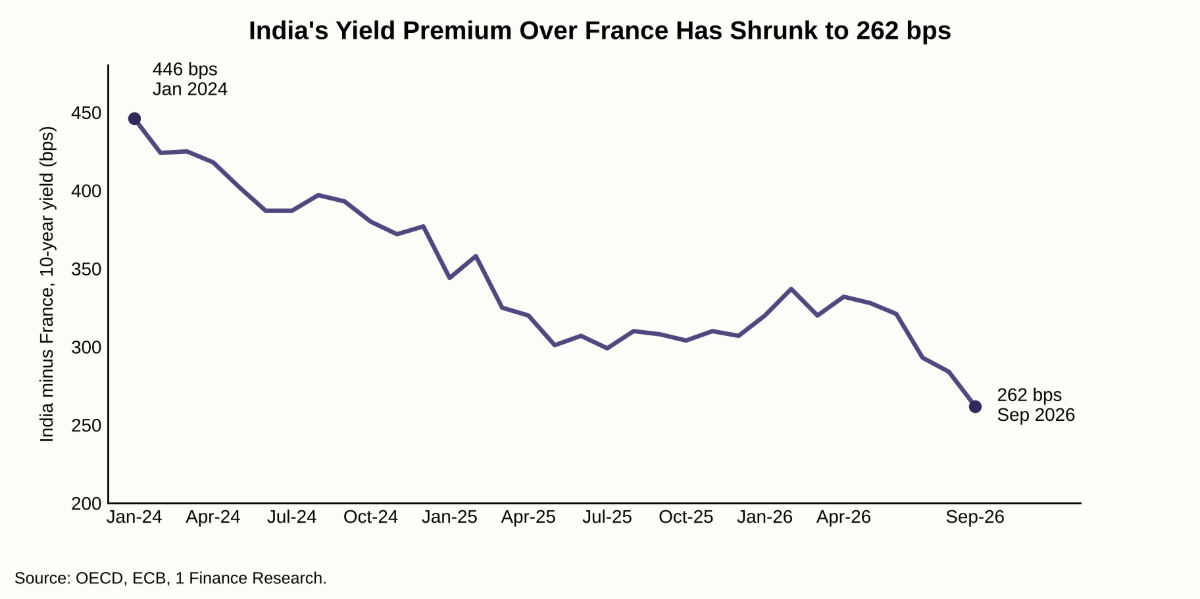
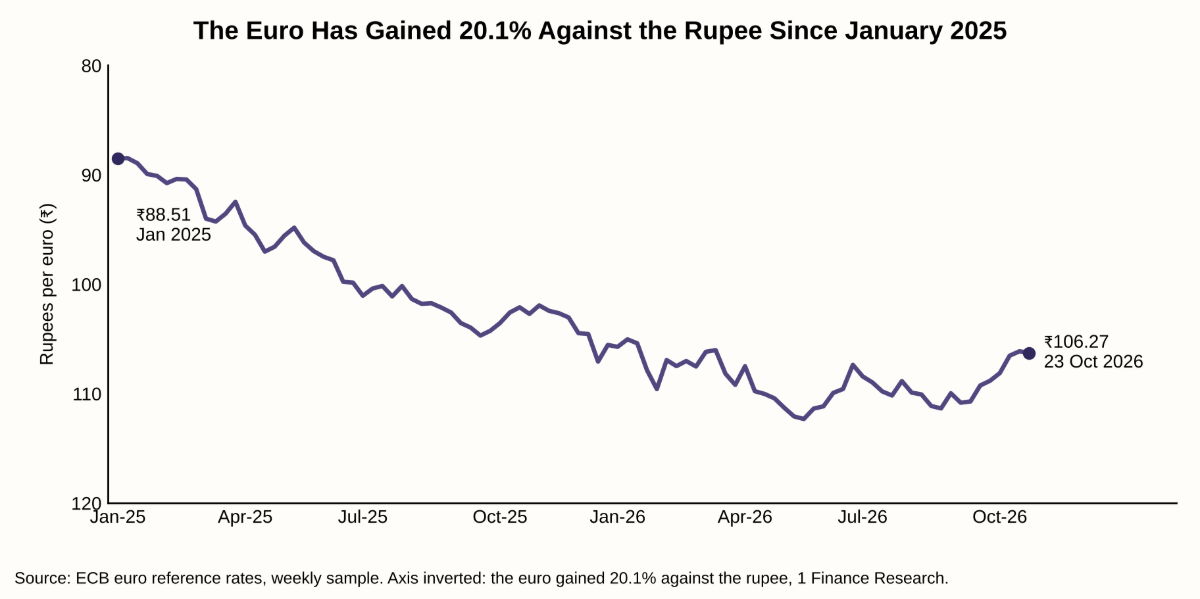
A thinner premium is only half the problem. A euro-based investor who bought Indian bonds in January 2025 has seen the euro rise 20.1% against the rupee since then, which has wiped out several years of extra yield. The same investor can now earn 5% at home on an A+ rated G7 bond with no currency risk. That arithmetic explains why foreign money has been leaving India even as Indian yields rise. FPIs have sold a record ₹ 3.12 lakh crore of Indian equities in 2026, with analysts citing the 10-year US Treasury above 5.15% on 19 October as the main pull.
France adds a second anchor to that global yield floor. For Indian yields to ease meaningfully, two things need to happen: oil has to retreat from above $100 a barrel, and long-term yields in the US and Europe have to stop rising. France makes the second condition harder to meet. With domestic CPI at 5.54% and the RBI's repo rate at 5.50% after a 25 bps hike, we expect the Indian 10-year to stay above 7% for the rest of FY27, with downside only if oil falls sharply.
A Quarter of Foreign Money in India Sits in European Funds
French investors held ₹ 1,71,205 crore of Indian assets in September 2026. That is 2.3% of all foreign holdings in India, a modest share on its own. The bigger exposure sits in the European funds around it. Funds domiciled in Luxembourg, Ireland and France together hold 16.3% of all foreign holdings in India.
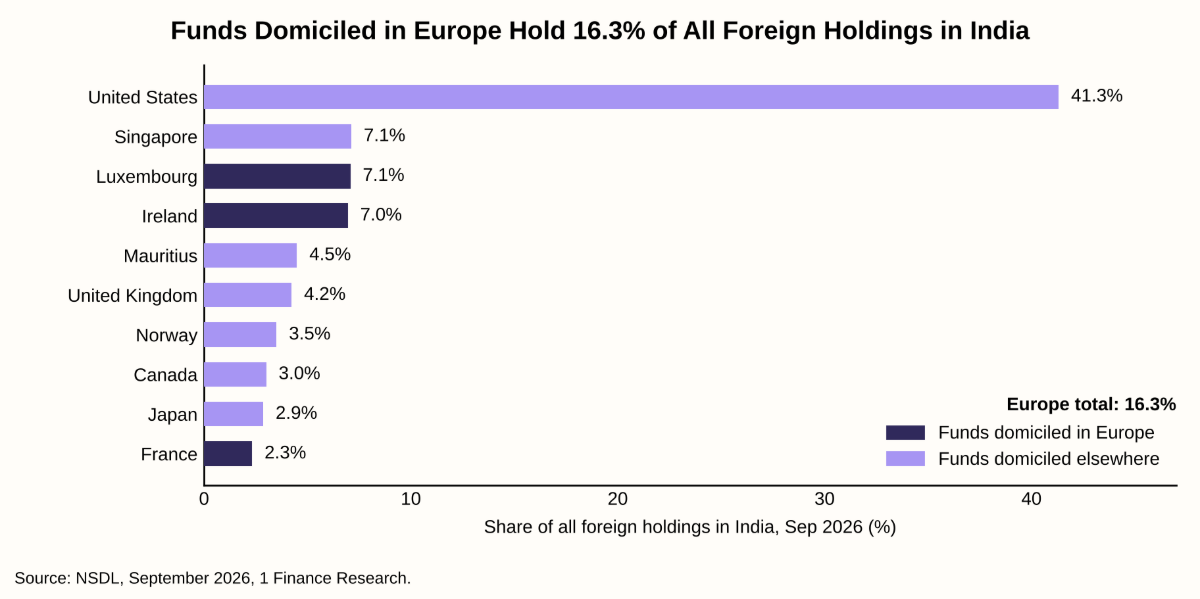
Not all of that is European money. Global managers house many of their Indian funds in Luxembourg and Ireland. But these holdings move with European risk appetite and European redemptions.
French holdings have also been volatile. They rose by about ₹ 30,900 crore in October 2025 alone, to ₹ 2,02,216 crore, then fell to ₹ 1,58,880 crore by March 2026. Part of those moves reflects market prices rather than new buying.
The risk now runs the other way. When a French insurer can earn 5% on its home government’s bonds, the bar for holding volatile emerging-market assets rises. Losses on French government bonds (OATs, or Obligations Assimilables du Trésor) also shrink insurers’ risk budgets. We do not expect European money to drive a wave of selling, because India’s weight in European portfolios is small. We do expect it to stay a marginal seller until French yields stabilise. That removes a source of demand when India can least afford it, which makes steady domestic SIP flows more important for market stability.
A Weaker Europe Squeezes Indian Exporters Now but Feeds Outsourcing Later
The euro has fallen from ₹ 112.32 on 20 May to ₹ 106.27 on 23 October, a 5.4% slide. For India, the effect splits cleanly. Anyone earning or holding euros loses in rupee terms. Anyone spending euros, from families paying European tuition to buyers of European capital goods, gains.
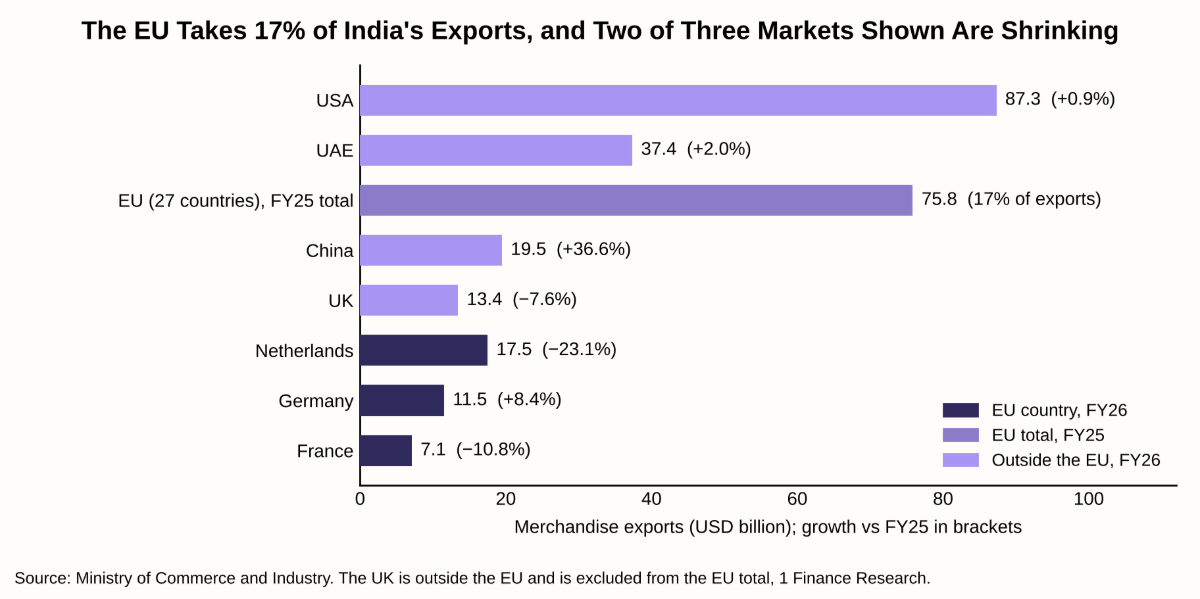
Goods trade with France is small. India exported $7.1 billion to France in FY26, about 1.6% of the total. The wider EU picture is mixed. The Netherlands and France fell, while Germany grew 8.4%. Services matter more. The UK and Continental Europe together make up a third of revenue at India’s largest IT company, at 17.8% and 15.2% of Q2 FY27 revenue respectively.
In the next two quarters, a softer euro and cautious European clients will weigh on deal timing and rupee realisations. Over two to three years, austerity and higher borrowing costs in Europe push companies to cut costs, and that favours India. The base is already in place: Thirty-eight of the CAC 40 companies are present in India. French firms employ about 300,000 people here, and cumulative French FDI reached about €9.8 billion between 2000 and March 2025.
The India-EU FTA lands weeks before the French first round. Tariff gains for garments, pharma and engineering goods should arrive on schedule. Investment protection provisions need national ratification, so they carry the real election risk.
What Advisors Should Tell Clients Now
Most clients will not ask about French bonds. They will ask why foreign investors keep selling, why their debt funds are flat and whether their European fund is safe. France is part of the answer to all three.
| Client situation | What France changes | How we would frame it |
|---|---|---|
| Holds global or European feeder funds | Unhedged euro exposure plus French political risk until May 2027 | Review how much of the fund sits in France. Avoid adding to France-heavy European exposure before the election |
| Has euro goals such as education, travel or property | The euro is 5.4% cheaper in rupees than on 20 May, and election volatility could swing it either way | Convert in stages over the coming months rather than all at once, keeping part of the amount flexible |
| Invests in debt funds | France and the US are holding up the global yield floor | Favour accrual over duration until global long-term yields stabilise |
| Worries about FPI selling in Indian equities | Outflows are driven mainly by US yields, with France adding at the margin | Explain that domestic SIP flows are the market's anchor and that discipline matters more than timing |
| Is overweight IT services or Europe-facing exporters | The UK and Continental Europe make up a third of TCS revenue, and the FTA arrives with election risk attached. | Expect near-term softness, and weigh it against a medium-term outsourcing tailwind |
The broader lesson is one advisors can use in any conversation about government debt. India's general government deficit, at 7.5% of GDP in the IMF's 2026 forecast, is actually wider than France's 5.4%. Markets treat India far more kindly because its debt is mostly held at home and issued in rupees, and because Indian private debt is about half of France's as a share of GDP. A deficit number tells a client very little until they know who funds it.
Seven Dates Will Decide How Much of This Reaches India
| Date | Event | What we are watching for |
|---|---|---|
| 29 October 2026 | ECB policy decision | Any signal that the ECB will slow quantitative tightening to calm bond markets |
| End of October 2026 | INSEE first estimate of Q3 GDP | A third weak quarter would make deficit targets harder to meet |
| 27 November 2026 | S&P review of France | A cut below A+ could force selling by rating-sensitive investors |
| December 2026 | ECB staff projections and India-EU FTA signing | Whether the ECB resumes hikes, and whether the FTA is signed on schedule |
| 11 December 2026 | KBRA review of France | The last rating action of the year |
| 18 April 2027 | French presidential first round | Whether a spending-led candidate leads by a wide margin |
| 2 May 2027 | Run-off | The single biggest event risk for euro-area bonds in the year ahead |
Signals to track
- France over Germany, 10-year spread: 97 bps as a September average. Above 150 bps on a sustained basis would mean we are moving from our base case into political breakdown.
- India over France, 10-year spread: about 240 bps now. A move below 200 bps would make Indian bonds noticeably less attractive to foreign buyers.
- EUR/INR: ₹ 106.27 on 23 October. A break below ₹ 104 would signal the euro is absorbing more of France's risk, which improves the case for converting euro needs early.
- Monthly FPI flows from European domiciles: a turn back to net buying would be the first sign that the French squeeze is easing.