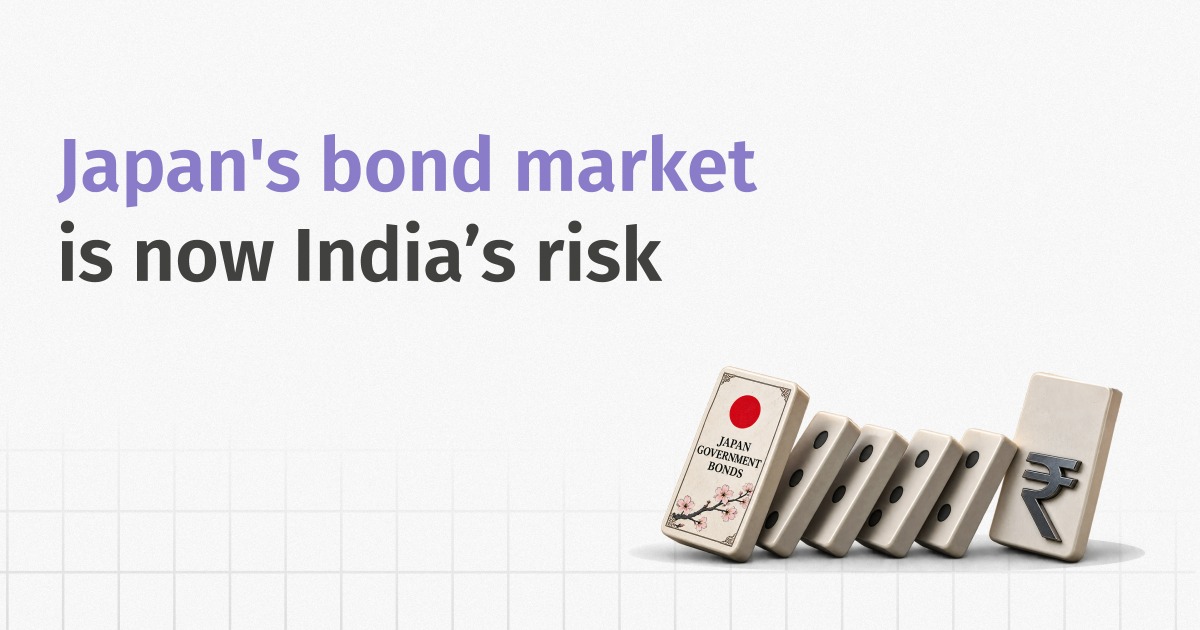
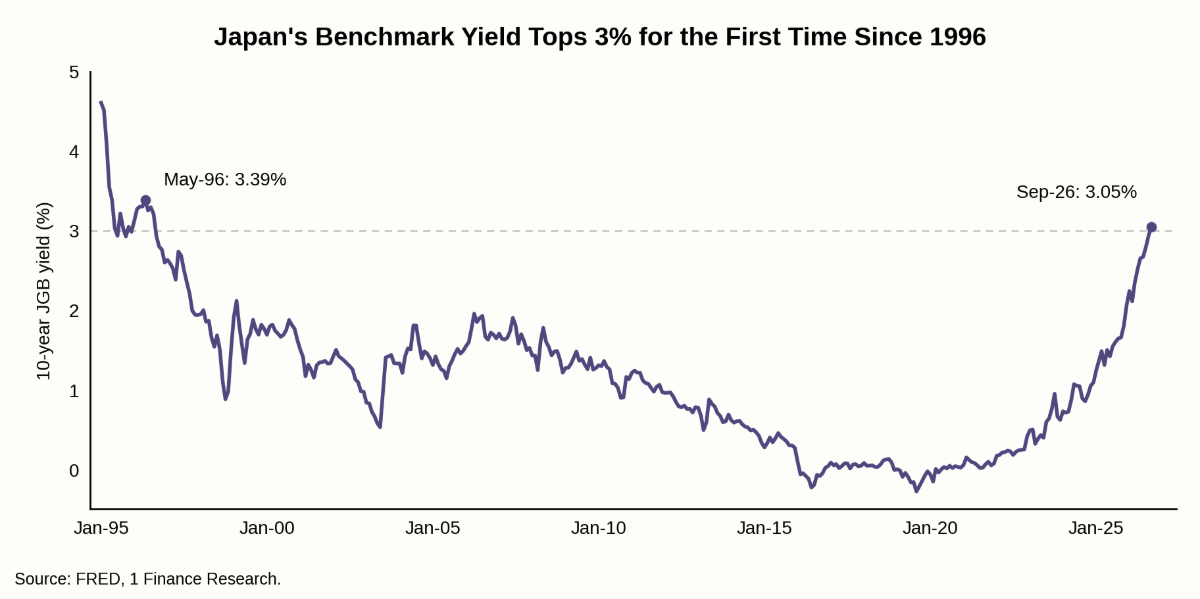
Here's a headline most Indian investors scrolled past. On 2 September, Japan's 10-year government bond yield closed above 3% for the first time since 1996. Two weeks later, the Bank of Japan raised its policy rate to 1.25%, the highest since 1995.
Japanese investors hold just 2.9% of the foreign portfolio money in Indian markets, so it's easy to file this under someone else's problem. We think that's a mistake. For three decades, Japan was the world's cheapest lender, and India competes for global capital every day. When the cheapest lender changes its terms, everyone's borrowing costs move.
There are two ways this reaches Indian portfolios. One can hit in days. The other builds over months. Neither needs Japanese investors to sell a single Indian share.
Key takeaways
|
Japan Has Stopped Exporting Cheap Money
For most of the last 30 years, Japanese interest rates sat at or below zero. Savers and institutions earning nothing at home sent trillions abroad, helping finance markets from the US to India.
That is changing quickly. The Bank of Japan only ended negative rates in March 2024. It has since lifted its policy rate from minus 0.1% to 1.25%, with the September hike passing on a 7 to 2 vote. Governor Ueda said on 16 October that he could not tolerate underlying inflation rising further above 2%. The 10-year yield stood at 2.94% on 19 October, and the 30-year yield hit a record 4.17% on 6 October.
Three forces are behind the rise.
- Higher oil prices following the closure of the Strait of Hormuz are adding to inflation in an economy heavily dependent on imported energy.
- Prime Minister Takaichi's expansionary fiscal plans, including a proposed cut in the consumption tax on food, are raising questions about how much more borrowing investors will absorb.
- And with long-term yields rising globally, Japanese bonds have to offer more to remain competitive.
The yen hasn't followed the script. It fell to nearly 164 per dollar in July, its weakest since 1986, and Japan spent a record ¥15.39 trillion between late July and late August buying it back, with the US joining in on 31 July. By 19 October the dollar still bought about 158 yen. Higher Japanese rates help the yen, but the wide gap with US rates and worries about Japan's finances are pulling the other way.
For Indian investors, the story gets interesting here. Japan is no longer simply a source of cheap money flowing into global markets. Its domestic bonds are becoming an increasingly attractive alternative. If the yen strengthens sharply, leveraged investors who borrowed in Japan to buy assets elsewhere may have to unwind their positions. If Japanese institutions gradually redirect more of their savings towards domestic bonds, global markets could lose an important source of demand.
Two Risks Travel From Japan at Different Speeds
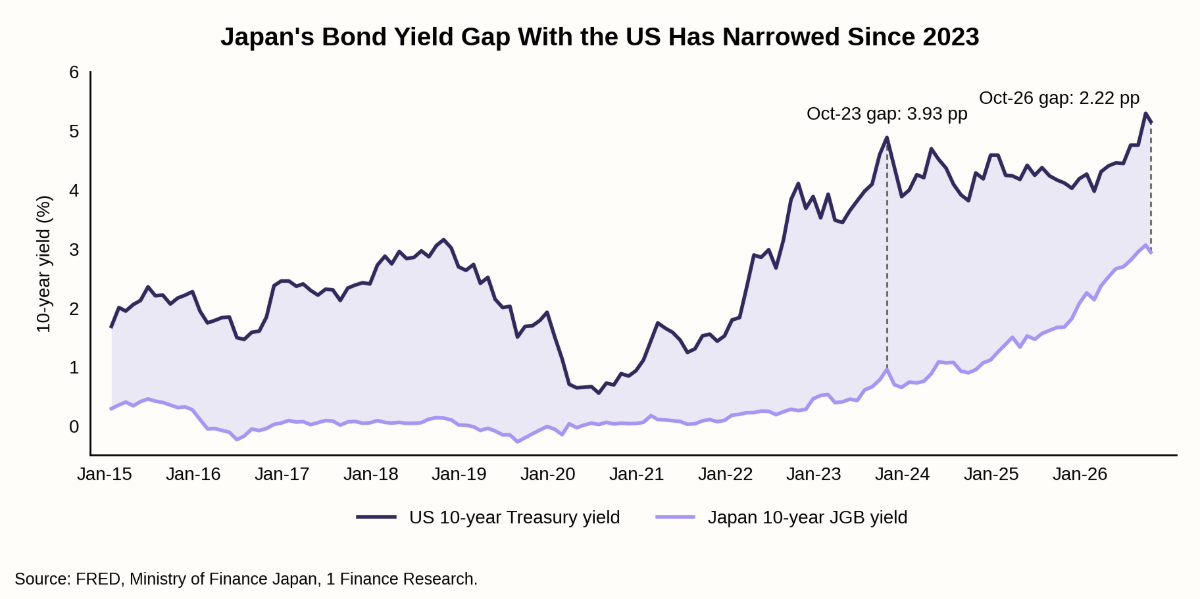
The fast risk is the yen carry trade. The idea is simple: borrow in yen at low rates and invest the money somewhere that pays more. Jefferies estimates cross-border yen borrowing at about $2.3 trillion, as of March 2026. US rates are still 2.5 to 2.75 percentage points above Japan's, so the trade still pays. The danger is the leveraged part, run by hedge funds and macro funds. When the yen jumps, their loans get more expensive overnight, and they sell whatever they can to raise cash.
The slow risk is Japan's savings coming home. Japan held ¥561.75 trillion of net foreign assets at the end of 2025, and is the third largest foreign owner of US Treasuries. When Japanese bonds paid nothing, buying abroad was the obvious choice. With the 10-year JGB now around 3%, it no longer is.
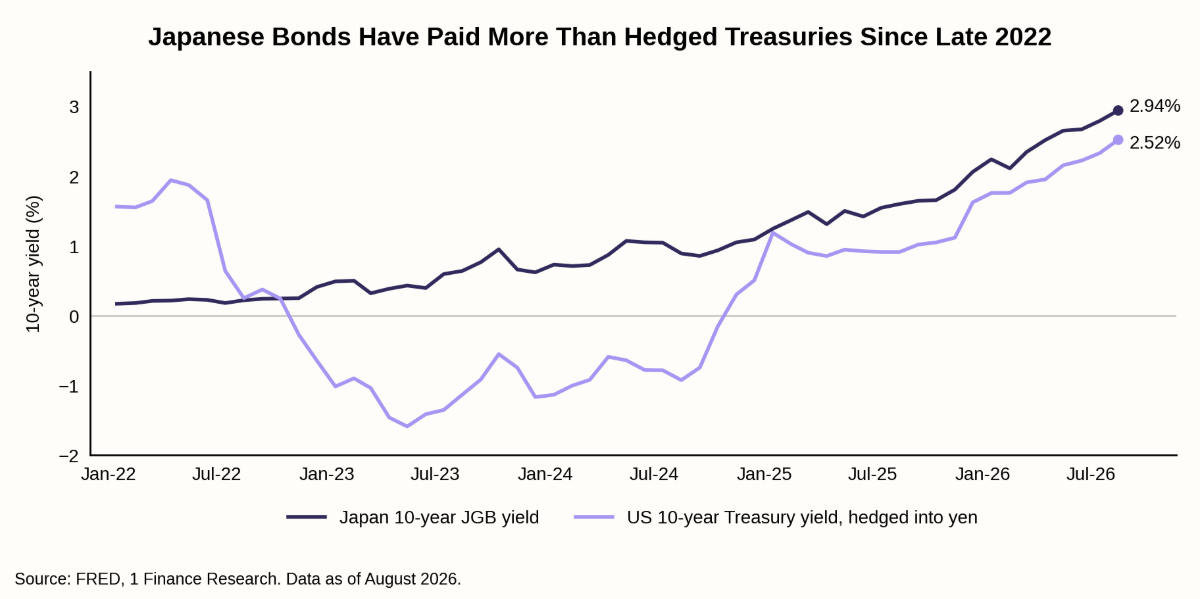
The fair comparison for a Japanese insurer is a US Treasury after paying to hedge the currency risk. On our estimate, using short-term rates as a guide to hedging costs, a hedged 10-year Treasury earned about 2.5% in August, against 2.94% on a 10-year JGB. Even after US yields jumped to 5.15% on 19 October, the hedged return is only about 2.8%.
Here's the twist: that gap is not new. JGBs have beaten hedged Treasuries in almost every month since late 2022, and the gap has actually narrowed from about 2 percentage points in mid-2023. What has changed is the level. Japanese bonds now pay close to 3%, enough for insurers and pension funds to meet their obligations at home.
So is the money coming home? Slowly, and not from where you'd expect. Japanese investors sold a net ¥4.2 trillion of foreign bonds from January to September, about $27 billion. Banks did most of the selling, ¥11.7 trillion, and life insurers sold ¥1.8 trillion. But pension and trust money bought ¥11.4 trillion, absorbing almost all of the banks' sales. For now, Japan's demand for foreign bonds is shifting between institutions rather than shrinking. The signal to watch is pension money turning from buyer to seller.
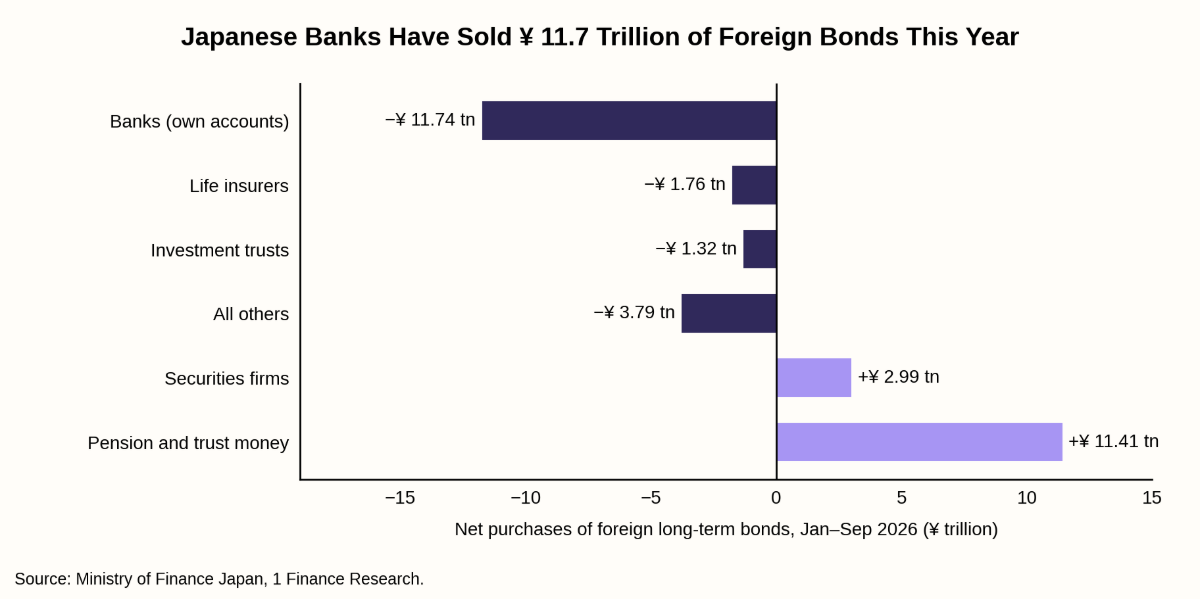
That distinction matters for India. What we are watching for is a slow change in the supply of global capital, rather than a sudden sale of Japanese holdings. The signal that would change our view is pension money turning from buyer to seller while banks keep selling. At that point, Japanese demand for foreign bonds would fall outright rather than shift between institutions.
August 2024 Showed How Fast the First Risk Moves
Japanese investors themselves own little of India: about $23 billion of the $806 billion in foreign portfolio money here. The fast risk goes around them, through global funds that sell whatever is easy to sell when they need cash. India's large caps are easy to sell.
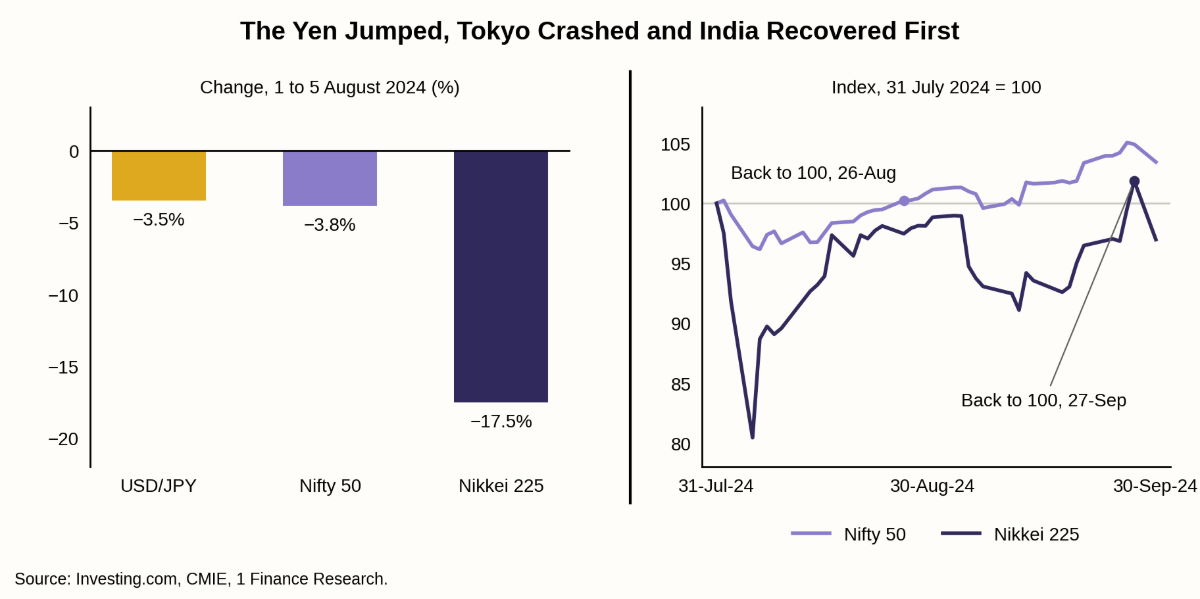
August 2024 shows how it plays out. The BoJ raised rates on 31 July. Two days later, weak US jobs data sparked recession fears and pulled US yields down, squeezing the rate gap from both sides. The yen jumped, crowded trades unwound, and on 5 August the Nikkei had its worst day since 1987.
| The shock: market moves around 5 August 2024 | |||
|---|---|---|---|
| Measure | Before | After | Change |
| USD/JPY, 1 to 5 August | 149.36 | 144.17 | −3.5% |
| Nikkei 225, 2 to 5 August | 35,909.70 | 31,458.42 | −12.4% |
| Nifty 50, 2 to 5 August | 24,717.70 | 24,055.60 | −2.7% |
| India VIX, 2 to 5 August | 14.3 | 20.4 | +42% |
| India 10-year G-sec yield, 2 to 5 August | 6.90% | 6.86% | -4 bps |
| The Aftermath: Drawdown, Recovery And Flows | |
|---|---|
| Measure | Value |
| Nikkei 225, fall from 31 July close to low (5 August) | −19.5% |
| Nifty 50, fall from 31 July close to low (6 August) | −3.8% |
| Nifty 50, back above 31 July close | 26 August (17 sessions) |
| Nikkei 225, back above 31 July close | 27 September (39 sessions) |
| FPI net equity flow, 5 to 9 August | −₹12,405 crore |
| DII net equity flow, 5 to 9 August | +₹20,871 crore |
| Net institutional flow, 5 to 9 August | +₹8,466 crore |
India fell about a fifth as far as Tokyo and recovered a month sooner. Foreign funds sold because they needed cash, not because India's earnings outlook changed, and domestic institutions bought ₹20,871 crore in the same week that foreigners sold ₹12,405 crore. Indian government bonds even rallied a little as money looked for safety. The catch: August 2024 doesn't promise the next unwind will be this mild, because India's own position has changed.
India Has Less Foreign Money to Lose but a Weaker Rupee to Defend
Start with the good news. Foreign institutional ownership of NSE-listed companies is at a 14-year low of 15.88%, down from 17.38% two years ago. FPIs have sold ₹3.12 lakh crore of Indian equities this year, including ₹52,100 crore so far in October, so there is simply less foreign money left to sell. Meanwhile domestic institutions keep buying: ₹76,030 crore in September alone, against ₹48,279 crore in August 2024.
The currency is the weak spot. The rupee was near 84 per dollar in August 2024. In early October it came close to its record low of 96.97 before RBI action pulled it back to 94.96. Reserves of $726 billion are still higher than two years ago, but they have fallen for five straight weeks as the RBI sold dollars. Another global scare would land on a rupee already under pressure.
| What Has Changed Since August 2024 | ||
|---|---|---|
| Measure | August 2024 | October 2026 |
| Foreign institutional share of NSE-listed companies | 17.38% (30 June) | 15.88% (30 June) |
| DII net equity buying, month | ₹48,279 crore (August) | ₹76,030 crore (September) |
| USD/INR | About 84 | 94.96 (16 October) |
| Forex reserves | $674.9 bn (2 August) | $726 bn (9 October) |
| US 10-year yield | 3.78% (5 August) | 5.15% (19 October) |
| India 10-year G-sec yield | 6.86% (5 August) | 7.37% (19 October) |
| India minus US 10-year yield | 3.08 points | 2.22 points |
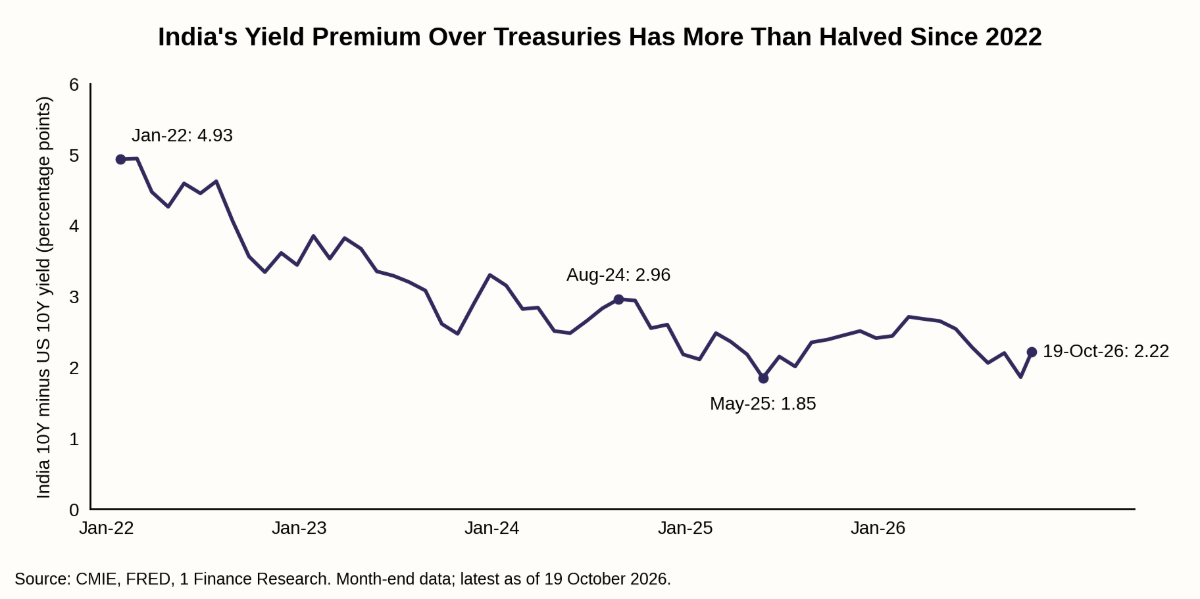
Bonds have lost some of their cushion too. The US 10-year yield closed at 5.31% on 5 October, its highest since 2002. India's 10-year now pays just 2.22 percentage points more than the US 10-year, down from 3.08 points in August 2024 and nearly 5 points in early 2022. Foreign bond investors are being paid less to take on more currency risk. If Japanese demand for foreign bonds fades, that cushion could thin further.
Japan Is Arriving as India Tightens Too
The slow channel would matter less if Indian bonds had room to rally. They do not.
Japan is arriving just as India tightens. The RBI raised its repo rate to 5.50% on 7 October, its first hike since February 2023, and expects inflation to peak near 6% this quarter. The 10-year G-sec reached 7.44% on 21 October, its highest since March 2023.
Domestic inflation, oil and the RBI are the main forces pushing Indian yields up. A weaker Japanese appetite for global bonds would add pressure from outside, just when the RBI has no room to offer relief.
There is an upside. At around 7.4%, the 10-year G-sec pays roughly 1.4 to 2.2 percentage points more than expected inflation. That makes short- and medium-term bonds a decent place to earn while you wait.
The Next Trigger May Come From Washington
Don't expect the BoJ to light the fuse this month. Markets see little chance of a hike at the 29 to 30 October meeting, and with the Fed also raising rates, the gap between the two should close only slowly. The bigger risk is a US growth scare. That is what turned August 2024 into a crash: weak US data pulled Treasury yields down while Japan was tightening. We got a small preview on 15 October, when worries about AI spending knocked the US 10-year yield down about 9 basis points in a single day.
What This Means for Client Portfolios
The two channels call for different responses. Advisors should not let a bad day in Tokyo drive an allocation change.
| Exposure | Fast unwind | Gradual reallocation | Our response |
|---|---|---|---|
| Indian large caps | Sharp volatility and foreign selling in liquid names | Valuation pressure if global yields rise | Treat a global liquidity shock as a staggered buying opportunity; fundamentals are unchanged |
| Indian mid and small caps | Deeper falls and thinner liquidity | Higher discount rates weigh on valuations | Review concentration and position sizes |
| Long-duration G-secs | Possible safe-haven rally | Sustained pressure from a higher global term premium | Do not chase a rally caused by a single risk-off day |
| Short-duration debt | Less sensitivity to long-end moves | Limited duration risk | Prefer high-quality short and medium duration, subject to credit risk |
| Japan equity funds | Nikkei falls; yen gains may partly offset the loss for unhedged funds | Outcome depends on the yen path | Check whether the fund is currency hedged |
| Global equity funds | Crowded trades may be sold quickly | Higher yields pressure valuations | Check actual geographic and currency exposure before acting |
For client conversations, the useful message is short. Japan's problem reaches India through global funds' leverage and through global bond yields. The first channel has historically been short-lived. The second is why we remain cautious on long duration.
Our View
Japan alone is no reason to cut Indian equities. It tells you where the next burst of volatility could come from, and August 2024 shows that a global unwind and a fall in Indian earnings are two very different things.
We think the slow reallocation is the more likely path over the next six months. It needs no shock, only Japanese institutions responding to yields near 3%. It is one more reason, alongside RBI tightening, to keep bond portfolios in short and medium maturities.
What would change our mind: Japanese pension money turning seller while banks keep selling, a sharp yen rally of 5 yen or more in a week, or India VIX jumping above 20. If those line up, Japan's bond market stops being a distant story and becomes an Indian portfolio decision.
For advisors: keep August 2024 ready as the example of a liquidity shock that passed, and position debt to earn while current yields pay you to wait.
For investors: keep your SIPs running, go easy on long-duration bond funds for now, and check whether any Japan or global fund you hold is hedged against currency moves.