India’s startup ecosystem has expanded rapidly, supported by government recognition programmes, growing investor interest and a wider range of entrepreneurial opportunities. But the number of recognised startups alone does not reveal how effectively businesses access capital, commercialise innovation or build sustainable operations. Comparing India with global trends helps put this growth into perspective and highlights where the ecosystem is gaining ground and where challenges remain.
The Global Startup Boom Has a Catch
More businesses are being created worldwide than ever before. The World Bank's Entrepreneurship Database, which tracks 188 economies, shows new business density, the number of newly registered companies per 1,000 working-age adults, rising from 2.9 to 4.3 between 2006 and 2024. 2024 is the latest year the World Bank has published. But capital and survival have not kept pace. Venture funding has recovered unevenly, and many new ventures never become established firms.
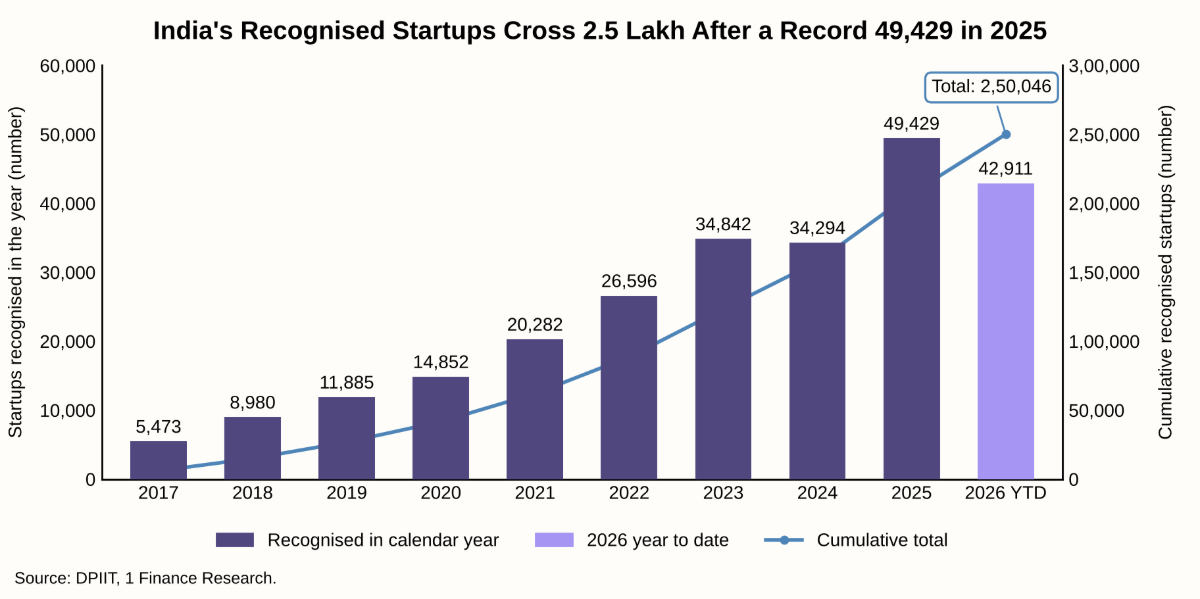
India sits at the centre of this story. The Department for Promotion of Industry and Internal Trade (DPIIT) had recognised 2,50,046 startups, according to a Ministry of Commerce and Industry statement on 27 October 2026. In calendar year 2025 alone, it recognised 49,429, a record.
Global Startup Creation Is Rising but Unevenly
The World Bank measures new business density, the number of newly registered limited liability companies per 1,000 adults aged 15 to 64. In 2024, high-income countries registered 7 new companies for every 1,000 adults. Low-income countries registered less than 1 (0.7) for every 1,000 adults. In lower-middle-income countries, the group that includes India, the number was 1.7 for every 1,000 adults, up from 0.5 in 2006. high-income economies averaged 7.0, about ten times the 0.7 in low-income economies. Lower-middle-income economies, India's group, averaged 1.7, up from 0.5 in 2006.
This is a different measure from India's startup count. The World Bank counts every new company. India counts only firms that DPIIT recognises as startups, a much narrower group of innovation-led businesses.
More Startups Do Not Automatically Mean More Survivors
The Global Entrepreneurship Monitor (GEM) 2025/2026 report finds that in most economies, far more adults are starting businesses than running established ones. GEM says this weak shift from startup to mature firm reflects gaps in finance, regulation, market access and skills.
GEM measures two rates: adults starting or running a business less than 3.5 years old, and adults owning one older than that. In India, the figures are 12.3% and 6.1%, about two new business owners for every established one.
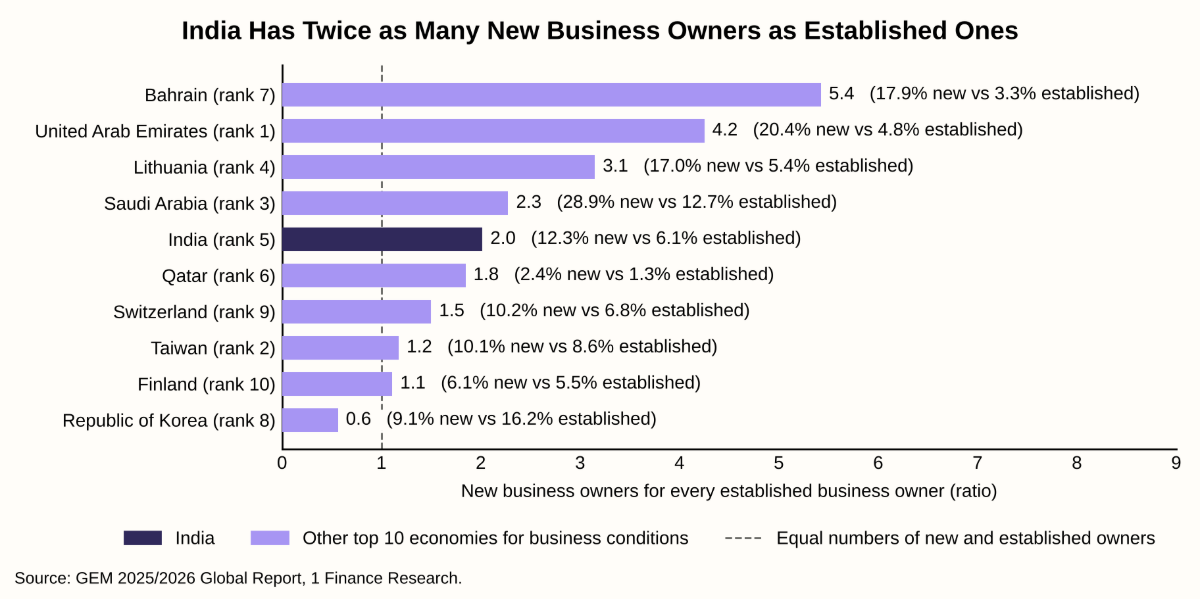
Mature economies such as Korea, Taiwan and Finland have far fewer new owners for each established one. A high ratio can mean a surge of new businesses as well as businesses that do not last, so for India it is a sign to watch, not proof of failure. Most new Indian businesses also start small: only 5.5% of new entrepreneurs expect to employ six or more people within five years.
| 💡Did you know? More than half (56.8%) of Indian adults who see a good business opportunity say fear of failure would stop them, down from 71.8% in 2024. Yet GEM finds that people who have closed a business are more likely than others to start another. |
Startup Recognitions Rebounded Sharply in 2025
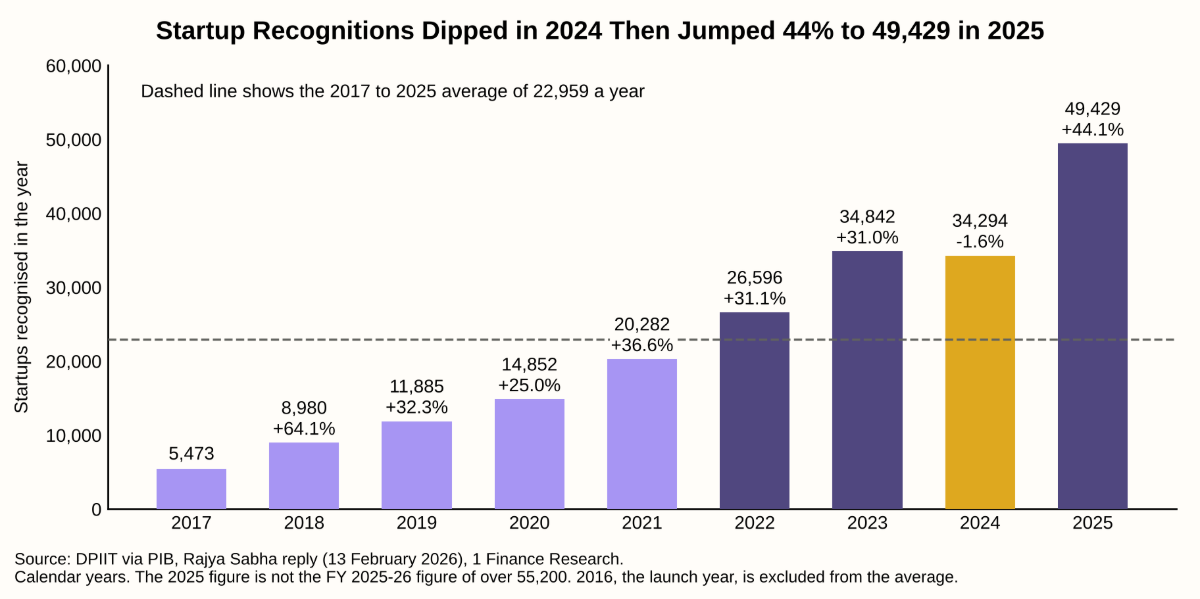
Recognitions grew by 25% to 37% a year between 2019 and 2023. They fell 1.6% in 2024, the only fall in the series, then jumped 44.1% in 2025.
Growth stayed strong in early 2026. From January to June 2026, DPIIT recognised 32,957 new startups. That is 43.4% more than the 22,977 it recognised from January to June 2025. By 30 June 2026, the total number of startups recognised since 2016 had reached 2,40,092.
The base is also broadening. By October 2026, recognised startups reported 25.42 lakh jobs across more than 770 districts. About 52% of recognised startups are in non-metro cities, and 48% have at least one woman director.
Where Startup Growth Is Concentrated
Since 2016, 41,440 startups in Maharashtra have been recognised, as of 30 June 2026. That is 17.3% of the national total of 2,40,092. The top five states, Maharashtra, Karnataka, Uttar Pradesh, Delhi and Gujarat, together hold 55.2%.
The chart below compares how fast each large state’s startup base grew over two years with how many of its startups have formally closed.
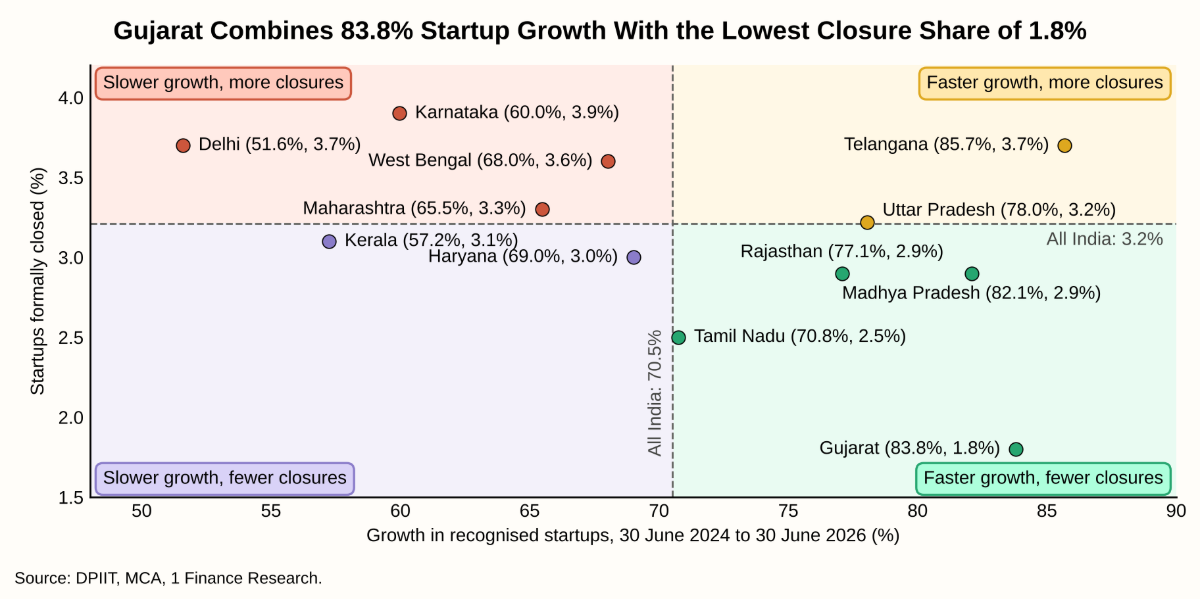
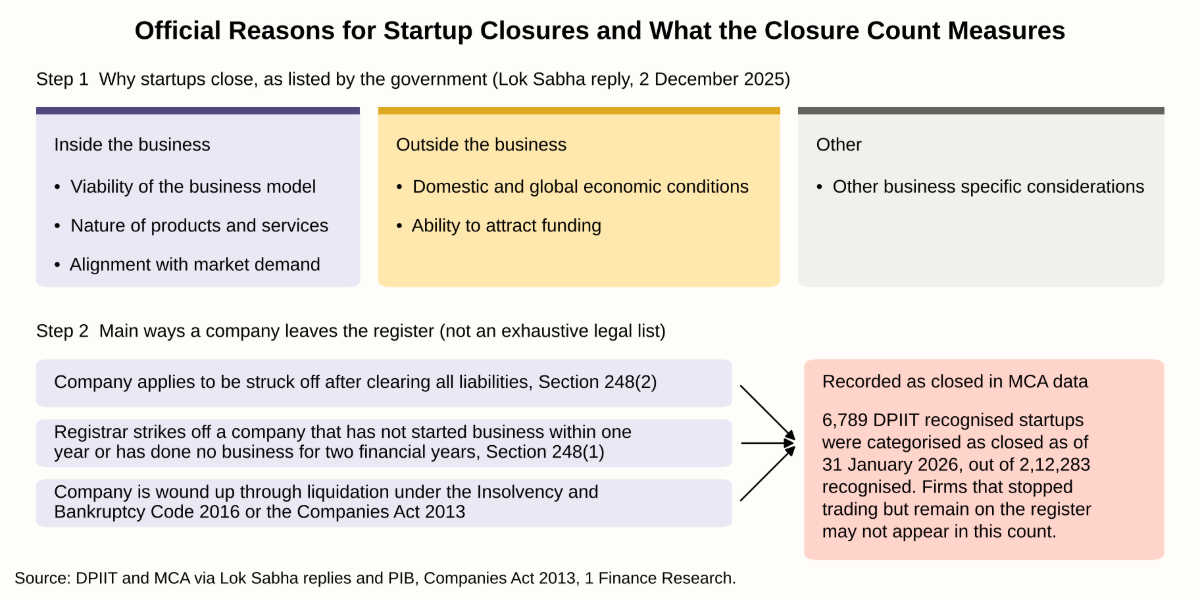
The formal closure share is the percentage of a state’s recognised startups that have been officially shut down, meaning their company was struck off or wound up in government records. Startups that have simply stopped operating, without formally closing, are not counted. So the real share of startups that have failed is likely higher.
Gujarat is the standout. Its recognised startups grew 83.8% in two years, faster than the national 70.5%, and only 1.8% had formally closed. In a young, fast-growing base, a low closure share does not by itself prove better survival. Karnataka and Delhi, two of the largest hubs, grew slower and had higher closure shares.
What India's Growth Means in a Global Context
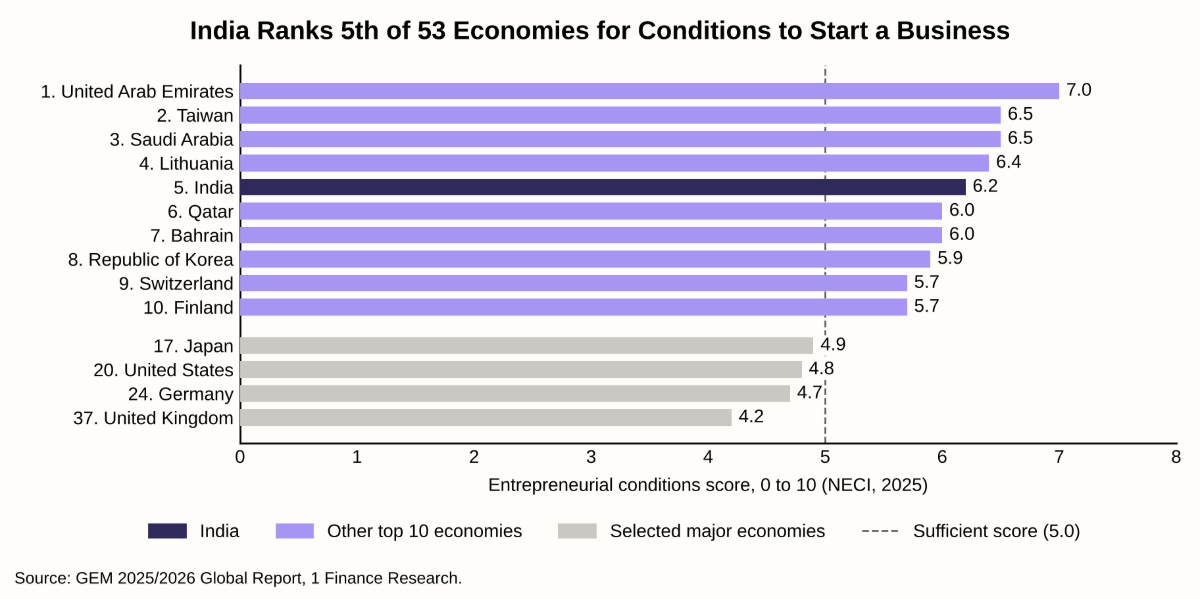
GEM ranks India 5th of 53 economies on its index of entrepreneurial conditions. India is one of four economies rated sufficient on all 13 conditions GEM tracks, and it ranks 2nd for ease of access to finance.
The World Intellectual Property Organization (WIPO) ranks India 38th in its Global Innovation Index 2026, up from 48th in 2020. At the top end, India had over 120 unicorns, private companies valued above $1 billion, by January 2026, up from four in 2014. Raw startup counts are not comparable across countries, since recognition rules and population sizes differ.
IT Services and Healthcare Dominate Startup Jobs
The government has not published an industry-wise count of recognised startups since February 2023. Its most recent industry breakdown is direct jobs reported by startups as on 31 October 2024, across 56 industries.
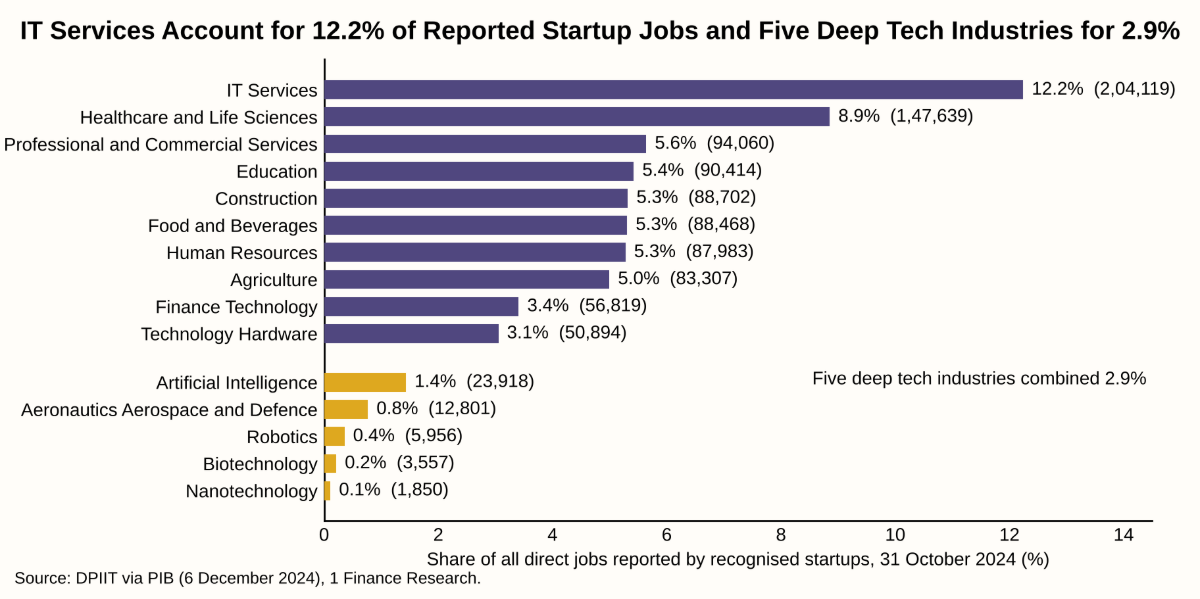
IT services startups reported 2,04,119 direct jobs, or 12.2% of the total, followed by healthcare and life sciences at 8.9%. Professional services, education, construction, food and human resources each reported about 5%. That mix reflects an old national strength. India ranks 1st in the world for ICT services exports in WIPO's index. The five deep tech industries together reported 2.9% of direct jobs. This is a share of jobs, not of startups.
Deep Tech AI and the Challenge of Commercialisation
Globally, the Organisation for Economic Co-operation and Development (OECD) finds that new equity is flowing mostly to large AI deals. India’s WIPO profile shows why turning research into products is hard here.
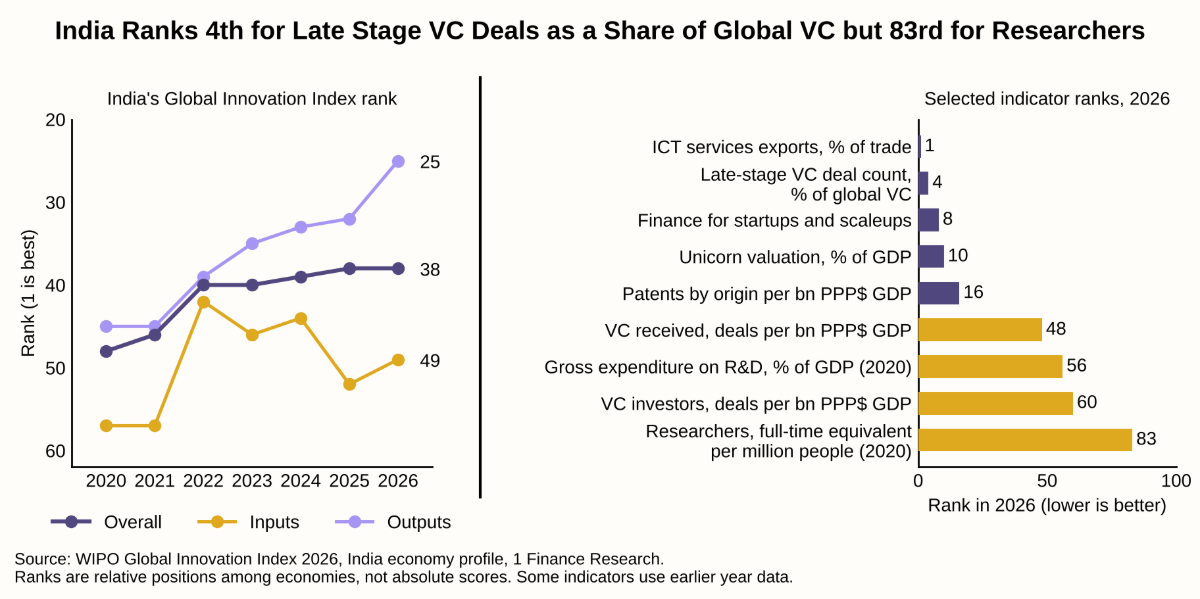
India ranks 10th for unicorn value as a share of GDP, so its successful startups are worth a lot relative to the size of the economy. Yet it ranks 83rd for researchers per million people and 56th for spending on research and development, at 0.65% of GDP in 2020. Mature firms attract capital, but the research pipeline that feeds deep tech is thin.
Policy is now shifting toward deep tech. A February 2026 gazette notification created a separate deep tech category. These startups can keep their recognition for up to 20 years and earn up to ₹300 crore in turnover, against 10 years and ₹200 crore for other startups. Startup patent filings also rose from over 2,850 in FY2024-25 to over 4,480 in FY2025-26.
Why Startups Close in India
The government has listed the main reasons in Parliament. The infographic below sets out those official reasons and the three legal routes through which a closure enters official records.
Funded Startups Show Lower Closure Shares
Startups that won government-backed funding had a lower observed formal closure share. As of January 2026, it was 1.2% for startups funded through the Fund of Funds, 0.8% for Seed Fund startups and 0.4% for Credit Guarantee startups, against 3.2% for all recognised startups. Startups with a woman director also had a lower share, at 2.9% against 3.5% for the rest.
| 💡Did you know Only 31 of the 4,245 startups supported by the Startup India Seed Fund had closed by 30 June 2026. That is 0.73%, less than a quarter of the national closure share. |
What the Fund of Funds for Startups Tells Us
The Fund of Funds for Startups is run by the Small Industries Development Bank of India (SIDBI). It commits government money to Alternative Investment Funds (AIFs) registered with the Securities and Exchange Board of India (SEBI). Those funds then raise more money from private investors and invest in startups.
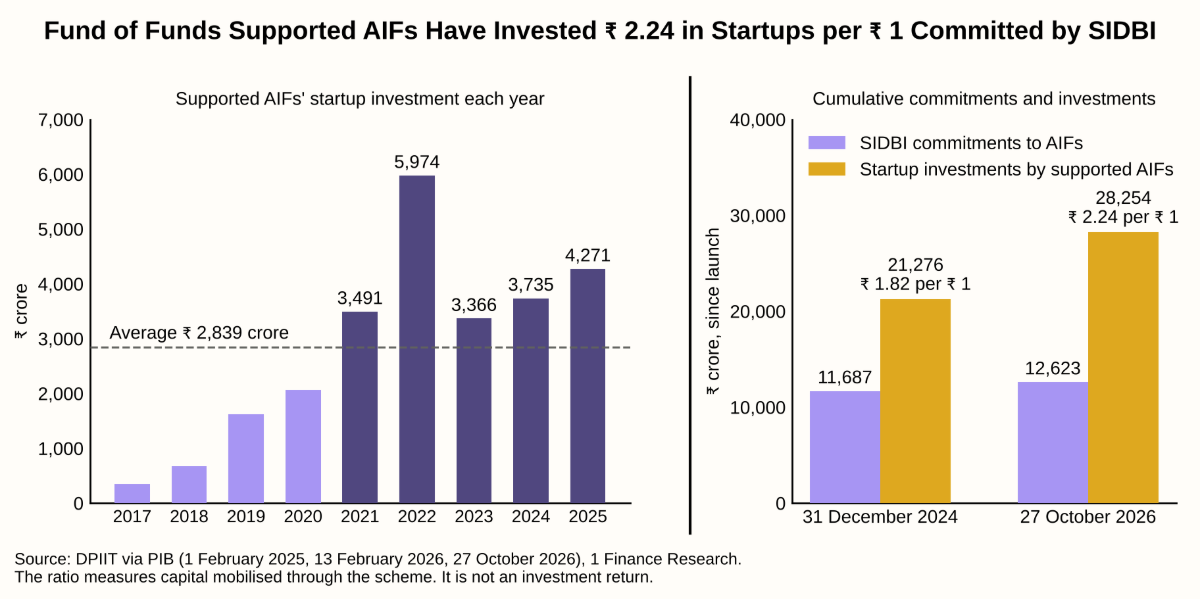
Supported AIFs invested ₹5,974 crore in startups in 2022, then cut back 43.6% in 2023. Investment has recovered for two years, reaching ₹4,271 crore in 2025.
Here is the simplest way to read the right panel. SIDBI has committed ₹12,623 crore to 166 funds since launch, and those funds have invested ₹28,254 crore in 1,475 startups. That is ₹2.24 invested for every ₹1 committed, up from ₹1.82 in December 2024. The ratio measures capital mobilised through the scheme, not an investment return, and the official data do not split the difference by source.
How India's Funding Picture Fits the Global Market
The OECD tracks small business finance in close to 50 countries. Its 2026 scoreboard finds that equity financing has recovered in some markets, but the rebound has been “concentrated in a limited number of large deals in artificial intelligence”. Borrowing costs for small firms remain above pre-pandemic levels, and banks still apply strict lending terms.
India follows the same pattern of capital clustering in bigger, later deals. It ranks 4th for late-stage VC deal count as a share of global VC but 48th for VC deals received relative to GDP, a different indicator. Mature startups appear to find money more easily than early ones.
SEBI data points to unspent capital too. Category I AIFs, which include venture capital funds alongside other fund types, had invested 45.6% of their cumulative net commitments as on 30 June 2026, the lowest share in eight quarters. Money is available, but investors are choosing deals carefully, as the OECD finds globally.
The Role of Government Support
| Government Support for Startups by Type | ||
|---|---|---|
| Scheme | Type of support | Latest reach |
| Fund of Funds for Startups | Equity through AIFs | ₹28,254 crore invested in 1,475 startups |
| Startup India Seed Fund Scheme | Early grants and debt through 244 incubators | ₹775.67 crore for 4,194 startups |
| Credit Guarantee Scheme for Startups | Loan guarantees of up to ₹20 crore | 532 loans worth ₹1,662.71 crore |
Note: The Seed Fund count differs from the June 2026 parliamentary reply, which listed 4,245 startups selected by incubators.
What India's Startup Ecosystem Needs to Compete Globally
Three gaps matter most.
- Capital. Early-stage funding is thin relative to India's economy, and venture investors are few for its size. The new ₹10,000 crore Fund of Funds 2.0, with segments for deep tech and early-stage funds, targets this gap. Its April 2026 guidelines create four segments, for deep tech funds, micro venture funds, technology-led manufacturing funds and sector-agnostic funds.
- Commercialisation. India must turn research into products with paying customers. GEM's score for R&D transfer fell from 6.0 to 5.8 in 2025, and researcher numbers remain low.
- Survival and scale. India measures registrations well but not outcomes. Official data on dormant firms, revenue and employment growth would show which startups last.
What This Means for Investors and Advisors
- Investment stage: Early-stage startups may offer greater growth potential but generally carry higher risks. Later-stage startups may have more established business models but can still face significant challenges.
- Sector diversification: Funds spread investments across different sectors to reduce dependence on a single industry. A highly concentrated portfolio may be more exposed to sector-specific risks.
- Fund performance: Review the fund’s track record, returns, past investments and reported exits or closures to understand its performance.
- Transparency and risk management: Prefer funds that clearly disclose their investment strategy, fees, risks and performance.
Conclusion
India's startup base reached 2,50,046 by October 2026, after a record 49,429 recognitions in 2025. Formal closures rose roughly in line with the base over the measured period, and scheme-backed startups show lower closure shares. Globally, capital is concentrating in fewer, larger deals, and India's late-stage funding strength reflects that. The next test is how many of India's startups build sustainable businesses and scale.